Tech PR: The Honest 2026 Guide (How Tech Companies Earn Press That Actually Moves the Needle)
Tech PR: The Honest 2026 Guide (How Tech Companies Earn Press That Actually Moves the Needle)
Here is a secret most tech founders learn too late: your product is not your story. Your product is the proof of your story — and tech PR is the discipline that turns that story into coverage, credibility, and customers.
Tech PR (technology public relations) is the specialized practice of earning trusted media coverage, analyst attention, and public credibility for technology companies, products, and founders. Unlike advertising, you cannot buy it. Unlike SEO, you cannot hack it. You earn it by giving journalists, analysts, and audiences a story worth telling.
This guide covers what tech PR is, how it differs from traditional and digital PR, the strategies that actually earn coverage, what it costs, how long it takes, why most campaigns fail, and exactly how to start your first one — with real data, not theory.
1. What Is Tech PR?

A journalist interviewing a company spokesperson. That conversation — and the coverage it produces — is the heart of tech PR. Photo: Werner Pfennig / Pexels.
Picture two startups launching the same week. Both have good products. One gets written up in TechCrunch, quoted in Forbes, and invited onto three podcasts. The other publishes a press release that nobody reads. Six months later, guess which one has the waitlist, the investor inbound, and the hiring pipeline?
That gap is tech PR.
Tech PR, in one sentence
Tech PR is the work of making a technology company understandable, credible, and newsworthy to the people who decide whether it gets covered, funded, bought, or trusted.
What does tech PR actually do?
At its core, tech PR does four jobs. First, it translates: it turns complex products, platforms, and innovations into clear narratives that non-experts can understand and repeat. Second, it builds relationships: with tech journalists, analysts, bloggers, and podcasters — the people whose coverage shapes what the market believes. Third, it manages reputation: including crisis response when something goes wrong, from a data breach to an outage. And fourth, it shapes perception: positioning a company as a leader, an innovator, or a trusted voice in its niche.
Who is tech PR for?
Tech PR is not only for tech companies. Any organization whose product, service, or story runs on technology can benefit — a retail brand launching an e-commerce platform, a healthcare provider introducing telemedicine, a fintech startup pitching investors. If your story involves innovation, tech PR is the channel that carries it.
What does tech PR produce?
The visible output is earned media: news articles, features, reviews, interviews, podcast appearances, analyst mentions, and speaking slots. The invisible output is what those things create — trust. A journalist’s verdict carries weight that no ad can buy, because the journalist was not paid to say it.
Is tech PR the same as marketing?
No. Marketing controls its message — you write the ad, you buy the placement, you choose the words. PR earns its message — a journalist decides whether your story is worth covering, and how to tell it. That loss of control is exactly why earned coverage is more credible than advertising. Anyone can buy an ad. Not everyone can earn a feature.
Tech PR vs advertising: the credibility gap
Consider two identical claims: “Our platform cuts onboarding time by 40%.” In an ad, readers think, “Of course they say that — they paid for the placement.” In a news article, readers think, “A journalist checked this.” Same claim, different belief. That gap is why companies that can afford both still fight for earned coverage. Advertising rents attention. PR earns belief — and belief is what turns a reader into a trial, a trial into a customer, and a customer into an advocate.
The one thing to remember
Tech PR is not about getting your name in the news. It is about giving the news a reason to carry your name. The companies that win at tech PR are not the loudest. They are the most useful to journalists: clear story, real evidence, fast answers, honest spokespeople.
Real-World Proof: What Tech PR Looks Like at Scale (Figma)
You have the definition. Now — before the strategies, the costs, the timelines — let us look at the evidence.
Figma is a design software company. Its public story is exactly what tech PR aims to create: product launches that become news, a flagship conference (Config) that becomes a calendar event, a vocal community of designers who talk about the product constantly, and coverage across tech, business, and design media. Nobody bought that reputation in one ad campaign. It was earned, story by story, year by year.
Here is what that earned reputation looks like in Semrush, US database, October 13, 2026:

Semrush Domain Overview for figma.com, US database, October 13, 2026. Screenshot 1 of 3.
- Authority Score: 86 — labeled “Industry leader”
- Monthly organic traffic: 4,037,483 (displayed 4M, down 5.3%)
- Referring domains: 186,304 (displayed 186.3K)
- Backlinks: 20,825,968 (displayed 20.8M)
- Organic keywords: 435,222 (displayed 435.2K, up 6.7%)
- Paid traffic: 70,939 (displayed 70.9K) — small next to 4M organic
- AI Search: AI Visibility 72, Mentions 53K, Cited Pages 5.7K
Now look at the shape of the growth:
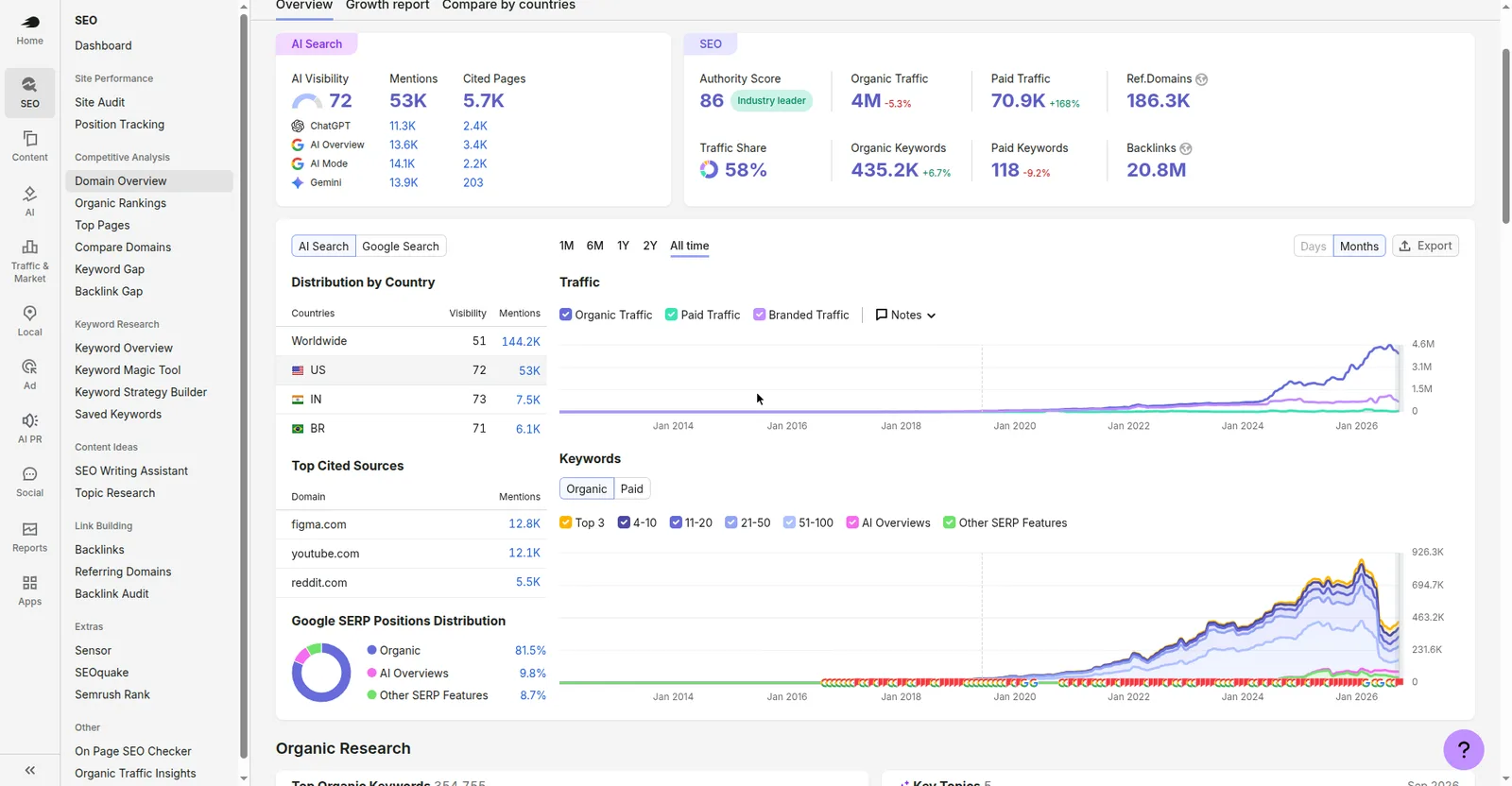
Figma’s organic traffic trend, All Time. Screenshot 2 of 3.

Figma’s referring-domains trend, All Time. Screenshot 3 of 3.
The traffic curve stayed flat near zero until around 2020, then climbed steeply to a peak near 4.6M around late 2025 (approximate, read from the chart axis). The referring-domains curve stayed flat until around 2019, then rose steadily — roughly 90K by August 2023, roughly 135K by around 2024 (both approximate, from the chart axis) — reaching 186,304 by October 2026.
The honest twist
Read this carefully, because it is the most important lesson in this guide. Figma’s traffic fell 5.3% recently, to 4,037,483 from its peak near 4.6M — while its referring domains kept growing. And Figma also runs paid traffic (70.9K). So this is correlation, not proof that PR alone caused the growth. Figma’s product, its free tier, its community, and its marketing all played a part.
What the data does show is the shape of an earned-reputation business: a company that spent years becoming worth talking about, and whose coverage, links, and traffic compounded together. Tech PR built the mountain. It did not freeze it in place.
2. Tech PR vs Traditional PR vs Digital PR: What’s the Real Difference?

Three arrows, three disciplines. Same destination — a trusted reputation — different routes. Photo: DS stories / Pexels.
Here is where most companies go wrong: they hire a general PR agency, get a generic campaign, and wonder why the coverage never comes. Tech PR is not traditional PR with a laptop. It is a different game with different rules.
The core difference: who the audience is
Traditional PR is built around reaching the largest possible audience through the most accessible media channels. The metrics that matter are reach, impressions, and share of voice. The goal is brand familiarity — making sure as many people as possible know the brand exists.
Tech PR operates on entirely different logic. The audience is not “as many people as possible.” It is a specific, often small set of high-value stakeholders: investors who operate in your sector, enterprise buyers with budget authority, technology journalists and analysts who shape category perception, and the talent market that will determine whether you can build the team you need.
What that means in practice
Reaching those stakeholders requires access to very specific media — the publications, platforms, and contexts where those audiences actually get their information. And getting into those outlets requires a fundamentally different approach to narrative. A traditional PR pitch says, “Here is a company that exists.” A tech PR pitch says, “Here is a shift in the market, here is the evidence, and here is the company at the center of it.”
Tech PR vs Traditional PR vs Digital PR — the comparison
| Factor | Traditional PR | Tech PR | Digital PR |
|---|---|---|---|
| Primary audience | Mass public, broad consumers | Investors, enterprise buyers, tech journalists, analysts, talent | Online audiences, searchers, niche communities |
| Main channels | Print, TV, radio, wire services | Tech press, trade media, analyst briefings, podcasts, conferences | Online publications, blogs, social, podcasts, data-driven content |
| What it optimizes for | Reach, impressions, share of voice | Credibility with decision-makers, category leadership, investor confidence | Online visibility, backlinks, referral traffic, search rankings |
| Speed | Slow — weeks to months of lead time | Medium — days to weeks for news; months for reputation | Fast — coverage can land within days |
| Measurement | Hard to track; mostly estimated reach | Coverage quality, analyst sentiment, investor/buyer inbound | Highly measurable — links, traffic, rankings, mentions |
| Typical cost | High, often with production costs | Medium to high — expertise is the cost | Medium — scales with content and outreach |
| Best for | Mass-market awareness, established brands | Tech companies at funding, launch, or category-building moments | Online growth, SEO authority, lead generation |
| Biggest risk | Expensive invisibility — big spend, no measurable return | Wrong narrative — coverage that positions you as a commodity | Coverage without credibility — links that do not move trust |
So which one do you need?
Most tech companies need tech PR as the strategy and digital PR as one of its engines. Digital PR is how tech PR’s stories become online coverage, backlinks, and search visibility. Traditional PR still matters when you need mass awareness — a consumer product launch, a national TV moment — but for a B2B tech company, it is usually the wrong tool for the job.
The overlap that matters
The lines keep blurring. A single announcement can gain credibility through established tech media while also reaching a wider online audience through digital publications. The smartest companies do not pick one discipline and ignore the rest. They tell one story through the right channels at the right time.
3. Why Does Tech PR Matter in 2026?

Momentum is not an accident. In a crowded market, coverage is the launchpad. Photo: Phyllis Lilienthal / Pexels.
Every year, more tech companies launch, more funding announcements flood journalists’ inboxes, and more AI-generated noise fills the feed. In 2026, the companies that get covered are not the ones with the most features. They are the ones with the clearest story and the strongest proof.
Reason 1: Trust is scarce, and ads cannot buy it
Buyers are skeptical. They trust what others say about a product more than what the brand claims in its own ads. A review from a trusted tech journalist, a feature in a major outlet, an analyst’s endorsement — these carry weight because they were earned, not purchased. In a market where most buyers worry about misleading claims from tech companies, third-party validation is the scarcest and most valuable currency.
Reason 2: Journalists are drowning — and relevance wins
According to Muck Rack’s 2025 State of Journalism Report, as cited by 5WPR, reporters receive 40 to 50 pitches a day and delete about 90% of them within seconds. That is not a reason to give up. It is a reason to be relevant. A tech PR strategy in 2026 succeeds on relevance and a clear story angle, not on press-release volume.
Reason 3: PR moves every stakeholder at once
A single great story does four jobs simultaneously. Investors see momentum. Enterprise buyers see safety. Journalists see a source worth quoting again. Talent sees a company worth joining. No other channel moves all four audiences with one asset. That is why tech PR supports every major growth milestone — product launches, funding rounds, IPO preparation, crisis response, and M&A communications.
Reason 4: Coverage compounds into SEO authority
Every earned placement typically carries a link back to your site. Those links — from real publications, with real audiences — are the hardest kind of authority backlink to earn, and the most valuable for search. Tech PR and SEO are not separate programs. Good PR is good link building, with credibility as a bonus.
Reason 5: AI search rewards the companies the media cites
AI search engines and AI Overviews cite the sources they trust. The Figma data above shows it plainly: 53K AI mentions and 5.7K cited pages. Companies that earn consistent, high-quality coverage are the ones AI systems quote. If your company is invisible to journalists, it is increasingly invisible to AI answers too.
Reason 6: In a commodity market, story is the differentiator
Features get copied in months. Pricing gets undercut in weeks. But a reputation — a founder known for a point of view, a company known for a category, a product known for a story — takes years to build and is brutally hard to copy. Tech PR is how you build the one asset competitors cannot clone overnight.
Reason 7: PR is reputation insurance
You cannot buy goodwill on the day you need it. When a breach, an outage, or a viral complaint hits, the companies that survive are the ones journalists already know and trust — the ones with a track record of honesty, a spokesperson who answers the phone, and a history of useful answers. Tech PR is the only marketing investment that pays off hardest on your worst day. Think of every honest placement as a deposit in a trust account you hope never to withdraw from.
4. What Are the Best Tech PR Strategies?

One tool does not build a house. Tech PR is a toolkit, and the best campaigns use several at once. Photo: Anastasia Shuraeva / Pexels.
There is no single “best” tech PR strategy. There is a toolkit — and the right tool depends on your moment: launching, fundraising, scaling, or defending. Here are the eight strategies that consistently earn coverage, with honest effort and payoff ratings.
1. The product launch story
What it is: Turning a launch into a news moment — an exclusive pitched to one outlet under embargo, a company blog post with demos, customer testimonials, and a short launch video. Why it works: Launches are the most natural news hook a tech company has. Journalists already understand the format. Playbook: Pitch the exclusive 2–4 weeks out, embargo the news, give one journalist first access, then open the floodgates on launch day. Insider note: Wire-only distribution alone is no longer enough. Pair the release with targeted outreach and multimedia. Effort: High. Payoff: High.
2. The funding announcement
What it is: Announcing a raise as a market story, not a money story. Why it works: Funding announcements earn coverage when they lead with a market trend rather than the dollar amount. A $12 million Series A can land an exclusive in a top outlet while a $50 million raise disappears, because reporters are buying a story, not a number. Playbook: Tie the round to a broader trend — AI, cybersecurity, robotics — give the reporter a bigger story to tell, and put a customer or data point inside the announcement. Effort: Medium. Payoff: High.
3. Data-driven stories and original research
What it is: Publishing original data, surveys, or studies that journalists can cite. Why it works: Journalists need evidence. A company that produces the numbers becomes the source every other story quotes. Playbook: Survey your users, analyze your product data (anonymized), or study your market, then package one headline finding per pitch. Insider note: This is where tech PR and link bait overlap — great data earns both coverage and links. Effort: High. Payoff: Very high.
4. Founder thought leadership
What it is: Positioning the founder as the voice of a point of view — op-eds, bylines, podcast appearances, conference talks. Why it works: Journalists do not quote press releases. They quote people with opinions. A founder with a clear, defensible stance becomes a repeat source. Playbook: Pick one opinion the founder genuinely holds, back it with evidence, and pitch it as a byline to three trade outlets. Effort: Medium. Payoff: High — compounds over years.
5. Analyst relations
What it is: Briefing industry analysts (Gartner, Forrester, IDC, and niche firms) so your company appears in their reports and shortlists. Why it works: Enterprise buyers do not Google and hope. They read analyst reports. An analyst’s mention is a sales weapon. Playbook: Brief analysts under NDA before launches, share roadmaps and customer proof, and treat the relationship as long-term, not transactional. Effort: Medium. Payoff: Very high for B2B.
6. Newsjacking and trend commentary
What it is: Offering fast, expert commentary when a story breaks in your space — a regulation, a breach, a big competitor move. Why it works: Journalists on deadline need a credible voice, fast. The first useful expert gets quoted. Playbook: Monitor your sector’s news daily, have a spokesperson ready to respond within hours, and always add a genuinely new angle — never “we agree.” Effort: Low per attempt. Payoff: Medium — high volume, variable hit rate.
7. Awards, rankings, and lists
What it is: Entering credible industry awards and “best of” lists — G2, Product Hunt, Deloitte Fast 500, sector-specific awards. Why it works: Third-party recognition is a shortcut to trust, and award announcements are pre-packaged news. Playbook: Target awards your buyers actually read, prepare customer evidence early, and announce wins with a story, not just a badge. Effort: Low to medium. Payoff: Medium.
8. Events, demos, and stunts
What it is: Creating a moment journalists want to attend — a flagship conference, a live demo, a visual spectacle. Why it works: Experiences beat press releases. Samsung’s 2024 Las Vegas Sphere activation generated massive coverage by combining visual spectacle with strategic storytelling. Playbook: Design the event for the camera and the headline, not for the room. One unforgettable image beats ten speeches. Effort: Very high. Payoff: Very high — when it lands.
5. How Do You Get Tech Press Coverage?

The microphone is waiting. The question is whether your pitch earns it. Photo: Karla De León / Pexels.
Getting coverage is not a mystery. It is a craft with a repeatable process — and most pitches fail for the same five fixable reasons.
Step 1: Know the journalist before you pitch
Read their last ten articles. Know what beat they cover, what angles they favor, and what they have already written about your competitors. A pitch that shows you read their work beats a mass blast every single time. Journalists can smell a mail-merge from the first line.
Step 2: Lead with the story, not your company
Your first sentence should contain the news. Not “We are excited to announce…” — journalists delete that. Try: “A new study of 2,000 CTOs shows 61% now ban shadow AI — and here is the data.” The company is the source. The story is the news.
Step 3: Make the pitch skimmable in ten seconds
Subject line: one line, news first. Body: three short paragraphs — the hook, the evidence, the offer (interview, data, demo, embargo). Attach nothing heavy. Link to a press page with assets, headshots, logos, and facts. A reporter who cannot grasp your pitch in ten seconds will not give it eleven.
Step 4: Offer something exclusive
Exclusives are currency. Give one journalist first access — an embargoed launch, an unpublished data point, a founder interview no one else has — and they have a reason to prioritize you over the forty-nine other pitches in their inbox. Exclusivity is the closest thing to a guarantee that PR has.
Step 5: Follow up once, politely, with something new
One follow-up is professional. Three is spam. And the follow-up should add value — a new data point, a customer quote, a fresh angle — not “just checking if you saw my email.” If they pass, thank them and move on. Today’s pass is tomorrow’s relationship.
Step 6: Deliver fast when they bite
When a journalist replies, speed is everything. Have your spokesperson, data, images, and approvals ready before you pitch. A two-hour response wins. A two-day response loses the slot to someone faster. This is the operational secret of every great PR team: the pitch is the easy part. Readiness is the hard part.
What journalists actually want from you
Three things, in order: a clear story angle, credible evidence, and a responsive human. Give them all three and you will get covered more often than companies ten times your size. Forget any one of them and even a great product will sit in the inbox unread.
How to build a media list that actually works
A media list is not a spreadsheet of 500 names. It is 30–50 people, researched by hand. For each journalist, record: their beat, their last five articles, the angle they favor, and one specific reason your story fits their coverage. Then rank them: ten tier-one targets you pitch first with exclusives, twenty trade and niche targets for volume, and ten podcasters and newsletter writers for conversation. Update the list monthly — journalists change beats constantly, and a pitch sent to someone who moved desks six months ago marks you as careless.
How guest posting fits in
When a pitch does not land as earned coverage, a well-placed contributed article can still put your expertise in front of the same audience. Guest posting and blogger outreach is a legitimate parallel channel — not a replacement for PR, but a way to stay visible while relationships build.
6. How Do You Build a Tech PR Campaign?

A campaign is not one pitch. It is a plan with a goal, an audience, and a calendar. Photo: Vlada Karpovich / Pexels.
A campaign is a PR program with a goal, a timeline, and a way to know whether it worked. Here is the build, step by step.
Step 1: Set one goal
Not five goals. One. “Get covered in three tier-one tech outlets before our Series B.” “Become the go-to source on AI regulation for fintech press.” “Earn 20 quality placements in 90 days.” A campaign with one goal can be measured. A campaign with five goals can only be defended.
Step 2: Define the audience precisely
Name the stakeholders: which investors, which buyers, which journalists, which analysts. List them by name. A media list of 200 generic contacts is worse than a list of 30 people who actually cover your beat. Precision beats volume in every tech PR campaign ever run.
Step 3: Craft the narrative
Write your story in one paragraph: the market shift, your position on it, and the proof. If you cannot write it in one paragraph, journalists will not be able to either. Test it on someone outside the company. If they cannot repeat it back, it is not ready.
Step 4: Build the press kit
Before a single pitch: company fact sheet, founder bios and headshots, product screenshots, logos, customer quotes, key data points, and a one-page FAQ. Host it on a press page on your site. Every hour you spend on the kit saves ten hours of back-and-forth later.
Step 5: Sequence the outreach
Start with exclusives for tier-one targets, then trade press, then podcasts and newsletters, then the wide release. Each wave should feel like news to its audience — not like leftovers. A launch plan typically takes two to four weeks to prepare: shaping the narrative, building press assets, identifying the right journalists, and coordinating approvals.
Step 6: Launch, monitor, and respond
On launch day, watch coverage in real time. Share it, thank journalists publicly, answer follow-up questions within the hour, and feed new angles to reporters covering the story. The first 24 hours of a campaign are worth more than the next 24 days. Show up for them.
Step 7: Measure what matters
Count placements, but weight them by outlet quality and audience fit. Track referral traffic, branded search lift, inbound demo requests, and — for SEO — the links you acquired from real publications. Report against the one goal from Step 1. Everything else is context.
7. How Much Does Tech PR Cost?

Tech PR is a retainer business. Know the ranges before you sign anything. Photo: olia danilevich / Pexels.
Tech PR is not cheap — and anyone who tells you it is cheap is selling something else. Here are the honest ranges, based on how the market actually prices this work. Treat every number below as a typical market range, not a quote: real prices vary by agency, market, and scope.
DIY tech PR: $0 to $500/month
Founder-led outreach costs time, not money: a media-list tool subscription, a press page, and 5–10 hours a week. It works for early startups with a genuinely newsworthy story and a founder willing to pitch personally. It stops working when the founder’s time becomes the bottleneck.
Freelance PR consultant: $2,000 to $5,000/month
A solo consultant with real journalist relationships can run a focused campaign for a startup. You get senior attention and flexibility. You do not get a team, a newsroom, or 24/7 crisis coverage.
Boutique tech PR agency: $5,000 to $15,000/month
The standard range for a serious tech PR retainer. A small team, a media list, regular pitching, and monthly reporting. Most venture-backed startups in the $1M–$20M revenue range live here. Expect a 3–6 month minimum commitment.
Large tech PR agency: $15,000 to $50,000+/month
Full-service firms with dedicated teams, analyst relations, crisis support, and global reach. This is the range for companies preparing for IPO, managing major crises, or running multi-market campaigns. The retainer buys depth, speed, and insurance.
Project-based PR: $3,000 to $25,000 per launch
A single launch, funding announcement, or event campaign, priced as a project. Good for companies that need one moment done well without a retainer. The catch: one moment rarely builds a reputation. It buys a spike, not a story.
What the retainer usually does NOT include
Wire distribution fees, event costs, travel, paid media, content production beyond pitches, and crisis work outside scope are often billed separately. Ask for the full list before you sign. The cheapest retainer with the longest list of extras is rarely the cheapest engagement.
How to pick an agency without getting burned
Before you sign, ask for three things: the names of the journalists they have placed clients with in your niche in the last six months, two client references you can call, and a sample monthly report. Red flags: guaranteed placements (nobody honest guarantees earned media), a refusal to name who will actually work on your account, and a pitch that promises coverage in outlets that do not cover your sector. The best agency question is not “how much?” It is “who exactly will pitch my story, and what did they place last month?”
The honest ROI question
Do not ask “what does PR cost?” Ask “what does one tier-one placement, one analyst mention, or one investor inbound cost us right now?” If a $8,000/month retainer produces two quality placements a month, that is $4,000 per placement — each of which may carry a link, a traffic spike, and a credibility asset you reuse for years. Compare that to the cost of a single paid ad campaign that vanishes the day you stop paying.
8. How Long Does Tech PR Take to Work?

Tech PR is a compounding game. The first win is fast; the reputation is slow. Photo: Towfiqu barbhuiya / Pexels.
Tech PR has two clocks, and confusing them is the most common reason founders quit too early.
The first clock: first coverage (2–6 weeks)
A focused campaign with a real news hook can land its first placements within two to six weeks. Newsjacking can land in days. A good pitch to the right journalist with a timely angle does not take months. If nothing has landed after six weeks of real pitching, the problem is usually the story, not the journalist.
The second clock: reputation (6–18 months)
Becoming “the company journalists call” takes six to eighteen months of consistent, useful, honest outreach. Analyst relationships take longer still. This is the compounding part: each placement makes the next pitch easier, each quote makes the next quote more likely, each conference talk builds the next invitation. The Figma curve above shows the same shape — years flat, then compounding.
The realistic timeline
- Weeks 1–4: Narrative, press kit, media list, first pitches. Expect rejections and silence. That is normal.
- Weeks 5–12: First placements — trade press, podcasts, newsletters, maybe one tier-two outlet.
- Months 4–6: First tier-one attempts, analyst briefings, founder bylines. Momentum becomes visible.
- Months 6–12: Repeat coverage, inbound journalist requests, conference invitations. The flywheel turns.
- Year 2+: Category presence. You are no longer pitching cold — journalists come to you.
What speeds it up
Real news (launches, funding, data), a responsive spokesperson, and a pitch that respects the journalist’s time. What slows it down: approval chains that take a week, spokespeople who cannot answer without legal review, and stories that are really ads in disguise.
When to expect nothing
During a news cycle dominated by a giant story — a major election, a market crash, a huge competitor launch — your pitch may simply not get read. That is not failure. It is timing. Reschedule the pitch, do not spam the inbox.
9. What Makes Tech PR Fail?

Most tech PR campaigns do not fail in public. They fail quietly, in inboxes nobody opens. Photo: Elina Volkova / Pexels.
Most tech PR does not fail because the product is bad. It fails because the story is wrong, the targeting is lazy, or the company gives up one month before the flywheel turns.
Mistake 1: Pitching a press release, not a story
“We are thrilled to announce version 3.2” is not news. Journalists cover change, conflict, data, and human stakes — not version numbers. If your pitch reads like an internal memo, it will be treated like one.
Mistake 2: Blasting a generic media list
The mass blast is the fastest way to burn journalist relationships. A reporter who covers cybersecurity does not want your HR-tech pitch. One irrelevant pitch is forgettable. Ten make you a blocked sender.
Mistake 3: Hiding the real story
Companies bury the interesting part — the failed pivot, the hard lesson, the contrarian bet — and pitch the boring part. Journalists want the honest version. The polished version gets deleted. The honest version gets quoted.
Mistake 4: No spokesperson, no speed
A journalist on deadline needs a quote in two hours, not next Tuesday. If your spokesperson needs three approvals to say anything, you will lose the slot to a competitor who can talk. PR readiness is a business decision, not a PR decision.
Mistake 5: Buying coverage and calling it PR
Paid placements labeled as editorial, undisclosed sponsored content, and link schemes dressed up as “media relations” are not PR. They are advertising without a label — and when discovered, they destroy the exact trust PR exists to build. Earned means earned.
Mistake 6: Measuring the wrong thing
Counting clips while ignoring whether any of them moved a buyer, an investor, or an analyst is how PR departments survive and companies stagnate. If your coverage never reaches a stakeholder, it is content, not PR.
Mistake 7: Quitting at month three
The most common failure of all. Month three is when the pipeline is warmest and the results are still invisible. Companies that quit at month three pay for the expensive part — setup, narrative, relationships — and never collect the compounding part.
The one failure that ends careers: lying to journalists
Every other mistake on this list is recoverable. This one is not. If you give a journalist a false number, a fake customer, or a claim you know is wrong — and they print it — you have burned that journalist, that outlet, and every journalist they tell about it. Tech PR runs on a small, talkative network. One lie can end a founder’s credibility for years. When you do not know, say so. When the number is not ready, say so. Honesty is not just the ethical choice in PR. It is the only strategy that survives contact with reality.
The crisis chapter nobody wants to read
Every tech company will face a bad day: an outage, a breach, a bad review that goes viral, a founder’s old tweet. Tech PR’s hardest job is crisis response, and the rule is simple: tell the truth fast, say what you are doing, and do not wait for the story to write itself without you. Silence is not a strategy. It is an invitation for someone else to tell your story for you.
10. How Do You Start Your First Tech PR Campaign?

Start with a checklist, not a press release. Photo: Jakub Zerdzicki / Pexels.
You do not need an agency to start. You need a story, a list, and the discipline to pitch for 90 days. Here is the exact first-campaign checklist.
Week 1: Build the foundation
- Write your one-paragraph narrative: the market shift, your position, your proof.
- Pick ONE goal for the campaign (see Chapter 6, Step 1).
- Build a press page: fact sheet, founder bios, headshots, logos, product screenshots, key data.
- List 30 journalists by name who cover your beat. Read their last ten articles each.
Week 2: Prepare three pitches
- Pitch A — the news pitch: your launch, funding, or data story, with an exclusive for one tier-one target.
- Pitch B — the insight pitch: a founder opinion or trend commentary for a trade outlet.
- Pitch C — the data pitch: one surprising finding from your own data or a small survey.
Weeks 3–6: Pitch, follow up, deliver
- Send Pitch A to the exclusive target. Wait 48 hours.
- Send Pitch B and C to trade outlets and podcasters.
- Follow up once per pitch, with something new added.
- When anyone bites, respond within two hours with everything they asked for.
Weeks 7–12: Compound
- Turn every placement into social proof: share it, add it to the press page, quote it in the next pitch.
- Brief one analyst. Apply to one award. Pitch one podcast a week.
- Review against the one goal. Double down on the pitch type that landed. Kill the one that did not.
DIY or agency?
DIY works when the founder has a real story, real availability, and patience for 90 days. An agency works when the company needs volume, analyst access, crisis readiness, or a team the founder cannot be. The wrong answer is doing neither — sitting invisible while competitors tell the market’s story.
Your first 90 days, in one line
One story, thirty journalists, three pitches, ninety days, one goal — and the discipline to keep pitching after the first twenty rejections. That is how every tech PR reputation in this guide started.
Keep Reading: The Rankestra Library
Tech PR sits at the center of earned media, link building, and reputation. Go deeper:
- White Hat Link Building Guide — the ethical foundation every earned link stands on
- Digital PR Link Building Guide — how PR stories become search authority
- Guest Posting & Blogger Outreach Guide — contributed articles as a parallel visibility channel
- Wikipedia Backlinks Guide — earning the hardest citation on the internet
- Niche Edits & Link Insertions Guide — placing links inside existing content
- Niche Link Building Guide — relevance-first link building
- Buying Backlinks Safely Guide — what to avoid, and what safe looks like
- Types of Backlinks — the full map of link types
- Backlink Exchange — when swapping links helps and when it hurts
- Authority Backlinks — earning links from sites that matter
- Backlink Benefits — what links actually do for you
- Link Acquisition — how to earn backlinks that work
- Link Bait — content that earns links on its own
- Link Building Tools: The Honest 2026 Guide (Which Ones Are Worth Your Money)
- Backlink Management: The 2026 Guide to Auditing, Monitoring & Protecting Your Link Profile
- Link Reporting: The 2026 Guide to Tracking, Measuring & Presenting Backlink Results
- How to Get Earned Media: The 2026 Guide to Coverage, Links & Brand Mentions
- High DA Backlinks: The 2026 Guide to Domain Authority & Link Quality
- How Much Do Backlinks Cost? The 2026 Pricing Guide
- Guest Post Outreach: The 2026 Guide to Pitches That Get Replies
- Niche Edits: The 2026 Guide to Link Insertions That Work
- Blog Submission Sites: The 15 Best Places to List Your Blog in 2026
- Web 2.0 Submission Sites: The 15 Best Platforms in 2026
- Link Outreach: How to Earn Backlinks With Outreach in 2026
- Outsource Link Building: The Honest 2026 Guide
- Backlink Submission: The Honest 2026 Guide
- Link Building Specialist: The Honest 2026 Guide
- SEO Outreach Service: The Honest 2026 Guide
- Blogger Outreach Service: The Honest 2026 Guide
- Forum Submission Sites: The 15 Best Forums in 2026
Frequently Asked Questions
What is tech PR in simple words?
Tech PR is the work of earning trusted media coverage for a technology company — getting journalists, analysts, and podcasters to tell your story because it is genuinely newsworthy, not because you paid them to.
How is tech PR different from digital PR?
Tech PR is a strategy focused on technology companies and their specific stakeholders (investors, enterprise buyers, analysts, talent). Digital PR is a channel — online coverage, backlinks, and search visibility. Most tech companies use tech PR as the strategy and digital PR as one of its engines.
How much does tech PR cost for a startup?
DIY tech PR costs mostly time ($0–$500/month for tools). A freelance consultant typically runs $2,000–$5,000/month, a boutique tech PR agency $5,000–$15,000/month, and a large agency $15,000–$50,000+/month. Project-based launch campaigns typically run $3,000–$25,000. These are typical market ranges, not quotes.
How long does it take to get press coverage?
First placements typically land within 2–6 weeks of real pitching. Building a reputation — becoming the company journalists call — takes 6–18 months of consistent outreach. Tech PR compounds: early placements make later ones easier.
Do startups need a tech PR agency or can they DIY?
DIY works when the founder has a genuinely newsworthy story, real availability, and patience for 90 days. An agency makes sense when you need volume, analyst access, crisis readiness, or a team the founder cannot be. The wrong answer is doing neither and staying invisible.
Does tech PR help SEO and backlinks?
Yes. Earned placements from real publications typically carry links back to your site — among the hardest and most valuable authority backlinks to earn. Good tech PR is good link building, with credibility as a bonus. Just never buy coverage and call it PR: undisclosed paid placements destroy the trust PR exists to build.