Backlink Benefits: The Honest 2026 Guide (What Links Actually Do for You)
Backlink Benefits: The Honest 2026 Guide (What Links Actually Do for You)
Backlinks benefit your site in seven ways: they help pages rank (usually as a tiebreaker, not a magic wand), send pre-interested referral visitors, help Google discover new pages, build trust through association, increase brand visibility, create a moat competitors cannot easily copy, and keep working long after you earn them. They do not guarantee rankings, revenue, or instant results — and anyone who tells you otherwise is selling something.
A backlink benefit is any measurable or observable advantage a website gains when another site links to it. The honest version of the story is less glamorous than the sales pitches: links are a factor in how Google evaluates pages — no longer described by Google as an important one — and their real value is spread across rankings, traffic, discovery, trust, and time. This guide walks through each benefit with real data, real quotes from Google, and none of the hype.
1. What Are Backlink Benefits, Really?
The definition, without the sales pitch
Strip away the marketing language and a backlink is simply one website vouching for another in public. Every benefit flows from that single act. When a respected publication links to your guide, it is telling both its readers and search engines that your page is worth their time.
That public vote of confidence produces the seven benefits this guide covers: ranking support, referral traffic, faster discovery, borrowed trust, brand visibility, a competitive moat, and compounding returns over time. None of them is automatic. All of them depend on the quality of the link, the relevance of the linking page, and the strength of the page being linked to.
Benefits are not promises
It helps to draw a hard line between a benefit and a promise. A benefit is something a backlink can do under the right conditions. A promise is something a vendor claims it will do. Most disappointment in link building comes from buying promises and receiving only potential.
This distinction matters because the SEO industry has a long habit of overselling links. Google’s own spokespeople have spent years gently lowering expectations — more on that in the next chapter — while practitioners keep finding that links genuinely move the needle. Both things are true at once. The honest position sits in the middle: backlinks are valuable, limited, and conditional.
Not every link delivers every benefit
A link buried in a footer on an unrelated site and a link inside a feature article on a major industry publication are technically both backlinks. They share almost nothing else. Different types of backlinks deliver different benefits — an editorial mention might drive qualified visitors, while a resource-page listing might quietly support rankings without sending a single click.
Understanding which benefit you are actually chasing should shape how you earn links. If you want referral traffic, you need links on pages people read. If you want ranking support, you need links from topically relevant, trusted pages. Chasing raw link counts without a target benefit is how budgets get burned. The white-hat link building guide breaks down which approaches map to which outcomes.
Every backlink serves two audiences
It helps to remember that each link speaks to two audiences at once: search engine crawlers and human readers. The crawler reads the link as a signal — a data point about relevance, trust, and discovery. The human reads it as a recommendation — a reason to click, to trust, to remember your name.
Most link-building advice obsesses over the first audience and ignores the second. That is backwards. Links that satisfy humans — placed where real readers will see them, inside content those readers value — almost always satisfy crawlers too. Links built only for crawlers, on pages no human visits, deliver a fraction of the possible benefit. Whenever you evaluate a link opportunity, ask the human question first: would a real person plausibly click this? If the answer is no, you are buying half a benefit at full price.
2. Do Backlinks Still Help You Rank Higher?

What Google itself says
Google has been unusually candid about links losing altitude. At PubCon in 2023, Google’s Gary Illyes said: “I think they are important, but I think people overestimate the importance of links. I don’t agree it’s in the top three. It hasn’t been for some time.”
Then, in March 2024, Google quietly edited its own spam-policy documentation. The old wording called links “an important factor in determining the relevancy of web pages.” The new wording calls them simply “a factor” — the word “important” was deleted. Search Engine Journal documented the change alongside Illyes’s follow-up remark that Google needs “very few links” to rank pages.
A month later, Google’s John Mueller added his own caution on Reddit: “There are more important things for websites nowadays, and over-focusing on links will often result in you wasting your time doing things that don’t make your website better overall.” The message from Mountain View is consistent: links count, but they are not the whole game, and obsessing over them has diminishing returns.
What practitioners actually observe
Here is where the story gets interesting. While Google downplays links, the people who do SEO for a living keep ranking them near the top. In Zyppy’s September 2026 survey of 131 SEO professionals, reported by Search Engine Land, backlinks came in second at 54.8% — just behind relevance at 57.1%. The report’s author, Cyrus Shepard, wrote that “the rumor of the death of backlinks has been greatly exaggerated.”
Large-scale correlation studies point the same way. Ahrefs analyzed 44,589 search results pages and found that URL Rating — its measure of a page’s link popularity — was the strongest correlating factor with high rankings. The full study is published at ahrefs.com/blog/links-with-traffic-study. A separate uSERP survey of 116 SEO leaders found that 62.1% still consider backlinks a top-three ranking factor, with only 3.4% calling their impact low.
So there is a genuine gap between what Google says and what practitioners see in their own data. The honest reading: Google is describing its aspirations and direction of travel, while SEOs are describing what still moves results today. Both can be right simultaneously.
The tiebreaker framing
The most useful mental model is to treat backlinks as a tiebreaker. When two pages both satisfy search intent, both load quickly, and both cover a topic well, the one with stronger, more relevant authority backlinks usually wins. Links rarely rescue a page that fails on relevance or quality — and relevance, at 57.1%, outranked links in the Zyppy survey for a reason.
This also explains why link building feels so inconsistent. On pages where content and intent are already strong, a few good links can be the nudge that moves a page from position six to position two. On pages with thin or mismatched content, the same links do almost nothing. The benefit is real, but it is conditional on everything else being in place.
3. Can Backlinks Send You Real Visitors, Not Just Rankings?

The benefit everyone undervalues
Ask most site owners what backlinks do and they will say “rankings.” Few mention the visitors who click the link itself. Yet a link on a well-read page is, before anything else, a doorway. People walk through doorways every day without any search engine involved.
This matters because referral traffic behaves differently from search traffic. A visitor who clicks a link inside an article about your exact topic arrives with context and intent. They already know what the linking page promised them. They are not bouncing between ten tabs comparing options — they followed a recommendation.
Why referred visitors arrive pre-sold
Think about your own browsing habits. When an author you trust links to a tool, a study, or a guide mid-article, you click with a head start of confidence. The linking site has done the qualifying work for you. That borrowed confidence transfers to the destination page.
No honest marketer can give you a universal conversion rate for referral traffic — it varies wildly by niche, page, and offer, and any article quoting one is guessing. But the mechanism is straightforward and observable: editorial context plus reader trust equals visitors who arrive warmer than cold search traffic. The benefit is structural, not statistical.
Which links actually send traffic
Here is the uncomfortable truth: most backlinks send zero visitors. A link on a page nobody reads, buried below the fold on an abandoned blog, is a ranking signal at best and decoration at worst. Traffic comes from links on pages with real audiences — which is exactly what the Zyppy survey respondents emphasized when they rated “links from pages with real visitors” among the most important backlink factors.
As SEO practitioner Nitin Manchanda put it in the Zyppy report: “A hundred links from real audiences beat a thousand links nobody ever clicks.” Digital PR placements, in-depth guest articles, and resource mentions on active sites are the formats most likely to deliver actual humans. Digital PR link building exists largely for this reason: coverage on publications people read produces both the link and the audience.
Conversely, link schemes built purely for search engines — reciprocal backlink exchanges between sites with no overlapping audience, for example — almost never send meaningful traffic. If no human would plausibly click the link, do not count referral visitors among its benefits.
4. How Do Backlinks Help Google Find Your Pages?

Google’s own description of discovery
There is no central registry of web pages. Google says so itself in its official How Search Works documentation, which describes the first stage of search as “URL discovery.” Some pages are known because Google has already visited them. Others, in Google’s words, “are discovered when Google extracts a link from a known page to a new page: for example, a hub page, such as a category page, links to a new blog post.”
That is the discovery benefit in one sentence: a backlink from an already-crawled page can put your new page on Google’s radar. Sitemaps submitted through Search Console do the same job — Mueller himself has pointed out that “there are many ways that search engines can discover websites, such as with sitemaps” — but links remain one of the primary paths, especially for pages on brand-new sites with no crawl history.
Discovery is not the same as indexing
An honest caveat: being discovered is not being indexed. Google explicitly notes that Googlebot does not crawl every page it discovers. A link can get your URL into the queue, but thin, duplicative, or low-value pages may still never make it into the index. Discovery is a necessary condition for rankings, not a sufficient one.
This is why the discovery benefit matters most in specific situations: launching a new website, publishing on a fresh domain, or releasing important pages that sit deep in your site architecture with few internal links pointing at them. In those cases, a handful of external links from crawled pages can meaningfully shorten the gap between publishing and appearing in search results.
Crawl attention follows link popularity
There is a secondary, softer effect worth mentioning honestly. Googlebot allocates its crawling resources algorithmically, deciding which sites to visit, how often, and how many pages to fetch. Sites that consistently earn links from across the web tend to be crawled more frequently — not because Google rewards them, but because a well-linked site looks like an active, connected part of the web worth revisiting.
Do not overstate this. Crawl frequency alone does not raise rankings, and a frequently crawled site with poor content gains nothing. But for publishers and e-commerce sites that update inventory or publish daily, the combination of fresh content and a healthy link profile keeps the crawl cycle turning. If your new pages take weeks to get indexed, earning links to them — alongside a clean sitemap and solid niche-relevant link building — is one of the legitimate levers available.
5. Do Backlinks Make People Trust Your Brand More?

The association effect
Humans judge by association. When a prospect researching vendors sees your company cited in an industry publication they already respect, something shifts: you stop being a stranger. The publication’s credibility rubs off on you — not completely, not permanently, but enough to change the starting temperature of the conversation.
This is borrowed authority, and it is one of the least measurable but most genuinely felt benefits of backlinks. Nobody can hand you a dashboard metric for it. But anyone who has watched a sales call go differently after a prospect says “I saw you mentioned in…” has felt it work. The link did the introducing before you ever spoke.
What this has to do with E-E-A-T
Google’s quality framework — Experience, Expertise, Authoritativeness, and Trustworthiness — is partly about exactly this kind of third-party validation. Search Engine Land has described effective digital PR as “earning authoritative backlinks, brand mentions, and media coverage that signal trust, expertise, and credibility to search engines and AI systems.” Independent sites choosing to reference you is, by definition, external evidence that you are worth referencing.
Note the word “independent.” Self-published claims about your own expertise carry limited weight with both algorithms and humans. A journalist, researcher, or practitioner who links to your work without being paid to do so is providing the kind of corroboration that cannot be manufactured on your own site. That is why digital PR and editorial Wikipedia-style citations punch above their weight: the trust signal comes from the independence of the source.
Trust compounds across touchpoints
A single mention rarely transforms perception. The trust benefit builds through repetition across independent sources: a podcast show-notes link here, a citation in a roundup there, a quote in a trade publication next quarter. Each one is a small deposit. Together, they form a pattern that both people and algorithms can read — this brand keeps showing up in credible places.
There is a flip side worth stating plainly. Association cuts both ways. Links from spammy, irrelevant, or disreputable neighborhoods do not borrow you trust; they raise questions. The Zyppy survey respondents ranked spammy backlinks among the strongest negative signals in the study. Trust is the benefit you gain from good company — and the reason to be selective about whose company you keep.
How trust-building links are actually earned
You cannot buy borrowed authority; you can only become worth borrowing from. The links that build trust share a pattern: they are given freely by independent parties because the destination deserved it. Original data that journalists cite, genuinely useful tools that bloggers recommend, expert commentary that reporters quote — these earn the kind of links that carry trust with them.
Notice what is missing from that list: anything transactional. A paid placement on a site with no editorial standards borrows nothing, because there is no credibility to borrow. When planning trust-focused outreach, aim for the publications your own customers already respect — trade press, respected industry blogs, academic or reference sources — and give them something genuinely worth citing. Guest posting on respected industry blogs is one of the most reliable routes: a bylined article puts your expertise directly in front of an audience that trusts the publication.
6. What Is the Brand Visibility Value of a Backlink?

Being seen where your buyers already are
Strip the SEO vocabulary away and a backlink is product placement. Your brand name appears in front of an audience that someone else spent years building. Unlike an ad, it arrives wrapped in editorial context — recommended, cited, or quoted rather than purchased.
This visibility has value independent of any ranking effect. A founder quoted in a trade publication gets remembered. A tool listed in a “best of” roundup gets bookmarked. A study cited by three industry blogs becomes, slowly, the default reference on its topic. None of these outcomes require the link to move a single ranking position. The impression itself is the benefit.
The AI-search dimension
Visibility is gaining a new dimension as AI-generated answers become a discovery channel. An Ahrefs analysis of 75,000 brands, summarized in 2026 coverage, found that branded web mentions correlated with AI Overview visibility at 0.664, compared with 0.218 for total backlinks. Correlation is not causation — well-known brands attract mentions, links, and citations all at once — but the pattern suggests that being discussed across credible sources matters for showing up where AI systems look.
The practical takeaway is not to abandon links for mentions, but to recognize that the same editorial placements often deliver both. A digital PR campaign that earns coverage typically produces the hyperlink, the brand mention, and the topical context together. Chasing any one of the three in isolation misses how they reinforce each other.
Visibility that outlasts the campaign
Unlike a social post that decays in hours or an ad that vanishes when the budget ends, an editorial link keeps your brand visible for as long as the page exists and ranks. A roundup article that holds its search position for three years is three years of passive brand exposure to everyone researching that topic. A resource page bookmarked by practitioners keeps sending your name into Slack channels and newsletters indefinitely.
This durability is what separates link-driven visibility from rented attention. Paid campaigns buy a window; earned placements buy a foothold. The foothold is smaller at first, but it does not close when the invoice is paid. Contrast this with artificial exchange schemes, where links sit on pages nobody visits — visibility requires an audience, and audiences cannot be faked.
7. Why Are Backlinks So Hard for Competitors to Copy?

Links are earned, not configured
Almost everything else in SEO can be copied quickly. A competitor can match your title tags in an afternoon, replicate your site speed with a better host, and rewrite your content structure by next week. Backlinks resist this kind of replication because they are not settings — they are the accumulated result of other people’s decisions.
Every editorial link represents a moment when a publisher, journalist, or blogger decided your page deserved their audience’s attention. A competitor cannot flip a switch to recreate hundreds of those independent decisions. They have to earn their own, one relationship and one pitch at a time, against an incumbent who already holds the placements.
The relationship moat
Link building, done properly, is relationship building with a paper trail. Outreach to editors, contributions to publications, expert commentary for journalists — each successful placement makes the next one easier. Publishers remember reliable contributors. Journalists return to sources who delivered good quotes on deadline. Industry analyses of link building’s long-term value consistently highlight these ongoing publisher relationships as one of the strategy’s most durable assets: a good guest contribution does not just earn one link, it opens the door to the next invitation.
This is the mechanism behind the moat. A new competitor entering your niche starts with zero relationships and zero track record. You start with an address book. Guest posting and blogger outreach compound in exactly this way — the fifth placement on a publication is dramatically easier to land than the first.
Time as a barrier to entry
There is also a simpler, less romantic version of the moat: time. A link profile built steadily over five years cannot be fast-forwarded. Search engines can see the age and growth pattern of your link graph, and sudden spikes of new links look nothing like half a decade of consistent editorial endorsement.
This cuts both ways, and honesty requires saying so. The moat protects incumbents, which means it works against you when you are the newcomer. A new site in a competitive niche faces competitors whose link profiles took years to build. There are no shortcuts around that — only the steady work of earning links worth having, including tactics like niche edits that place you inside already-trusted, already-ranking content.
The data behind the moat
The moat is not just theory; it shows up in the numbers. Ahrefs’ research finds that pages with more referring domains get more organic traffic and rank for more keywords — a correlation the company is careful to label as correlation rather than proof of causation. The uSERP survey of 116 SEO leaders found that only 3.4% consider backlinks’ impact on rankings low, with the rest rating it moderate or high.
Read together, these paint a consistent picture: the sites dominating competitive search results tend to be the ones with the deepest, oldest link profiles, and displacing them requires matching years of accumulated endorsement. That is precisely what makes the moat valuable — and precisely why building one is a long game. Competitors can outspend you on content or out-optimize your pages, but they cannot retroactively earn five years of other people’s trust.
8. Do Backlinks Keep Paying Off Over Time?

The compounding case, stated carefully
The strongest honest claim for link building is that its returns stack. Each quality link does its own work — supporting rankings, sending visitors, signaling trust — and the collection becomes more than the sum of its parts. A stronger overall profile helps new pages get traction faster, which earns more visibility, which attracts more organic links. The flywheel is real, even if nobody can give you a precise multiplier for it.
Industry analyses describe this as link permanence: a link you earn this year can still be sending referral visitors and passing ranking value years from now, provided the linking page stays live and relevant. Paid channels cannot make this claim. The moment an ad budget pauses, the traffic stops. An editorial link has no meter running.
What “compounding” actually looks like
In practice, compounding shows up in three observable ways. First, established pages with strong link profiles tend to hold their rankings through algorithm updates better than thinly-linked competitors — the profile acts as ballast. Second, new content published on a well-linked domain gets discovered and evaluated faster, shortening the gap between publishing and performance. Third, visibility breeds visibility: pages that rank get seen by writers and researchers, who link to them, which supports the rankings further.
None of this is automatic, and none of it justifies invented ROI percentages — you will not find a credible “X% return per link” figure in this guide because no honest one exists. But the structural advantage is straightforward: you pay for the effort once, and the asset keeps working. Anyone evaluating how to acquire backlinks safely should weigh this durability heavily — a link that survives for years is worth far more than a cheap one that disappears in months.
What can erode link value
Intellectual honesty requires the other side of the ledger. Links decay. Pages get deleted, sites get redesigned, domains expire, and content gets updated with your link removed. Studies of link rot consistently find that a meaningful share of links disappear over time — which is one reason ongoing link building beats one-off campaigns.
Relevance can decay too. A link from a page that was topically aligned in 2022 may sit on a page that has since pivoted to an unrelated topic. And the ranking value of any individual link depends on the linking page maintaining its own standing — if the linking page loses its audience and authority, the link’s power fades with it. The compounding benefit is real, but it is not maintenance-free. Profiles need tending, lost links need replacing, and the flywheel needs occasional pushing. The white-hat approach — earning links from stable, reputable publications — minimizes this erosion by starting from the most durable placements available.
Backlink benefits compared, honestly
| Benefit | What it actually does | Reliability | Notes |
|---|---|---|---|
| Rankings tiebreaker | Helps pages outrank equally matched competitors | High, but conditional | Strongest when relevance and content quality are already in place; links rarely rescue weak pages |
| Referral traffic | Sends visitors who click the link itself | Medium | Only from links on pages with real audiences; most backlinks send near-zero clicks |
| Discovery & indexing | Gets new pages found and crawled by Google | High | One of Google’s documented discovery paths, alongside sitemaps; discovery is not a guarantee of indexing |
| Trust & credibility | Borrows authority from respected sources | Medium | Powerful but hard to measure; builds through repetition across independent sources |
| Brand visibility | Puts your name in front of new audiences | Medium | Editorial context beats raw impressions; durable as long as the linking page lives |
| Competitive moat | Makes your position hard to replicate | High | Time and relationships cannot be fast-forwarded; protects incumbents and challenges newcomers equally |
| Compounding returns | Keeps paying off long after the effort | Medium | Real structural advantage over paid channels, but links decay and need maintenance |
| Revenue impact | Supports the funnel indirectly | Low (indirect) | No honest direct ROI figure exists; revenue comes through rankings, traffic, and trust — never from the link itself |
Bonus: Real-World Proof — What 438,000 Referring Domains Looks Like in Semrush
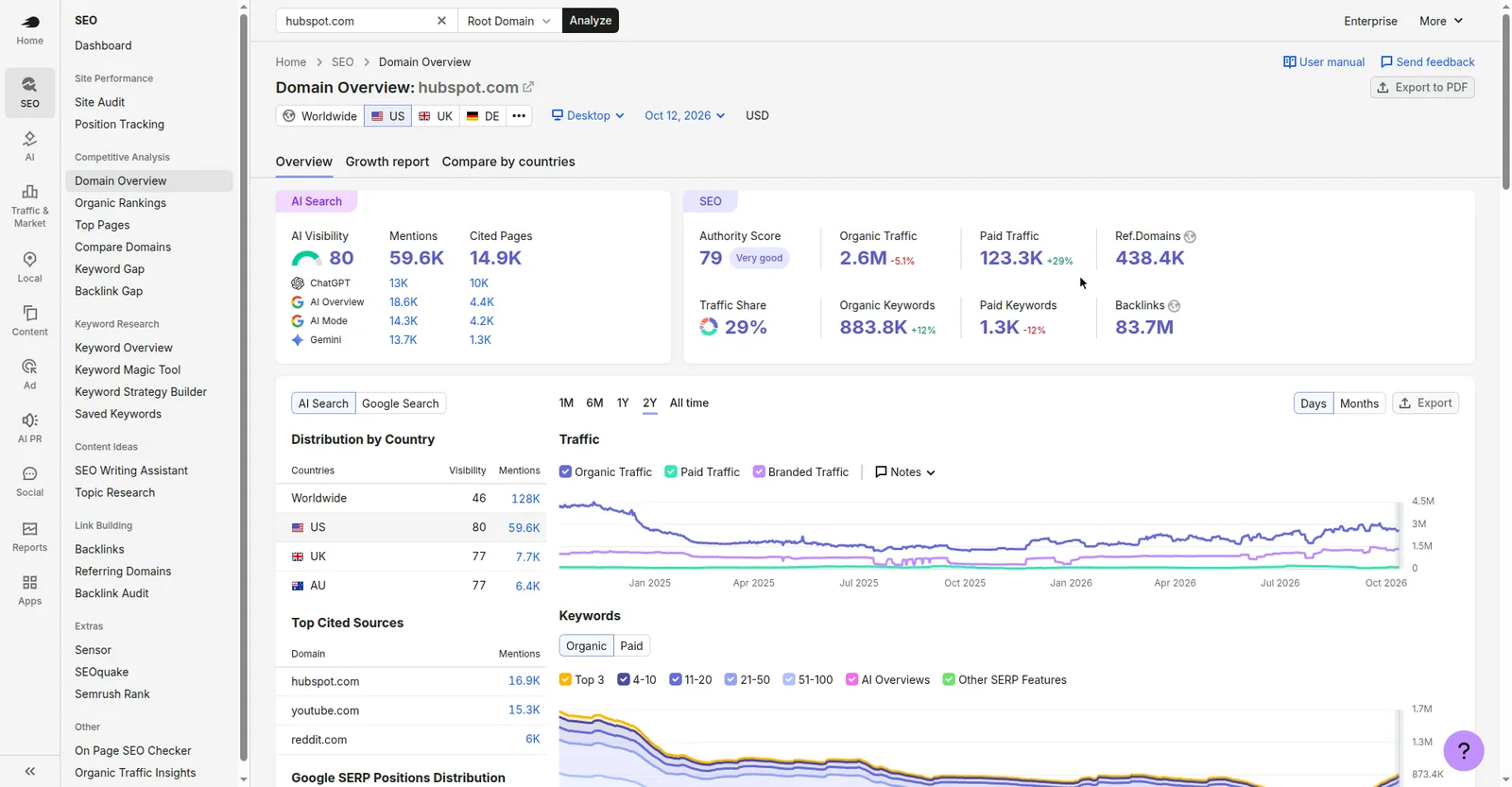
Enough theory. Let’s look at one real website and watch what a decade of earned backlinks actually looks like inside Semrush — the growth, and the honest twist at the end.
The numbers, exactly as Semrush reports them
HubSpot — the marketing software company, used here purely as a public data example — is one of the most link-earned domains on the web. Semrush’s Domain Overview (US database, October 12, 2026) reports: Authority Score 79 (“Very good”), 2.6 million monthly organic visits, 438,400 referring domains, and 83.7 million total backlinks. These are Semrush’s measurements, not ours, and not Google’s.
A decade of parallel growth
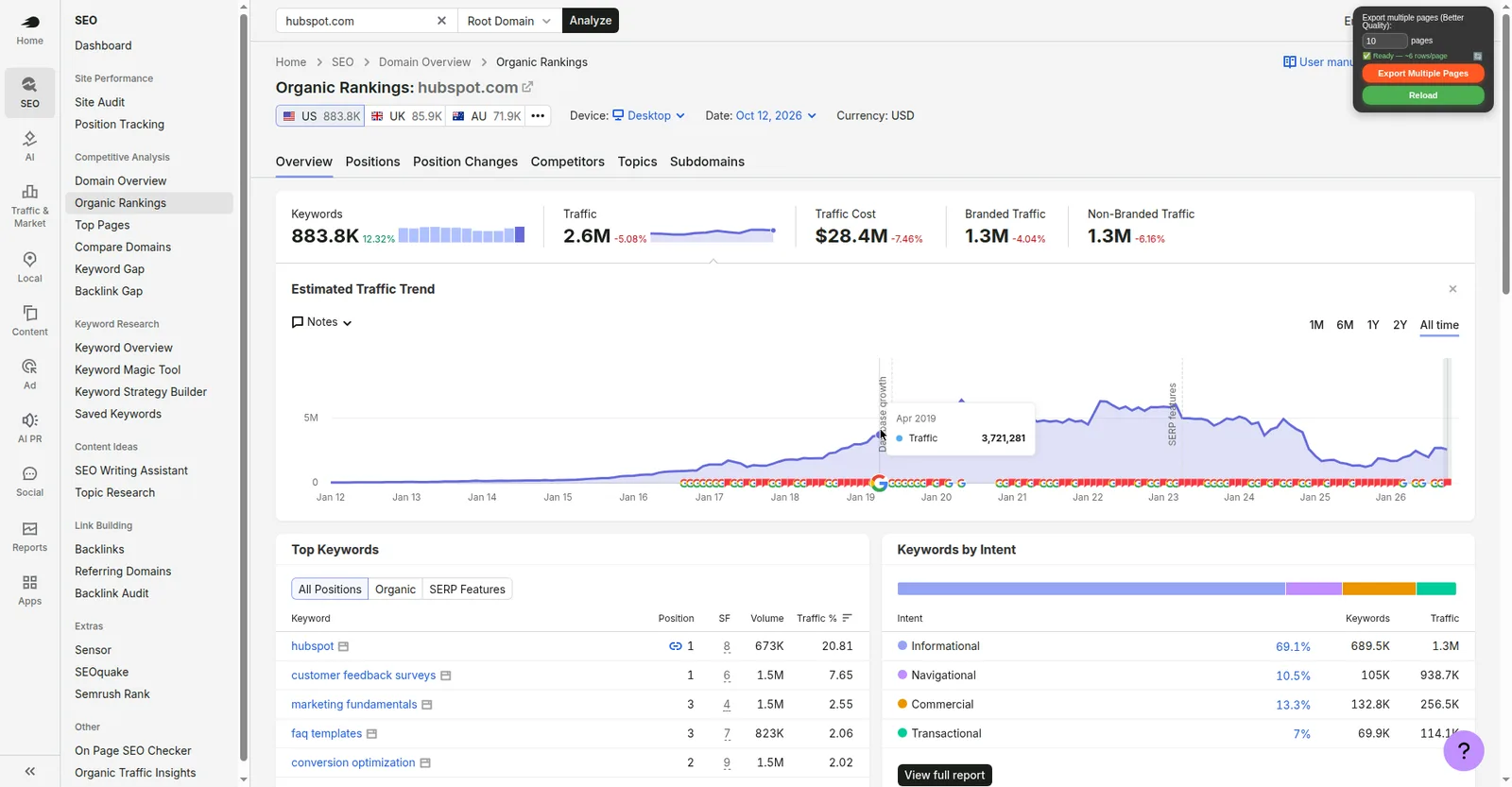
Pull the timeline back and the pattern is striking. HubSpot’s estimated organic traffic sat near zero in 2012, climbed relentlessly through the late 2010s — passing 3.7 million monthly visits by April 2019 — and peaked above 4 million around 2022–2023.
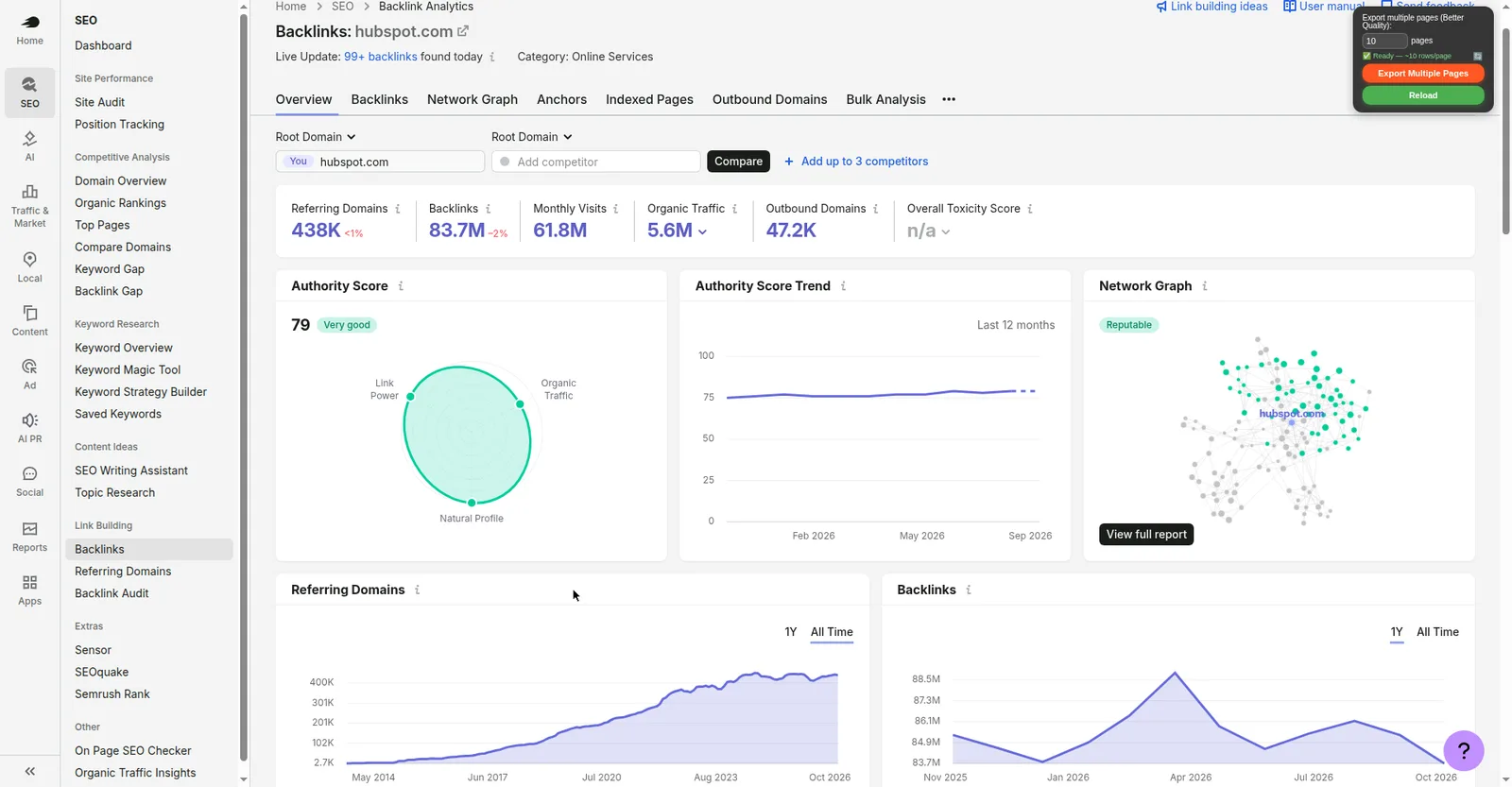
Now look at the referring-domains chart for the same era: roughly 2,700 referring domains in 2014, climbing every single year to 438,000 by October 2026. Two curves, one decade, same direction. This is the billion-page correlation from chapter 2 playing out on a single famous domain: as referring domains compounded, organic traffic compounded with them.
The honest twist
But look at the right edge of the traffic chart. Since the 2022–2023 peak, HubSpot’s estimated organic traffic has fallen back to 2.6 million — while referring domains kept climbing. If backlinks were the whole story, that couldn’t happen. It happened because rankings also answer to content freshness, SERP layout changes, AI Overviews, and competition — exactly the “links are a factor, not the factor” point Google itself makes. The data supports backlinks and humbles them at the same time, which is precisely the honest position this guide takes.
What this means at your scale
You are not going to earn 438,000 referring domains, and you don’t need to. The mechanism is identical at every scale: earn links steadily from relevant, trusted pages, and the traffic curve gets a reason to slope upward over years. Just don’t expect links alone to carry the whole strategy — HubSpot’s own chart is the proof. For the playbook that earns the kind of links in these charts, start with our white-hat link building guide.
9. What Don’t Backlinks Do for You?

They don’t guarantee rankings
This is the myth that refuses to die: buy enough links, rank number one. The data says otherwise. Ahrefs’ analysis of roughly 14 billion pages found that 96.55% get zero traffic from Google — and a large share of those pages have backlinks. Links are one input among many, and piling them onto a page that fails on relevance or quality is like putting premium fuel in a car with no engine.
Correlation is not causation, either. Pages with many referring domains tend to get more traffic — Ahrefs confirms the correlation — but the causality runs both ways: great content earns both links and rankings, and attributing all the success to the links is a classic analytical error. Treat every “links = rankings” claim with the skepticism it deserves.
They don’t fix bad content
John Mueller’s warning bears repeating: “over-focusing on links will often result in you wasting your time doing things that don’t make your website better overall.” If your page does not satisfy search intent — the factor 57.1% of surveyed SEOs ranked above backlinks — no link profile will save it. The page has to deserve to rank before links can help it rank.
This is the most common way link-building budgets get wasted: buying links to pages that needed rewriting instead. Before spending anything on outreach, the honest question is whether the destination page is genuinely the best answer to its target query. If it is not, fix the page first. Links amplify; they do not compensate.
They don’t work instantly — or equally
Search engines need time to discover new links, recrawl the involved pages, and fold the signals into their evaluations. Anyone promising ranking movement in days is either mistaken or selling something automated. Realistic expectations run in weeks to months, varying by crawl frequency, competition, and how dramatically the link profile changed.
They also do not work equally. A single editorial link from a trusted, topically relevant publication can outweigh hundreds of low-quality directory or comment links. The Zyppy survey respondents were explicit: spammy backlinks ranked among the strongest negative signals. Bad links are not merely worthless — they can actively work against you, which is why understanding which types of backlinks help versus hurt matters more than any raw count.
They don’t replace everything else
Perhaps the sharpest limit: links were never the whole of SEO, and their share keeps shrinking. Google’s Gary Illyes has said links are not in the top three ranking factors and “haven’t been for some time.” Content that satisfies intent, technical health, user experience, and brand signals all compete for the influence links once monopolized.
The practical implication is budgetary. Money spent on links is money not spent on content, site speed, or conversion optimization — and for many sites, those investments return more. If you are considering paid link acquisition, do it with eyes open: links are one line item in a balanced strategy, not the strategy itself.
They don’t make people want what you’re selling
One final limit that rarely gets stated: backlinks amplify demand, they do not create it. A brilliant link profile pointing at a product nobody wants, a service with terrible reviews, or a page with a confusing offer produces traffic that bounces and rankings that do not convert. Links can put you in front of the right people, but they cannot make those people care.
This is worth internalizing before any link-building investment. If your offer, pricing, or reputation has fundamental problems, links will expose those problems to a larger audience faster — an outcome nobody wants. Fix the offer, earn the reviews, clarify the page. Then let backlinks do what they do best: make something good easier to find, easier to trust, and harder to displace.
10. Backlink Benefits: What’s Your Next Move?

Start from the benefit you actually want
Go back to the seven benefits and pick the one or two that matter most for your situation. A new site that Google barely crawls should prioritize discovery — links from frequently-crawled pages plus a clean sitemap. A business competing on trust should prioritize editorial mentions in respected publications. An established site stuck on page two should prioritize relevant, authoritative links to the specific pages it wants to move.
This sounds obvious, but most link building starts from the tactic (“let’s do guest posts”) instead of the goal (“we need referral traffic from our buyers’ favorite publication”). Tactic-first planning is how you end up with fifty links and nothing to show for them. Benefit-first planning keeps every placement accountable to an outcome.
Earn links worth having
The tactics that deliver real benefits share one trait: they earn links from real publications with real audiences. Original research and proprietary data attract citations. Digital PR earns coverage that brings links, mentions, and visitors together. Guest posting on relevant, read blogs builds both links and relationships. Niche edits place you inside content that already ranks and already gets read.
For a complete map of legitimate approaches, the white-hat link building guide covers the full playbook, and the niche link building guide shows how to adapt it to your specific industry. Whatever you do, keep it editorial, relevant, and defensible — the links that deliver lasting benefits are the ones you would be proud to show a Google reviewer.
Measure what matters, not what flatters
Stop counting links and start tracking outcomes. For rankings: the positions of the specific pages you built links to, not your domain’s total link count. For referral traffic: sessions and conversions from referring domains in your analytics. For discovery: how quickly new pages get indexed. For trust and visibility: brand mentions, branded search volume, and the caliber of publications citing you.
Link counts flatter; outcomes inform. A campaign that earned twelve links and moved three money pages is worth more than one that earned two hundred links nobody clicked and nothing moved. Hold every link-building effort — in-house or outsourced — to the benefits it was supposed to deliver, and cut whatever cannot show its work.
Set a review rhythm and stick to it. Quarterly is enough for most sites: pull ranking movement for target pages, referral sessions and assisted conversions from new referring domains, indexation speed for new content, and any uptick in branded search or press mentions. Compare against the cost of the effort. If a tactic consistently delivers one benefit well — say, digital PR driving referral traffic but not rankings — keep it for that benefit and stop expecting it to do everything. Honest measurement is what turns link building from superstition into strategy.
Explore the Rankestra Link Building Library
Ready to go deeper on any tactic mentioned in this guide? These in-depth guides cover the full spectrum of link building:
- White-Hat Link Building Guide — the complete playbook for earning links the right way
- Guest Posting & Blogger Outreach Guide — place expert content on relevant blogs
- Wikipedia Backlinks Guide — earn citations from the web’s most trusted reference
- Niche Edits & Link Insertions Guide — get placed inside content that already ranks
- Niche Link Building Guide — adapt every tactic to your specific industry
- Buying Backlinks Safely Guide — navigate paid links without risking penalties
Frequently Asked Questions
What is the biggest benefit of backlinks?
The biggest benefit depends on your situation, but for most sites it is the ranking tiebreaker effect: when pages are evenly matched on relevance and quality, stronger backlinks decide who ranks higher. That said, referral traffic from links on well-read pages and the trust borrowed from respected publications often deliver more direct business value than a one-position ranking gain.
Do backlinks still matter in 2026?
Yes. In Zyppy’s September 2026 survey of 131 SEO professionals, 54.8% ranked backlinks among the three most important Google ranking factors — second only to relevance. Google’s own spokespeople have downplayed links (Gary Illyes says they are not in the top three), but practitioner data and large-scale correlation studies consistently show links still move results. The honest position: links matter, but less than they used to, quality matters far more than quantity, and they work best supporting strong content rather than rescuing weak content.
How many backlinks do I need to rank?
There is no honest number. Google’s John Mueller has explicitly advised against focusing on absolute link counts, noting there is no objective way to count links and that over-focusing on them wastes time. What matters is earning enough relevant, trusted links to compete with the specific pages ranking for your target keyword — sometimes that is a handful, sometimes it is hundreds. Analyze the top results, not a quota.
Do backlinks help with AI search visibility?
Indirectly. An Ahrefs analysis of 75,000 brands found branded web mentions correlated with AI Overview visibility more strongly (0.664) than total backlinks (0.218) — but correlation is not causation, and strong brands attract both. Editorial placements that earn you links usually earn brand mentions and topical context too, which is the combination AI systems appear to weigh. The practical move is to pursue coverage worth citing — original data, expert commentary, genuinely useful resources — not just hyperlinks.
Can backlinks hurt my website?
Yes. Spammy, manipulative, or irrelevant backlinks ranked among the strongest negative signals in the Zyppy 2026 survey, and Google’s spam policies explicitly penalize link schemes — sites that violate them “may rank lower in results or not appear in results at all.” This is why earning editorial links from relevant, reputable sources beats buying cheap links in bulk every time.
How long do backlink benefits last?
As long as the linking page exists and stays relevant — potentially years. Unlike paid ads, which stop delivering the moment you stop paying, an editorial backlink keeps passing ranking value, sending referral visitors, and lending credibility indefinitely. Links do decay over time through link rot and content changes, so ongoing link building and occasional profile maintenance beat one-off campaigns.