The fastest link in SEO is one you didn’t write a single word for.
No outreach marathon. No 2,000-word guest post. No waiting three months for a new page to rank. Just your link, inserted into an article that’s already ranking, already trusted, already getting traffic — live within days.
That’s a niche edit. A niche edit (also called a link insertion) is a backlink placed into an existing, already-published article on someone else’s website — rather than into a brand-new guest post written from scratch. The site owner edits their old content, adds a sentence or a resource mention that references your page, and your link goes live on a page Google already knows and trusts.
It’s one of the most effective — and most misunderstood — link building tactics in 2026. Done right, niche edits are surgical: relevant page, relevant anchor, instant authority. Done wrong, they’re the fastest way to light money on fire on links Google ignores or, worse, links that paint a target on your back.
This guide covers everything: what niche edits are (and how they differ from guest posts), why they work at a mechanical level, a full dissection of Shopify’s 1.4-billion-backlink profile showing real niche edits in the wild, how to find opportunities, the outreach playbook, what to actually pay, a 10-point quality checklist, and the honest truth about what Google’s spam policy says.
No hype. No fake case studies. Just mechanics, data, and straight talk.
Chapter 1: What Niche Edits Actually Are
The 30-second definition
A niche edit = a link inserted into existing content on a third-party site. The article already exists. It already ranks. It already has backlinks of its own. The site owner adds your link into the body of that article — usually with a short new sentence that gives the link a natural reason to exist — and publishes the update.
That’s the whole tactic. You’re not creating new content. You’re joining content that’s already winning.
The other names you’ll hear
SEO people love renaming the same thing. “Niche edit,” “link insertion,” and “curated link” all describe the same transaction: a contextual link placed into aged content. Vendors tend to say “niche edit” because it sounds like a service; SEOs tend to say “link insertion” because it describes the mechanics. Same thing.
What matters isn’t the label — it’s the placement. A link edited into the body of a relevant, trafficked article is a niche edit. A link dumped in a footer, sidebar, or author bio is not, no matter what the invoice says.
Niche edit vs. guest post — the core difference
A guest post creates a new page: you write an article, the site publishes it, Google discovers it, and over weeks or months it (maybe) earns authority. A niche edit skips all of that and attaches your link to a page that already did the work.
Think of it like real estate. A guest post is buying an empty lot and building a house — slow, expensive, uncertain. A niche edit is moving into a house in an established neighborhood — the schools, roads, and reputation are already there. You just pay the premium for the address.
Chapter 4 breaks this comparison down completely, with an honest scorecard of when each one wins.
Why it’s called a “niche edit”
The name comes from the practice itself: the link has to fit the niche of the existing article. You’re editing a page about, say, “best CRM tools for startups” to mention your CRM comparison guide. The edit only works if your content genuinely belongs in that article’s topic.
This is also the tactic’s built-in quality filter. A niche edit on an irrelevant page isn’t a niche edit — it’s just a paid link wearing a costume. Relevance is the whole game, and Chapter 8’s checklist will show you how to verify it.
The insertion, visualized
Here’s the anatomy of a clean niche edit. Three parts, all visible:
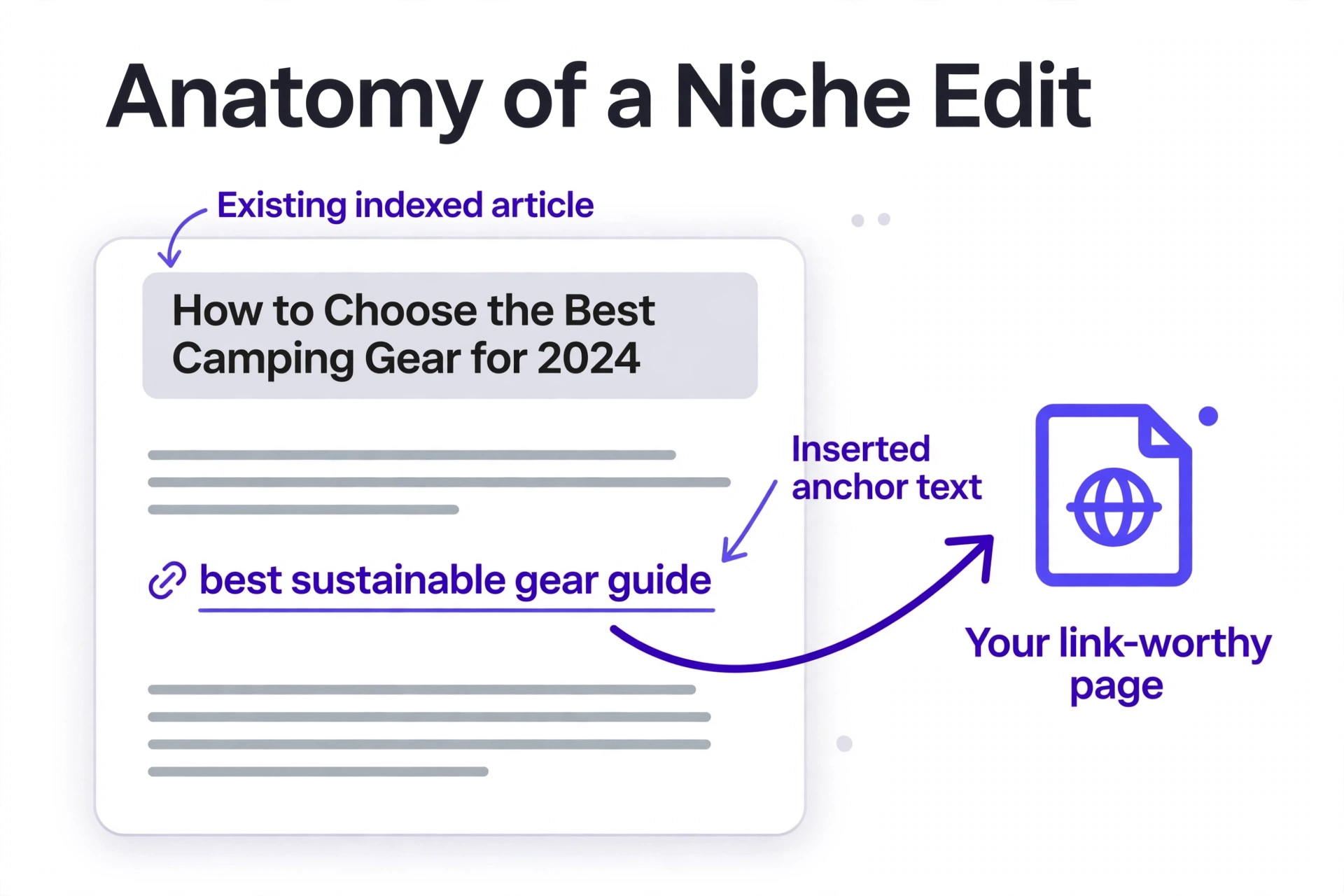
Part 1: the host article. Already published, already indexed, ideally already ranking and receiving traffic. Its topic matches your page’s topic.
Part 2: the inserted sentence. One or two sentences added by the site owner that create a natural reason for your link — a resource mention, a data reference, an “as explained in this guide” bridge.
Part 3: the link itself. In-content, contextual, with a natural anchor, pointing at your most relevant page. Not the homepage by default — the page that actually deserves the citation.
When all three parts are right, the edit is invisible: it reads like the article always contained it. When any part is wrong, it reads like an ad — and both readers and Google notice.
Real talk: most “niche edits” sold on marketplaces fail at Part 1. The host article has no traffic, no rankings, and no reason to exist. You’re buying a link on a page nobody visits. The checklist in Chapter 8 exists so you never pay for that.
Chapter 2: Why Niche Edits Work (The Mechanics)
Aged content, instant authority
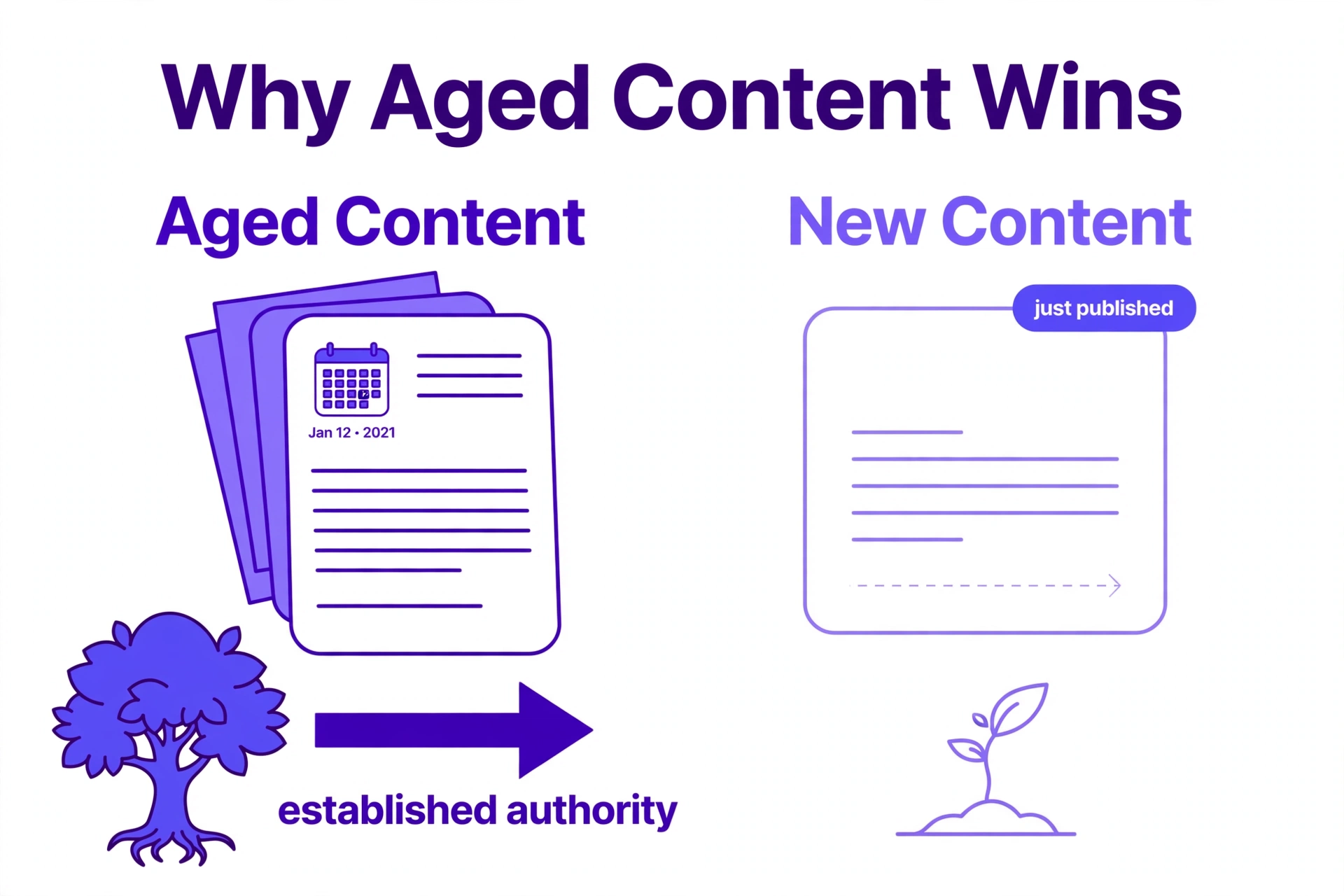
Here’s the mechanical advantage that makes niche edits special: Google already trusts the host page. An article published two years ago has a crawl history, user signals, and its own backlinks. When your link appears on it, it inherits that page’s standing from day one.
A new guest post starts at zero and has to earn everything. A niche edit starts at the host page’s current level. It’s the difference between opening a store on a busy street versus building a road and hoping traffic comes.
Google’s view: already-indexed, already-evaluated
Google’s systems have already crawled, indexed, and scored the host page. They know its topic, its quality, and its place in the link graph. A new link appearing in that page’s body text is processed in the context of everything Google already knows about the page.
This matters because link value isn’t just about the linking domain — it’s about the linking page. A link from a strong page on a medium site routinely outperforms a link from a weak page on a strong site. Niche edits let you target page-level strength directly instead of hoping a new page develops it.
The crawl-speed advantage
New pages can take weeks to get discovered, crawled, and indexed — and longer to accumulate any authority signals. An established article is already in Google’s crawl rotation. When the site owner updates it, Google typically recrawls it within days.
Your link gets found fast, evaluated fast, and counted fast. For time-sensitive campaigns — a product launch, a seasonal push — that speed is the entire point.
Contextual relevance at full strength
Google evaluates links partly by the surrounding content. A link sitting in a paragraph about your exact topic, surrounded by semantically related text, carries more topical weight than the same link on a generic page.
Niche edits are inherently contextual — the link lives inside real editorial content about the topic. That’s the placement type Google’s systems are designed to reward, and it’s exactly what the white hat link building foundations describe as the gold standard: earned-feeling, relevant, editorial links.
No “new page” waiting period
Every new page goes through a quiet probation: discovered, indexed, evaluated, and only then trusted enough to pass meaningful value. SEOs argue endlessly about how long this takes, but nobody argues it exists.
Niche edits bypass it entirely. The page did its probation years ago. You’re not waiting for trust to develop — you’re plugging into trust that’s already there.
The compounding math
Here’s the part most people miss. An established article doesn’t sit still — it keeps earning its own backlinks, keeps ranking, keeps accumulating authority. Your link rides that growth curve.
A guest post on a new page needs the page to succeed after your link goes live. A niche edit puts your link on a page that’s already succeeding and still climbing. You’re not betting on the future; you’re buying into a proven present.
Real talk: this is also why niche edits cost more per link than guest posts. You’re paying for someone else’s years of content investment. Whether that premium is worth it depends entirely on the quality of the host page — which is why Chapters 5 and 8 exist.
Chapter 3: The Shopify Case — 1.4 Billion Backlinks, Dissected
Enough theory. Let’s look at niche edits in the wild — inside the backlink profile of one of the biggest e-commerce platforms on earth.
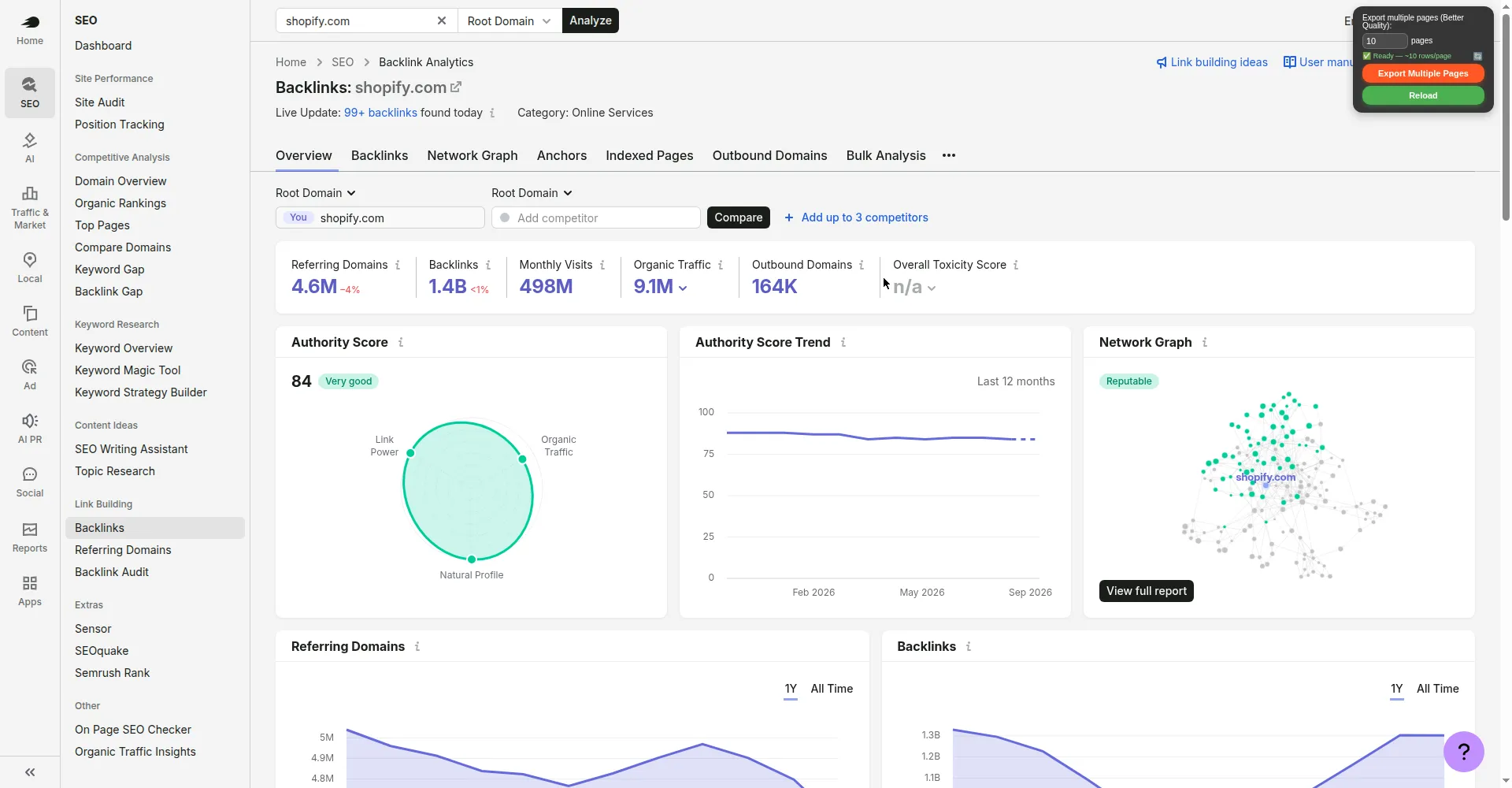
Shopify (shopify.com) was analyzed in Semrush’s Backlink Analytics on 2026-10-10. Every number below is real, observed data. And buried in those 1.4 billion backlinks are textbook examples of exactly what this guide teaches.
The headline numbers
- Authority Score: 84 — rated “Very good”
- Referring domains: 4.6 million
- Backlinks: 1.4 billion
- Monthly visits: 498 million
- Organic traffic: 9.1 million
- Outbound domains: 164,000
That’s one of the largest link profiles on the internet. But the raw size isn’t the lesson — the shape of it is.
The anatomy of the profile
The follow/nofollow split tells the first story: 71% follow (975 million) vs. 29% nofollow (402 million), with sponsored and UGC links under 1% each. That’s an unusually high follow ratio for a site this size — a sign of genuine editorial linking rather than comment spam or forum footprints.
Link types: 78% text (1.1 billion), 21% image (299 million). The profile is dominated by real text links in real content — exactly the environment where contextual niche edits live.
Geography is skewed hard: 85% of referring domains are Canadian (3,888,902), 12% American (543,825) — Shopify is a Canadian company, and its link graph reflects its home market. Germany, the UK, Singapore, and France each contribute under 1%.
And the authority distribution is a perfect pyramid: 46 domains at AS 91–100, 54 at 81–90, growing steadily down to 781,000 domains at AS 0–10 (78% of the total). Every healthy profile looks like this — a few giants, many minnows.
Real contextual insertions, found in the data
Filtering Shopify’s backlinks for in-content editorial placements surfaces exactly the kind of links this guide is about. Six examples, all real:
- officialzzstore.com (Page AS 89) — anchor “SHOPIFY” → shopify.com/ — in-content, first seen June 2026
- shopify.dev/docs (Page AS 87) — anchor “Shopify Partners blog — Educational resources and product previews” → shopify.com/partners/blog
- phonewarehouse.co.za (Page AS 87) — anchor “SHOPIFY” → shopify.com/
- lobstter.com (Page AS 86) — a French Shopify agency’s page, anchor “voir tous nos avis” (see all our reviews) → Shopify’s partner directory
- flowte.com/terms-of-service (Page AS 86) — anchor “Flowte Partner Program” → shopify.com/partners/terms (now lost — link removed)
- startmyshoptoday.com (Page AS 83) — three separate mid-article insertions (more on these below)
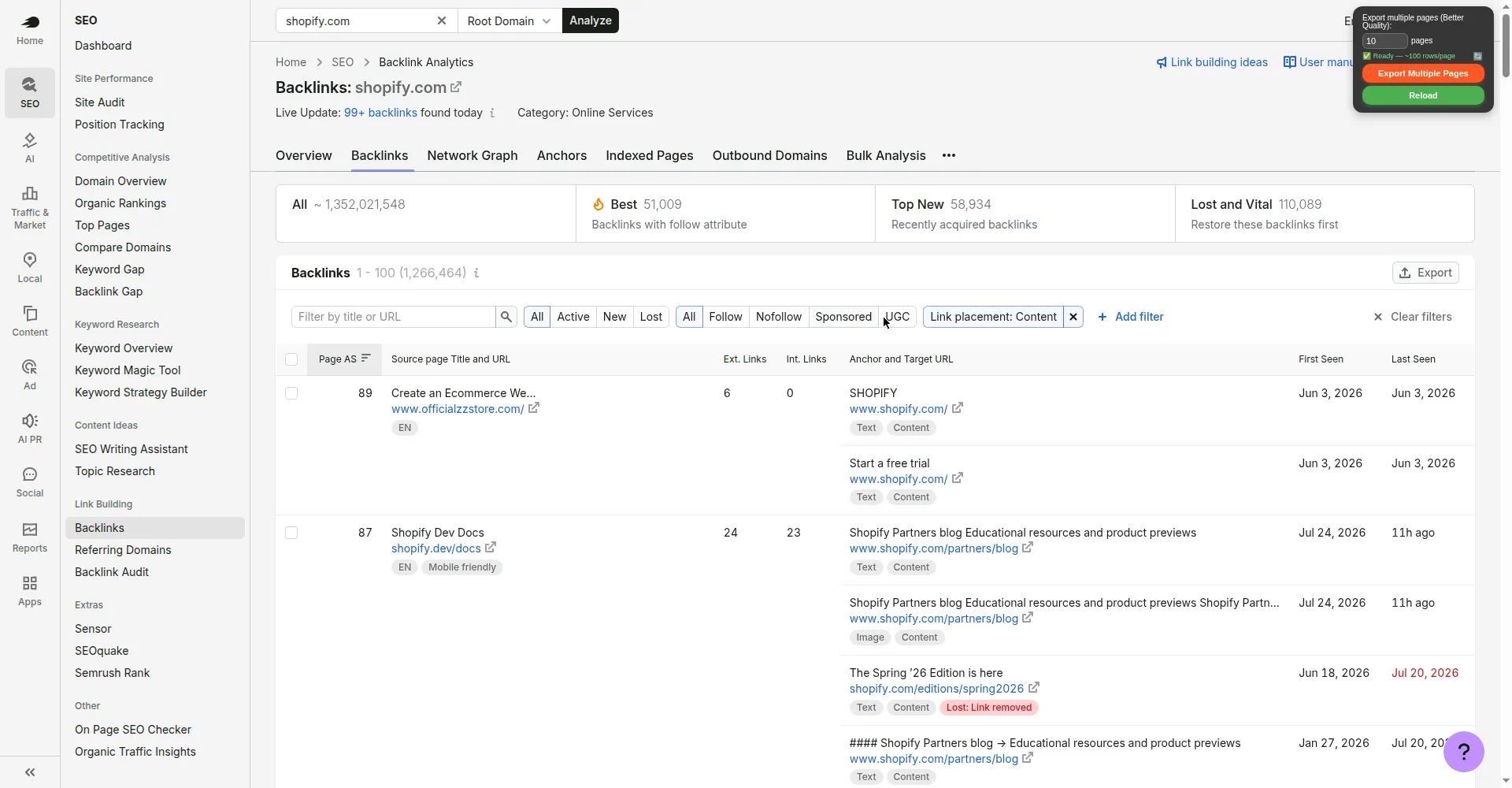
Notice the pattern: these aren’t homepage vanity links. They point at deep resource pages — the partners blog, the partner directory, partner terms, docs. The insertions cluster around help content, pricing, partner programs, and app listings. That’s the signature of a real niche-edit-shaped profile: links landing where the content deserves the citation.
The startmyshoptoday.com insertions — textbook niche edits
This is the single best example in the entire dataset. startmyshoptoday.com is a Chinese-language Shopify tutorial site (Page AS 83). Inside its existing tutorial articles, it inserted three separate mid-article links to official Shopify resources:
- Anchor “查看官方后台语言说明” (view official backend language docs) → Shopify’s Chinese help docs on account languages — first seen September 2026
- Anchor “查看 Shopify 官方实时定价” (view Shopify’s official live pricing) → shopify.com/pricing
- Anchor “官方支持地区与要求” (official supported regions and requirements) → Shopify’s help docs on supported payment countries
Read that again. An existing tutorial article. Mid-content insertions. Descriptive, local-language anchors. Pointing at the official resource pages that genuinely help the reader. That is a niche edit in its purest form — and it’s sitting in the backlink profile of a company worth billions.
The partner-ecosystem cluster tells the same story from a different angle: app developers (robotshatemonkeys.com linking to an App Store listing, mida-app.io linking to app reviews) and agencies (lobstter.com, clinique.com) citing Shopify’s deep pages contextually. Nobody built these links with a “link building campaign” — they’re the natural insertions of an ecosystem that references the platform constantly.
Real talk: this is the standard your niche edits should be judged against. Would this insertion look natural in Shopify’s profile? If yes, it’s a good edit. If it looks like it belongs on a link farm, it is one.
The anchor profile — and the 254-million-link warning
Shopify’s top anchors are a masterclass in what natural scale looks like — and a warning about what doesn’t count:
- “powered by shopify” — 254,721,076 backlinks from 1,788,287 domains
- “create account” — 138,590,551 backlinks from 105,347 domains
- “Empty Anchor” — 88,344,807 backlinks from 2,288,363 domains
- “create an account” — 73,638,408 backlinks from 42,223 domains
- “my account” — 15,882,924 backlinks from 11,821 domains
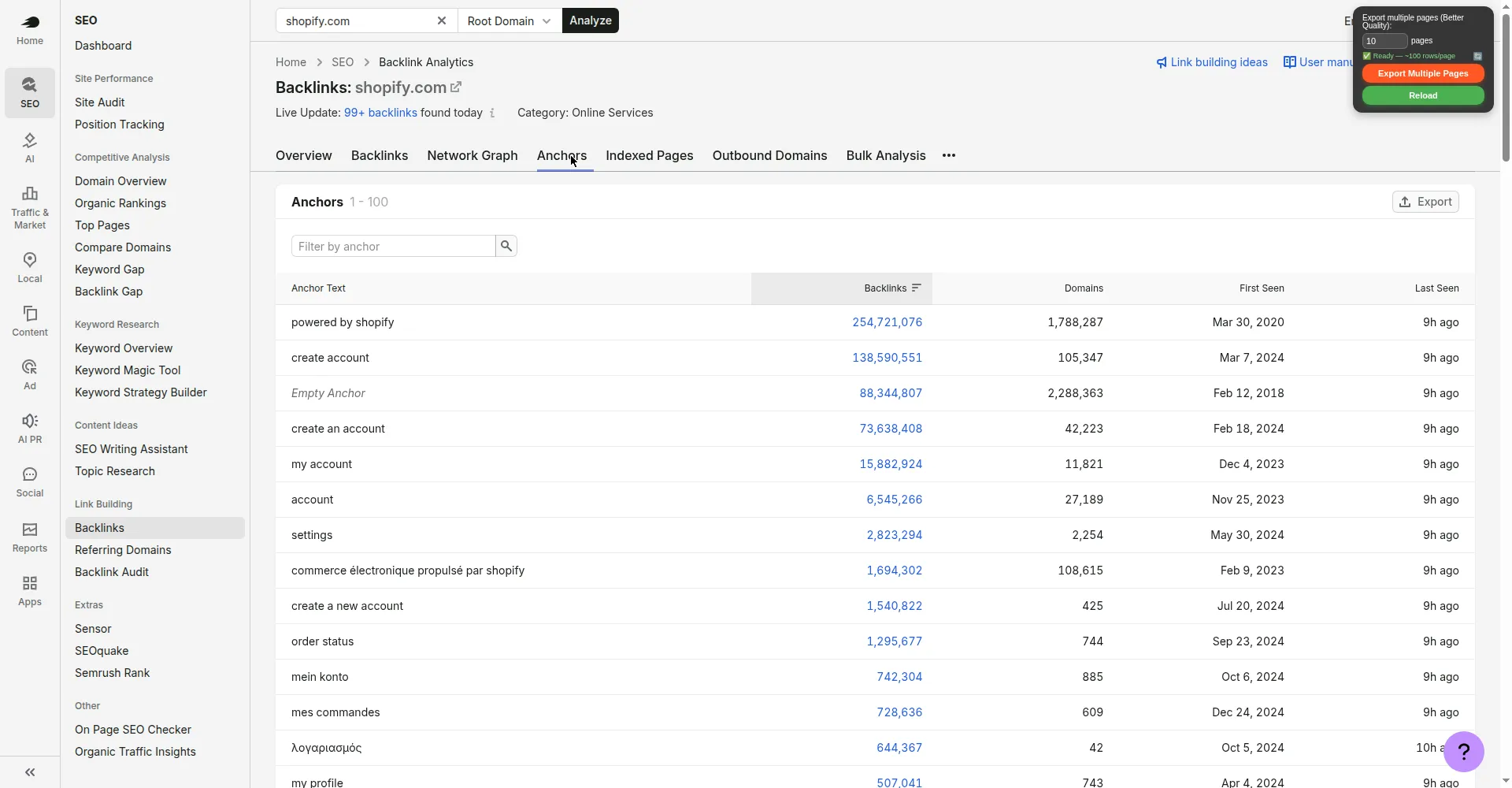
That first row deserves a pause. 254.7 million backlinks from 1.79 million domains — all from the “Powered by Shopify” footer credit stamped on every Shopify store template. It’s the largest single anchor footprint in the dataset, and every one of those links is a template link: automatic, footer-placed, zero editorial intent.
Here’s the cautionary lesson: template links dwarf editorial links in volume — and that’s exactly why they don’t count the same. Google’s systems have discounted boilerplate footer links for over a decade. 254 million of them don’t make Shopify rank; the contextual, in-content, editorial links do.
When a vendor offers you “1,000 backlinks for $50,” you’re buying the “powered by” tier — automated, templated, worthless. A single genuine niche edit on a real article outperforms ten thousand template links. Volume is the oldest lie in link building. The data proves it.
Chapter 4: Niche Edits vs. Guest Posts — The Honest Comparison
These two tactics compete for the same budget in almost every link building plan. Here’s the honest scorecard — no sacred cows.
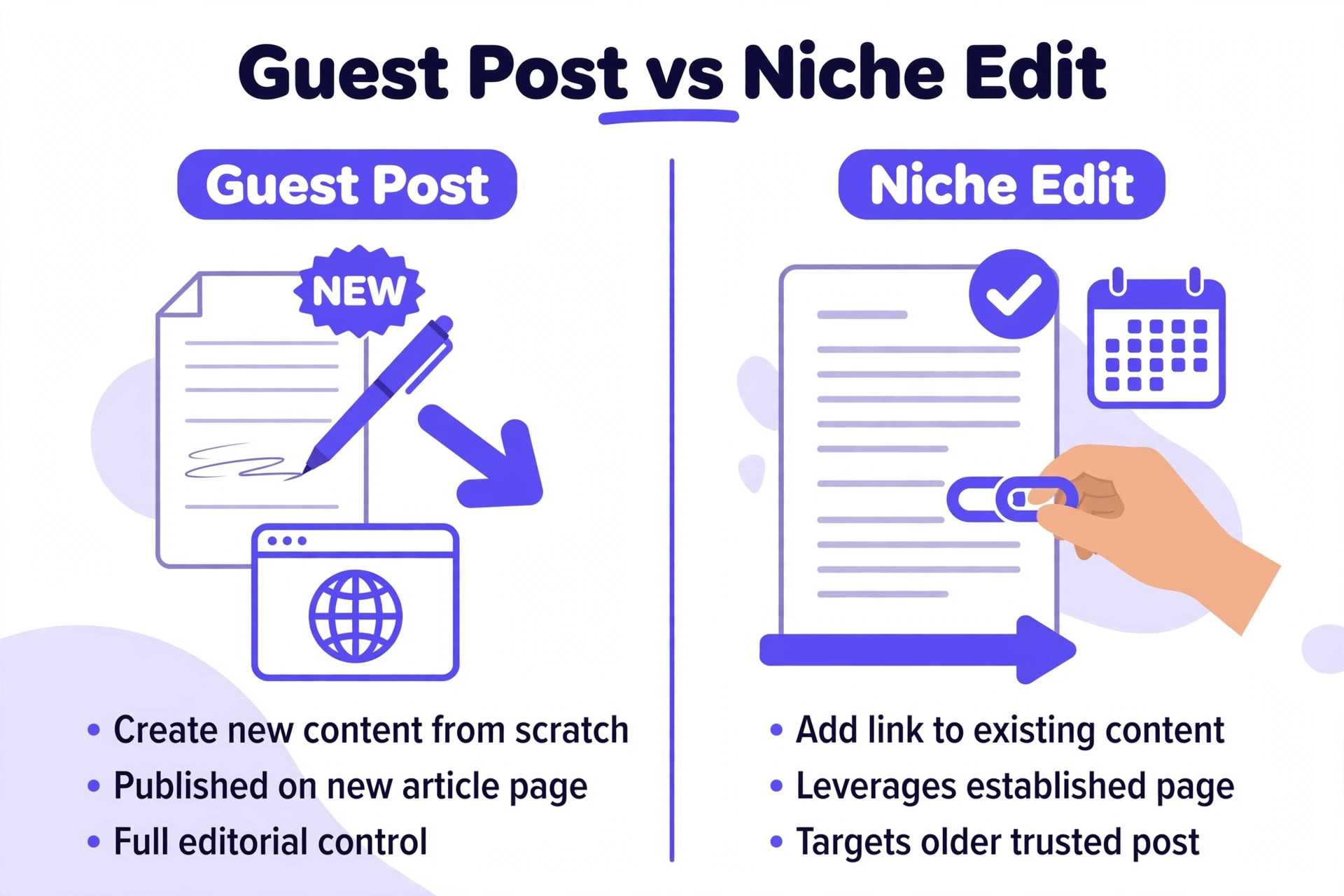
The head-to-head table
| Factor | Niche Edit | Guest Post |
|---|---|---|
| Speed to value | Days — page already trusted | Weeks–months — new page probation |
| Cost per link | Higher — you pay for existing authority | Lower–medium — content cost + placement |
| Content control | Low — 1–2 sentences, owner’s voice | Full — you write the whole article |
| Anchor control | Medium — negotiated, owner approves | High — your draft, your anchors |
| Topical precision | High — pick the exact ranking page | Medium — new page must rank first |
| Scalability | Lower — each needs manual outreach | Higher — content teams can mass-produce |
| Link longevity | High — established pages persist | Medium — new pages often decay |
| Risk profile | Medium — paid placements need care | Low–medium — editorial framing is easier |
When niche edits win
Choose niche edits when speed and page-level authority matter most: competitive keywords where you need trusted placements fast, product launches, seasonal campaigns, or when you’ve identified specific ranking pages whose audience matches yours perfectly.
They also win when your linkable asset is a resource rather than a story — a data study, a tool, a definitive guide. Resource pages earn insertions naturally because existing articles genuinely want to reference them. That’s the startmyshoptoday.com pattern: the tutorial needed official docs, so the docs got linked.
When guest posts win
Choose guest posts when you need control: a specific narrative, multiple links, branded storytelling, or topics where no good host article exists yet. They’re also better for relationship-building with editors — a great guest post opens doors that a transactional insertion doesn’t.
And frankly, guest posts are the safer training ground. If you’re new to outreach, guest posting and blogger outreach teach you the relationship skills that make niche-edit outreach work later.
The hybrid strategy (what actually works)
The best link profiles don’t pick one — they layer both. Use digital PR for high-authority editorial links, guest posts for controlled topical placements, and niche edits for surgical strikes on pages that already rank for your target keywords.
Think of it as a portfolio: guest posts are your steady index funds, niche edits are your targeted bets. Both have a place. The only losing move is buying either one blind, without the quality filter in Chapter 8.
Chapter 5: Finding Niche Edit Opportunities
Good niche edits are found, not bought from a list. Here’s the prospecting system — the same logic behind every legitimate placement.
Start with the asset, not the prospect
The number one mistake: hunting for sites before having something worth linking to. Nobody inserts a link to a thin product page. They insert links to resources: original data, definitive guides, free tools, visual explainers, templates.
Before you prospect a single site, ask: “If I owned a blog in my niche, would I genuinely reference this page in an existing article?” If the answer is no, fix the page first. The best niche-edit campaigns are won during content creation, not outreach.
The resource-page method
Search for existing articles that already link out to resources like yours. These pages have proven they’ll insert external links — the behavior you need already exists. Queries like:
keyword + "resources"keyword + "further reading"keyword + "tools" / "examples" / "statistics"keyword + inurl:guide / inurl:resources
A page titled “37 Email Marketing Statistics for 2026” that links to five studies is a page that would link to a sixth — yours — if your data is better.
The competitor backlink gap
Pull a competitor’s backlink profile in Semrush and filter for in-content links on aged pages. Every contextual link a competitor earned via insertion is a page you can pitch too — the owner has already said yes once, to content like yours.
This is how professionals prospect at scale: not by guessing, but by following the proven trail of insertions in their niche. If three competitors all have links from the same “ultimate guide,” that guide’s owner is your warmest possible prospect.
The broken-link angle
Find aged articles linking to dead resources in your niche — a 404, a discontinued tool, an outdated study. Offer your live, better resource as the replacement. The site owner gets to fix a broken link; you get a niche edit.
It’s the highest-converting angle in outreach because you’re solving a visible problem, not asking for a favor. Broken-link building and niche edits are natural allies — one finds the gap, the other fills it.
The unlinked-mention upgrade
Some articles mention your brand, your data, or your topic without linking. Others link to an inferior or outdated version of what you offer. Both are warm opportunities: the editorial intent already exists, you’re just completing it.
Set up alerts for your brand and key statistics. Every unlinked mention is a niche edit waiting for a polite email.
Qualifying prospects before you pitch
Not every aged page deserves your effort. Run every prospect through a quick filter:
- Real traffic? The page should rank for something and receive organic visits — check in Semrush or Search Console data.
- Topical match? Your link must belong in the article’s subject matter, not just the site’s niche.
- Editorial standards? Real author, real dates, real content — not a content farm with 10,000 thin pages.
- Link hygiene? Not selling links to everyone, not stuffed with outbound commercial links.
Pitch 50 qualified prospects, not 500 random ones. Chapter 8 turns this quick filter into the full 10-point checklist.
Chapter 6: The Outreach Playbook
Finding opportunities is half the battle. Getting a “yes” is the other half. Here’s the outreach system that actually converts.
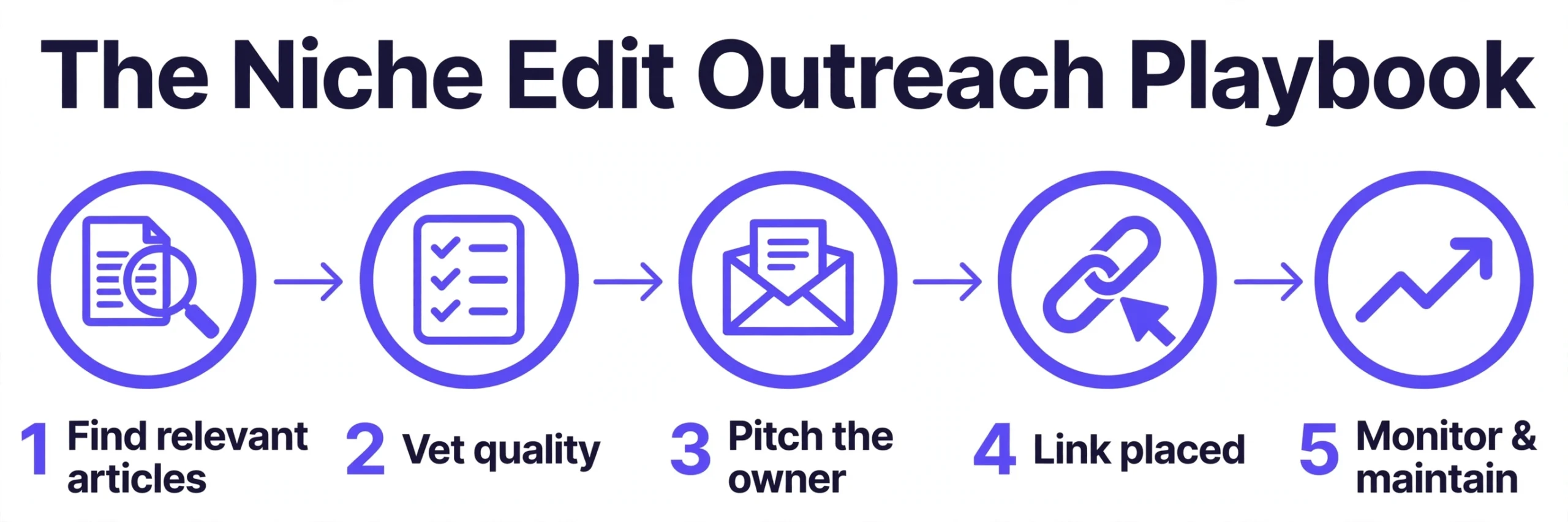
The mindset shift
Stop thinking “how do I get a link” and start thinking “how do I improve their article.” The site owner doesn’t care about your rankings. They care about their content being better. Every successful niche-edit pitch is framed as a content improvement, not a link request.
This isn’t manipulation — it’s alignment. If your resource genuinely improves their article, the link is the natural outcome. If it doesn’t, no email template will save you.
Find the right contact
Don’t pitch generic inboxes. Find the article’s author — their name is usually on the byline. LinkedIn, author bio pages, and the site’s team page are your friends. An email to the person who wrote the article converts dramatically better than one to “info@” or a contact form.
For larger sites, the content manager or editor works. For small blogs, it’s the owner directly. Match your ask to the person’s incentives: authors want their work to look good; owners want traffic and revenue.
The email structure
Keep it short. Site owners get dozens of link pitches weekly — yours wins by being specific and low-effort to say yes to:
- Subject: reference their article by name — “Quick suggestion for your [Article Title]”
- Opener (1 line): prove you read it — cite a specific section or point
- The pitch (2 lines): name the exact spot where your resource fits and why it helps their reader
- The asset (1 line): link your resource with a one-line description of what it adds
- Close (1 line): make “yes” effortless — offer the exact sentence they could insert
The magic ingredient is specificity. “I noticed in your section on X, you mention Y — our 2026 data on Z would strengthen that point” beats “I’d love a link from your great article” every single time.
Propose the exact insertion
Don’t make the owner do the work. Draft the 1–2 sentences you’d add, with the anchor text, and show exactly where they fit. You’re reducing their effort to a copy-paste decision.
Example: “In your ‘Pricing Models’ section, after the paragraph on tiered pricing, this could fit: ‘For current benchmarks across 200+ SaaS companies, see this [pricing study].’ Happy to adjust the wording to match your voice.”
Giving them the sentence does two things: it proves the fit is natural, and it removes the friction that kills most pitches.
The follow-up sequence
Most replies come from follow-ups, not first emails. The sequence:
- Day 1: the pitch
- Day 5: one polite bump — new angle or added value, not “just checking in”
- Day 12: final follow-up — shorter, with an easy out (“if now’s not the time, no worries”)
Then stop. Three touches is professional; five is pestering. A “no” today from a gracious exit often becomes a “yes” six months later.
What to offer in return
Sometimes the value exchange is the content improvement itself. Sometimes owners want more: a social share, a link back from your site, a testimonial, or — commonly — a placement fee.
There’s nothing inherently wrong with compensating a site owner for their editorial time. What matters is how it’s handled: disclosed where required, natural in execution, and never at a scale or pattern that looks manufactured. Chapter 9 covers the policy reality honestly.
Negotiation without getting fleeced
When money enters the conversation, anchor on page value, not domain vanity metrics. A niche edit on a trafficked, relevant article is worth more than one on a high-DR page nobody reads. Ask for the page’s traffic data. Verify it independently.
And never pay before the link is live and verified — or use an escrow-style arrangement through a reputable marketplace. The horror stories in this industry almost always start with upfront payment to a stranger.
Real talk: the best niche-edit “outreach” doesn’t feel like outreach at all. Build genuinely link-worthy resources, and half your insertions will come from people who found you on their own — like those Shopify ecosystem sites that cite official docs because the docs are simply the best source. Great content is the ultimate outreach hack.
Chapter 7: Pricing — What Niche Edits Actually Cost
Let’s talk money honestly — because this is where most buyers get separated from their budgets.
What moves the price
Niche edit pricing isn’t random. Five factors drive it:
- Page traffic: real organic visitors to the specific host page — the #1 value driver
- Topical relevance: exact-topic matches command premiums over loose niche fits
- Domain authority: the site’s overall strength (a multiplier, not the core value)
- Link attributes: dofollow in-content placements cost more than nofollow or bio links
- Exclusivity: pages that rarely sell links charge more than link-market regulars
A placement scoring high on all five is worth 10x one scoring high on none. Price follows value — when the seller is honest about the value.
A real published pricing reference
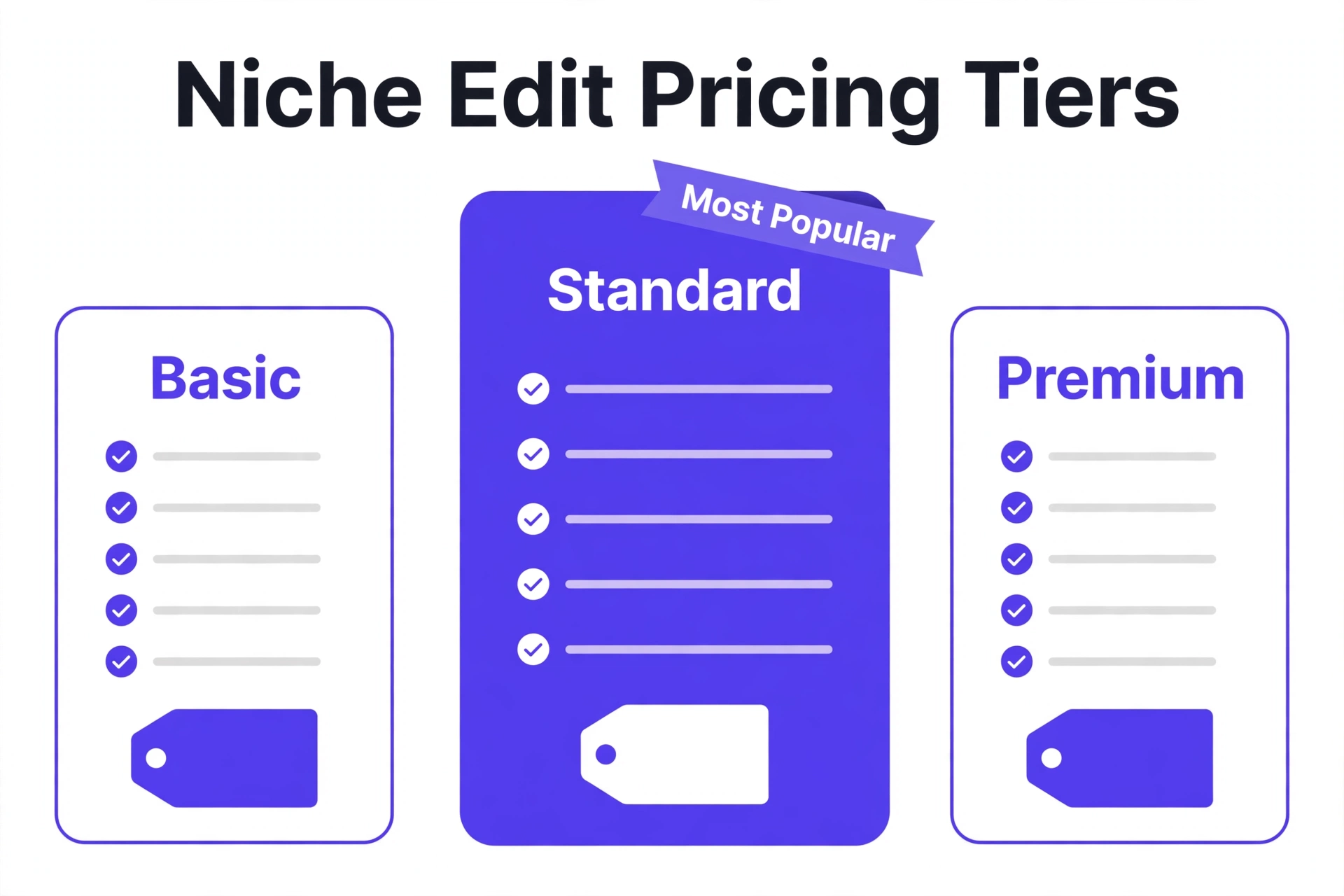
For grounding, here’s a published tier structure from an actual agency service page — Rankestra’s own Link Insertion service lists three tiers: $199 / $399 / $999, scaling with the authority and traffic level of the placement sites.
That 5x spread between bottom and top tier is the honest shape of this market: a basic insertion on a modest blog and a premium insertion on a high-traffic authority page are fundamentally different products. Any vendor charging the same price for both is either overcharging the small ones or lying about the big ones.
What’s overpriced
Red flags on pricing:
- DR/DA-only pricing: charging by domain metric alone, ignoring whether the page has traffic
- Flat-rate “premium” networks: every site costs the same because every site is equally mediocre
- Homepage-link pricing for inner pages: you’re buying an inner-page edit, not the homepage’s authority
- Rush premiums on commodity links: urgency fees for something that isn’t scarce
Budgeting a campaign
Work backward from outcomes, not forward from link counts. Decide what a ranking improvement is worth, estimate how many quality placements you need (fewer than you think — quality compounds), and allocate per-placement budgets by tier.
A useful rule: five excellent niche edits beat fifty mediocre ones — in rankings, in risk profile, and usually in total cost. The Shopify data backs this philosophy: it’s the contextual editorial links that carry the profile, not the millions of template links.
Real talk: if a deal looks too good to be true — “50 niche edits for $500” — it is. That’s $10 per placement. No site with real traffic sells editorial access for $10. You’re buying PBN links with extra steps, and Chapter 9 explains why that ends badly.
Chapter 8: The 10-Point Quality Checklist
Before you pay for — or celebrate — any niche edit, run it through all ten checks. A placement that fails even two of these is a placement to walk away from.
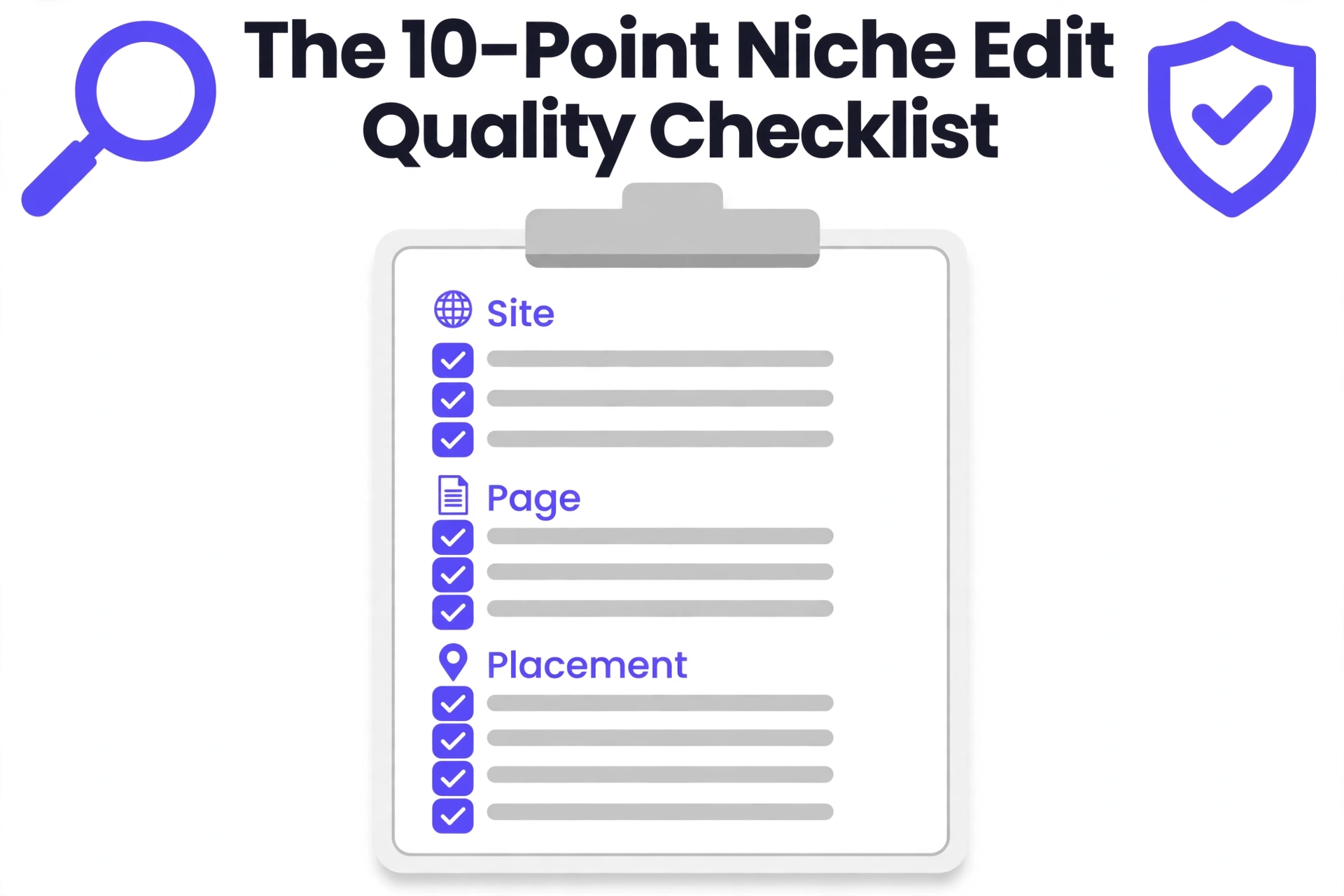
1. Real organic traffic to the page
The host page — not just the domain — should receive genuine organic traffic. Check the specific URL in Semrush or a similar tool. A page with zero traffic passes zero value, regardless of the domain’s metrics. This is the single most important check.
2. Topical relevance
Your link must belong in the article’s subject matter. A fitness supplement link in an article about marathon training: relevant. The same link in an article about car insurance: a paid placement wearing a costume. Google’s systems evaluate the semantic fit between linking content and linked content — relevance isn’t optional.
3. Aged, indexed, established content
The whole point of a niche edit is buying into existing authority. Verify the article has been published for a meaningful period, is indexed, and ideally ranks for something. A “niche edit” on an article published last week is just a guest post with extra steps.
4. Natural anchor text
The anchor should read like something an editor would write: descriptive, varied, occasionally branded or generic. Exact-match commercial anchors on every placement are the oldest detectable pattern in link building. Shopify’s own profile shows the healthy mix — branded, descriptive, and empty anchors coexisting naturally.
5. In-content body placement
The link must live in the article body, surrounded by relevant text. Footer links, sidebar links, author-bio links, and “partner” blogrolls are not niche edits — they’re template links, the “powered by shopify” tier. The data in Chapter 3 showed exactly how little those count.
6. Limited outbound links on the page
A page linking out to 200 external sites dilutes every link it gives. Check the host page’s outbound link count — fewer is better. A focused article with a handful of editorial outbound links passes far more value per link than a link-farm page spraying links everywhere.
7. Clean overall link profile
Look at the domain’s backlink profile, not just the page. Is it earning links naturally, or does it show the footprints of manipulation — sudden spikes, irrelevant foreign anchors, obvious PBN patterns? Your link inherits the neighborhood’s reputation. The white hat guide’s section on evaluating link neighborhoods applies here directly.
8. Dofollow (usually)
For ranking impact, you generally want links that pass equity — standard links without nofollow, sponsored, or UGC attributes. That said, a nofollow link on a high-traffic relevant page still drives referral traffic and looks natural in a mixed profile. Don’t reject nofollow outright; just don’t pay premium prices for it. And where money changes hands, be aware that Google’s guidelines expect sponsored attributes on paid links — Chapter 9 covers this tension honestly.
9. Genuine editorial standards
Real author bylines. Real publication dates. Real expertise in the content. Comments, social shares, signs of life. If the “blog” is 10,000 AI-generated articles with no authors and no audience, your link is decoration on a content farm — invisible to everyone except your invoice.
10. No PBN footprints
Private blog networks are the dark twin of niche edits: aged-looking sites built solely to sell links. Footprints include: same hosting/IP blocks, identical themes, interlinked networks, no real traffic despite “high DR,” and owners selling the same “niche edits” across dozens of sites. One PBN link can be worse than no link — it associates your site with a penalized network.
Real talk: print this checklist. Literally. Every time money is about to change hands for a link, run the ten checks. The five minutes it takes has saved more SEO budgets than any tool ever built. The Wikipedia backlinks guide makes the same point about citations: survival and quality beat volume, every time.
Chapter 9: Risks — What Google Actually Says
Time for the honest conversation most niche-edit sellers avoid. There are real risks here. Let’s look at what Google actually says — not what vendors wish it said.
Google’s spam policy, briefly quoted
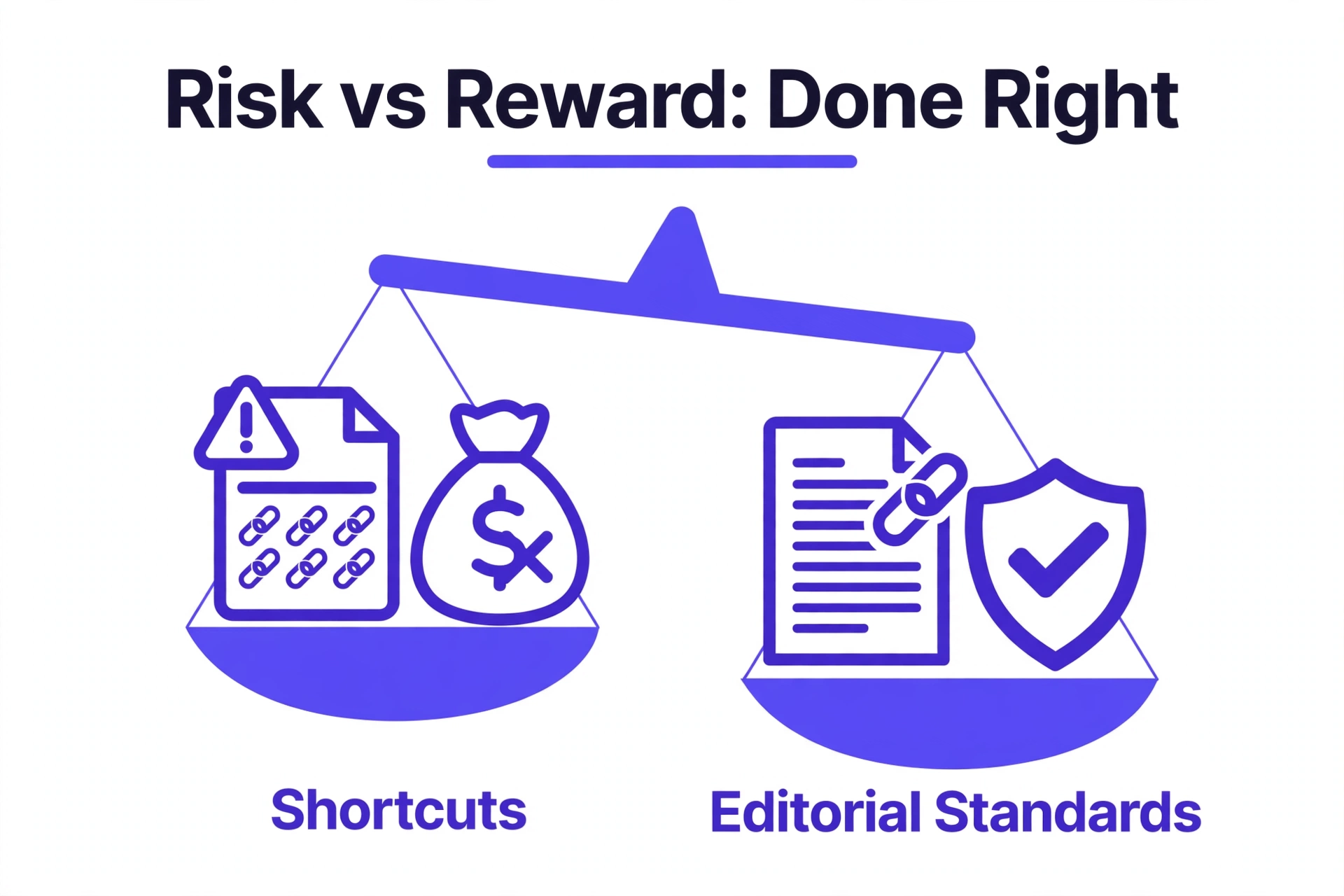
Google’s spam policies define link spam as links “intended to manipulate a site’s ranking in Google search results.” The policy explicitly lists “buying or selling links for ranking purposes” as a violation — including exchanges of money, goods, or services for links.
That’s the core of it. The rest of the policy elaborates on patterns: excessive link exchanges, large-scale article marketing with keyword-rich anchors, and automated link creation. The principle is consistent: links meant to manipulate rankings, rather than earned editorially, violate the guidelines.
The paid-link problem, honestly
Here’s the tension nobody in the industry can dodge: many niche edits involve payment, and Google’s guidelines say paid links for ranking purposes are link spam. Full stop.
Does that mean every paid niche edit gets penalized? No — Google penalizes patterns it can detect, and enforcement focuses on obvious manipulation at scale. But “unlikely to get caught” is not the same as “compliant.” An honest guide has to say both things: the risk of enforcement on a single careful placement is low, and the practice still sits outside the guidelines when money buys ranking intent.
The safest framing — and the one this guide recommends — is the editorial-value standard: every placement should be defensible as something an editor would do without payment. Real relevance. Real content improvement. Natural anchors. If you removed the money from the equation and the link would still make sense, you’re in the safest possible territory for this tactic.
Patterns that actually get caught
Google’s systems and manual reviewers look for patterns, not individual links. The patterns that trigger action:
- Anchor over-optimization: dozens of new links with identical commercial anchor text
- Velocity spikes: hundreds of new referring domains appearing overnight
- Network footprints: links from interlinked PBNs or known link-selling networks
- Irrelevance at scale: links from topics with zero connection to your site
- Reciprocal schemes: obvious “you link me, I link you” rings
Notice what these have in common: they’re all scale problems. A handful of careful, relevant, well-paced niche edits doesn’t look like any of these patterns. Industrial-scale buying does.
How to de-risk every campaign
The de-risking playbook:
- Pace yourself: acquire links at a natural velocity — a few per week, not hundreds per day
- Diversify tactics: mix niche edits with digital PR, guest posts, and genuinely earned links — a one-tactic profile looks manufactured
- Vary anchors: branded, descriptive, generic, and naked URLs in natural proportions
- Prioritize relevance over metrics: a relevant DR-30 link beats an irrelevant DR-70 link on both safety and value
- Vet sellers ruthlessly: the Chapter 8 checklist, every time, no exceptions
- Keep records: document every placement — if you ever need to disavow, you’ll know exactly what to cut
The honest risk summary
Niche edits are not “white hat” in the purist sense when payment is involved — and anyone telling you they’re risk-free is selling you something. But they’re also not the reckless gamble some purists claim. Done with relevance, pacing, quality vetting, and diversified tactics, they’re a standard part of how competitive niches build links in 2026.
The real risk isn’t the tactic. It’s the execution: cheap vendors, PBN networks, over-optimized anchors, and industrial scale. Avoid those, and the risk profile of a careful niche-edit campaign is modest. Chase bargains, and you’ll eventually pay more in cleanup than you saved on placements.
Chapter 10: Niche Edit FAQs
The six questions everyone asks — answered straight.
Are niche edits white hat?
It depends on the execution. A niche edit earned through genuine outreach — where your resource truly improves an existing article — follows the spirit of editorial linking. A niche edit bought at scale from a link vendor, with money as the only reason the link exists, sits outside Google’s guidelines on paid links. The tactic itself is neutral; the transaction around it determines the color of the hat. When in doubt, apply the editorial-value test from Chapter 9: would this link make sense if no money changed hands?
How much do niche edits cost?
Quality placements typically range from around $100 for modest blogs to $1,000+ for high-traffic authority pages, driven by page traffic, relevance, and domain strength. Published agency tiers illustrate the spread — for example, Rankestra’s Link Insertion service is listed at $199/$399/$999 across three placement levels. Be deeply suspicious of anything dramatically cheaper: a $10 “niche edit” is a PBN link with better marketing.
How fast do niche edits work?
Faster than any other link type, mechanically speaking. Because the host page is already indexed and trusted, Google typically discovers the new link within days of the page being recrawled. Ranking movement depends on the keyword’s competitiveness and your overall profile — but the link itself starts counting far sooner than a link on a brand-new guest post page. For time-sensitive campaigns, that speed is often the deciding factor.
Niche edits vs. guest posts — which is better?
Neither — they solve different problems. Niche edits win on speed and page-level authority: your link goes live on a page Google already trusts. Guest posts win on control and scale: you own the narrative and can produce them systematically. The strongest link profiles layer both, alongside digital PR and earned links. If you can only afford one, choose based on your constraint: need results fast on competitive terms? Niche edits. Need controlled, scalable topical coverage? Guest posts. The full scorecard is in Chapter 4.
Can niche edits get you penalized?
Any manipulative link pattern can, in principle. In practice, penalties follow detectable patterns — anchor over-optimization, velocity spikes, PBN footprints, irrelevance at scale — not individual careful placements. A small number of relevant, well-vetted, naturally-paced niche edits doesn’t match any known penalty pattern. The risk concentrates in cheap, scaled, low-quality buying. Vet with the Chapter 8 checklist, diversify your tactics, keep anchors natural, and the risk profile stays modest.
Where can I get niche edits safely?
Three routes, in order of safety: (1) DIY outreach — prospect with the Chapter 5 methods and pitch with the Chapter 6 playbook; slowest but safest and cheapest. (2) Reputable agencies — with published pricing, transparent site lists, and quality guarantees; you pay a premium for their vetting. (3) Marketplaces — fastest and cheapest, but quality varies wildly; never buy without independently verifying traffic and relevance. Whichever route you take, the 10-point checklist is non-negotiable.
Continue Building Your Link Building System
Niche edits are one weapon — here’s the full arsenal:
- White Hat Link Building: The Complete 2026 Guide — the foundations every tactic here rests on
- Digital PR for Link Building — earn high-authority editorial links at scale
- Guest Posting & Blogger Outreach — the perfect complement to niche edits
- Wikipedia Backlinks — trust and entity signals that compound everything else
- Rankestra’s Link Insertion Service — done-for-you niche edits with published $199/$399/$999 tiers
Don’t Be the 99%
Here’s the uncomfortable truth this whole guide has been building toward:
99% of people who read about niche edits will do one of two things. They’ll either buy the cheapest “50 niche edits for $500” package they can find — and wonder why nothing happens, or worse, why things get worse. Or they’ll read this guide, nod along, and never send a single outreach email.
Both groups lose. The first group loses money. The second group loses to competitors who actually execute.
The 1% does something different. They pick one linkable asset on their site — the best guide, the best data, the best tool. They find ten existing articles where it genuinely belongs. They send ten specific, personalized pitches this week. They land two or three placements. Then they repeat.
No hacks. No shortcuts. No $10 links. Just the unglamorous work of putting genuinely good resources into genuinely good articles — the same pattern sitting inside Shopify’s 1.4-billion-link profile right now.
Your move: open your site, find your single most link-worthy page, and identify five existing articles in your niche that should reference it. Send the first pitch today. The 99% are still reading. You’re already moving.