Digital PR for Link Building: The Complete 2026 Guide
Let me tell you about the most unfair advantage in link building.
While everyone else is begging bloggers for guest posts and refreshing their inbox hoping for a reply, some brands wake up to find the New York Times, TechCrunch, and Forbes linking to them. They didn’t ask. They didn’t pay. Journalists just… wrote about them.
That’s digital PR. And it’s the closest thing to a cheat code that still exists in SEO.
Here’s the part nobody tells you: digital PR isn’t PR. Traditional PR wants brand awareness and warm feelings. Digital PR wants one thing — earned backlinks from websites Google already trusts. Everything else is a bonus.
In this guide, I’m breaking down exactly how digital PR earns links, with real Semrush data from Canva (Authority Score 100 — a perfect score), 7 strategies that actually work in 2026, the anatomy of a pitch journalists open, and the mistakes that kill most campaigns before they start.
Buckle up — this is the one that separates the link builders from the link earners.
Chapter 1: What Digital PR Actually Is (And What It Isn’t)
The 30-second definition
Digital PR = creating newsworthy stories, data, or assets about your brand, then pitching them to journalists and publications so they cover you — earning editorial backlinks.
That’s it. You make something worth writing about. Journalists write about it. Their article links to you.
How it’s different from traditional PR
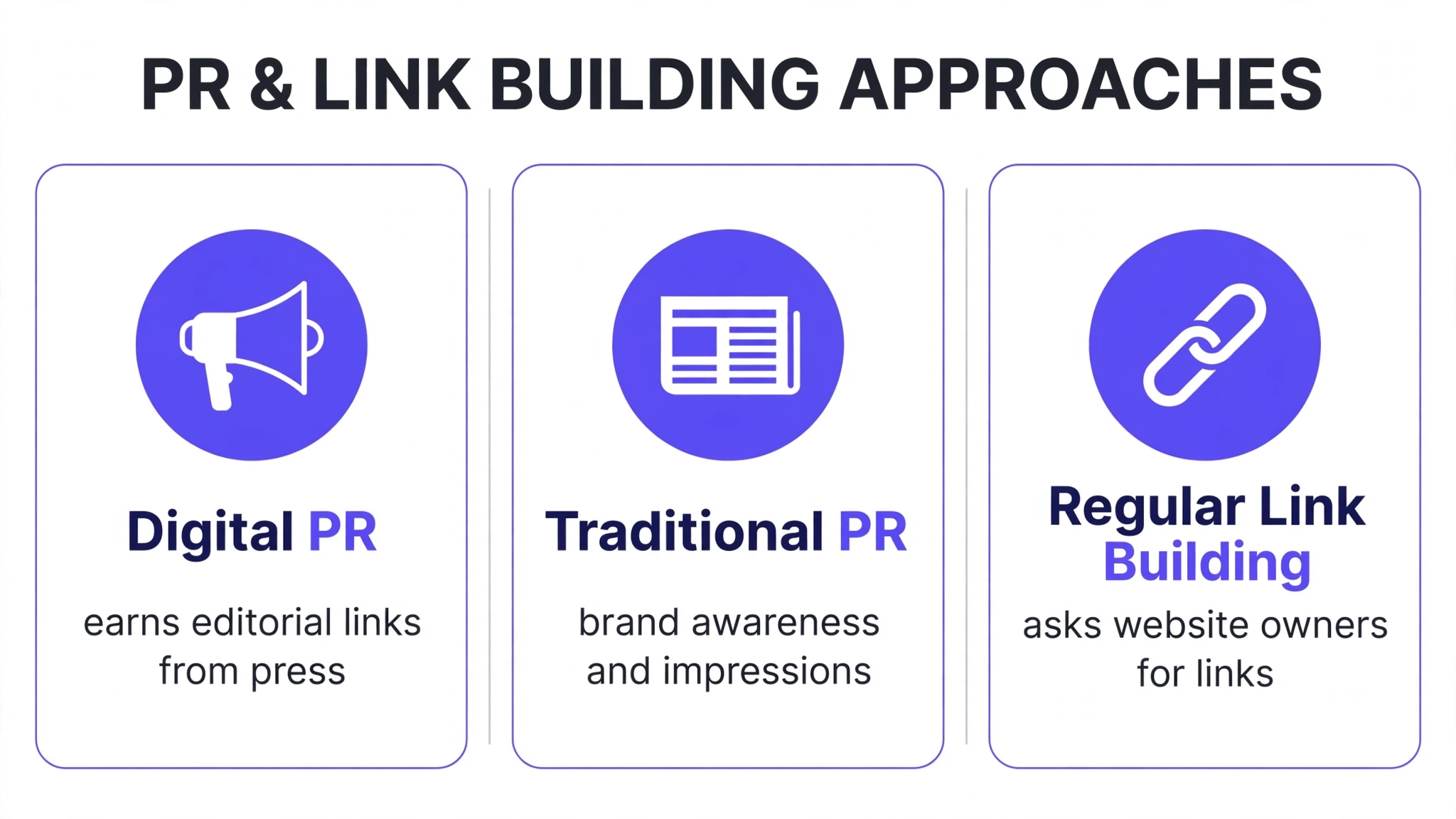
Traditional PR measures success in “impressions” and “sentiment.” Digital PR measures success in referring domains. A traditional PR firm celebrates when your CEO gets quoted. A digital PR link builder celebrates when that quote comes with a followed link from a DR 85 news site.
This distinction matters because it changes everything about how you work:
- Traditional PR pitches brand stories. Digital PR pitches link-worthy assets — data studies, tools, surveys, creative campaigns.
- Traditional PR targets TV and print. Digital PR targets online publications that actually link out.
- Traditional PR avoids SEO talk. Digital PR is SEO with a press pass.
How it’s different from regular link building
Regular link building asks for links. Digital PR earns them by being genuinely interesting. The outreach email doesn’t say “please link to my guide.” It says “we found something your readers will love — here’s the exclusive.”
Real talk: journalists don’t care about your link. They care about their story. The moment you understand that, digital PR clicks. You’re not a link beggar — you’re a source.
Why Google loves digital PR links
Google’s spam policies are crystal clear about one thing: links intended to manipulate rankings violate the guidelines. But editorial links — links a journalist chose to include because your content genuinely helped their story — are exactly what Google’s algorithms are designed to reward.
A digital PR link is the hardest link to fake. You can’t manufacture a Forbes feature in your bedroom. That’s precisely why it carries so much weight.
Chapter 2: Why Digital PR Beats Every Other Link Strategy
The math nobody argues with
Let me put it bluntly. One link from a major publication can outperform 50 guest posts. Not because of some magic — because of how authority flows.
A news site with an Authority Score of 90 linking to you passes more trust than dozens of small blogs combined. And here’s the kicker: that link also brings referral traffic, brand searches, and secondary links when other sites pick up the story. One campaign, three wins.
The compounding effect
Here’s what makes digital PR unfair: stories syndicate. When TechCrunch covers your data study, 20 smaller sites rewrite the story — and most of them link to you too. I call this the “echo effect.” You pitch 50 journalists, land 3 features, and wake up with 15 links.
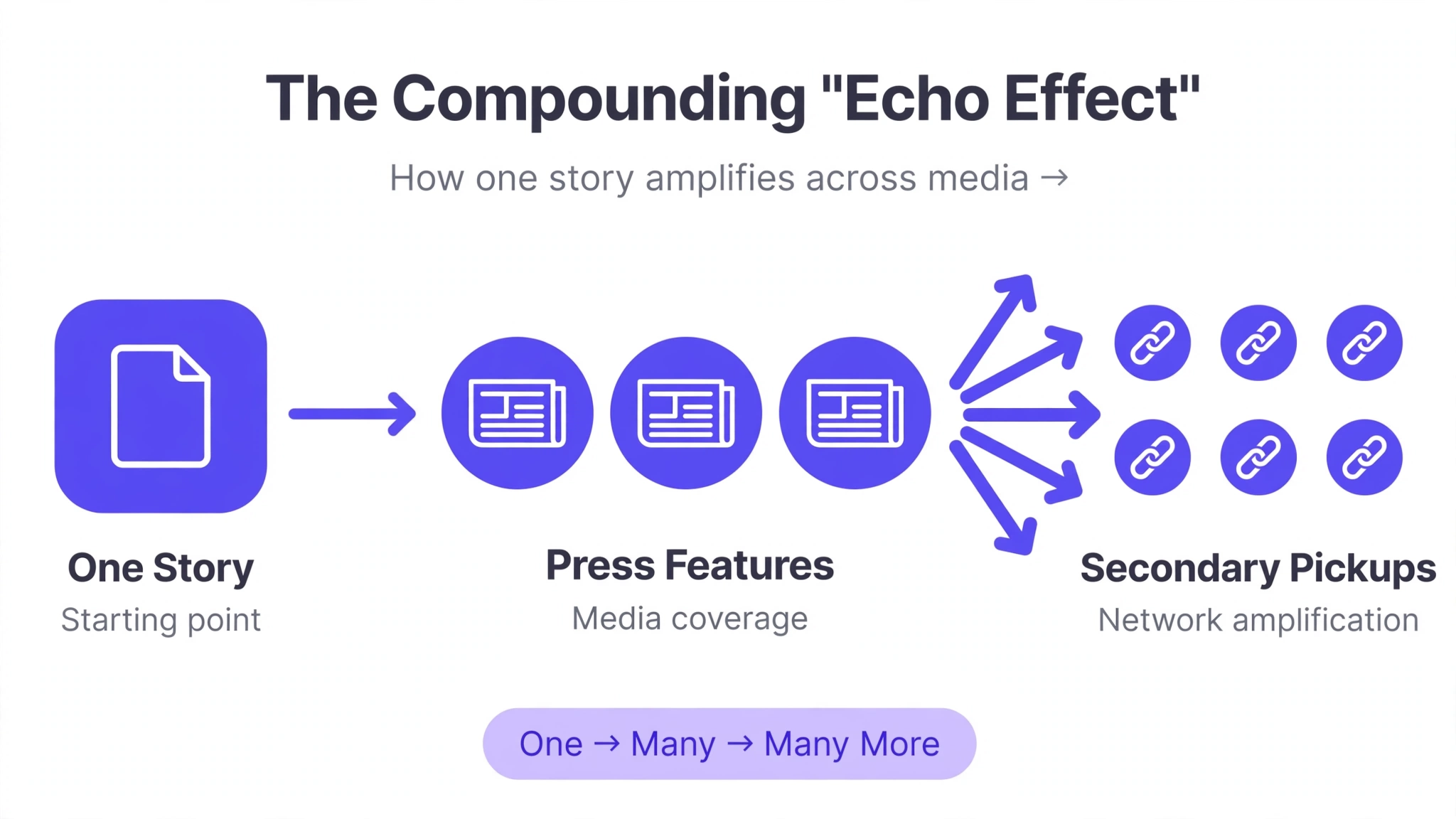
Guest posting doesn’t do this. Nobody syndicates your guest post. But everyone syndicates news.
Links you can’t buy (and shouldn’t)
Try buying a link on a major news site. Go ahead — I’ll wait. You can’t, because their editorial teams don’t sell links, and Google would nuke them if they did. Digital PR is the only reliable way onto these domains. It’s a moat. While competitors fight over the same guest post farms, you’re playing a game they can’t even enter.
The brand bonus
Every digital PR link is also a brand mention in front of thousands of readers. Your branded search volume goes up. Your conversion rate goes up (people trust brands they’ve seen in the press). Your next outreach campaign gets more replies because journalists have heard of you. It’s a flywheel.
The honest caveat: digital PR is harder than guest posting. It needs creativity, real data, and thick skin — most pitches get ignored. But the payoff per link is in a different universe. If you want links that actually move rankings in competitive niches, this is the strategy.
Digital PR vs. other link strategies — the honest comparison
Strategy / Link quality / Cost per campaign / Speed / Scalability / Best for — Digital PR: Highest (editorial, AS 70+), $500–$10,000, Slow (4–12 weeks), Medium, Competitive niches and brand building. Guest posting: Medium (AS 20–50), $50–$500 per link, Fast (1–3 weeks), High, Steady link velocity and anchor control. Niche edits: Medium (AS 20–60), $100–$1,000 per link, Fast (days), Medium, Quick wins on aged content. HARO / expert quotes: High (editorial), $0–$500 per month in tools, Medium (2–6 weeks), Low, Free entry into digital PR. Directories: Low (AS 10–40), $0–$50 per link, Fast, High, Foundational diversity only.
How to read this: no single strategy wins everything. The best link profiles in 2026 blend digital PR (for authority spikes) with guest posting and niche edits (for consistent velocity). If you only pick one and your niche is competitive, pick digital PR — it’s the only column your competitors can’t copy.
Chapter 3: The Canva Case Study — What 624,000 Referring Domains Looks Like
Enough theory. Let me show you what a digital-PR-powered link profile actually looks like — with real numbers, not vibes.
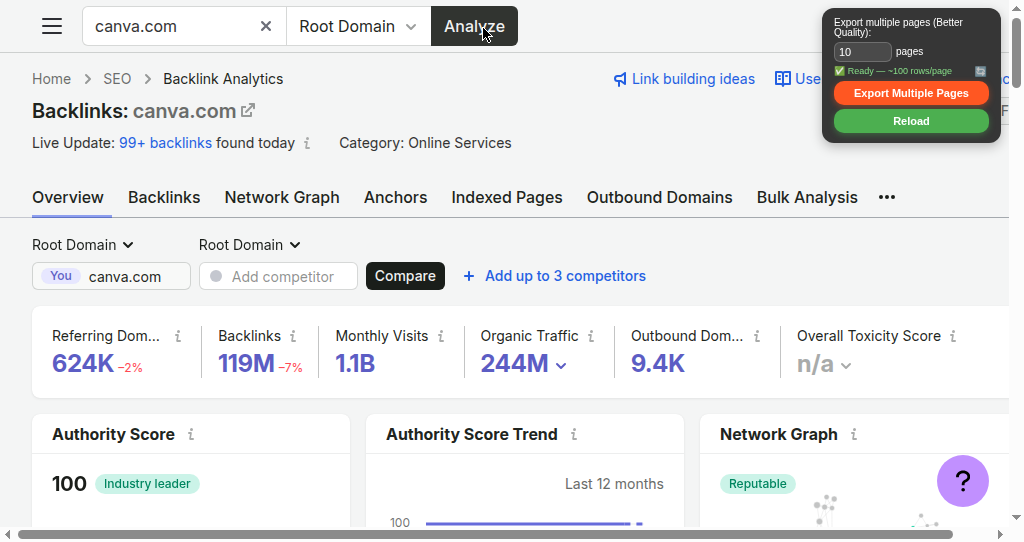
I pulled Canva’s backlink profile in Semrush. Canva isn’t an SEO company. They don’t “do link building” the way agencies do. They do product, they do PR, they get covered — and their link profile is a monster.
The headline numbers
Stare at these for a second:
- Authority Score: 100 — literally the maximum. Semrush labels it “Industry leader.”
- Referring domains: 624,000
- Backlinks: 119 million
- Organic search traffic: 244 million visits
- Monthly visits: 1.1 billion
What the anchors reveal
The anchor text profile tells the real story. Canva’s top anchors:
- “canva” — 4.1 million backlinks from 143,837 domains. That’s branded anchors at a scale most companies will never see. People link to Canva by name because journalists and bloggers write about Canva.
- Empty anchors (image links) — 25.8 million backlinks from 148,805 domains. Product screenshots, embedded designs, press images.
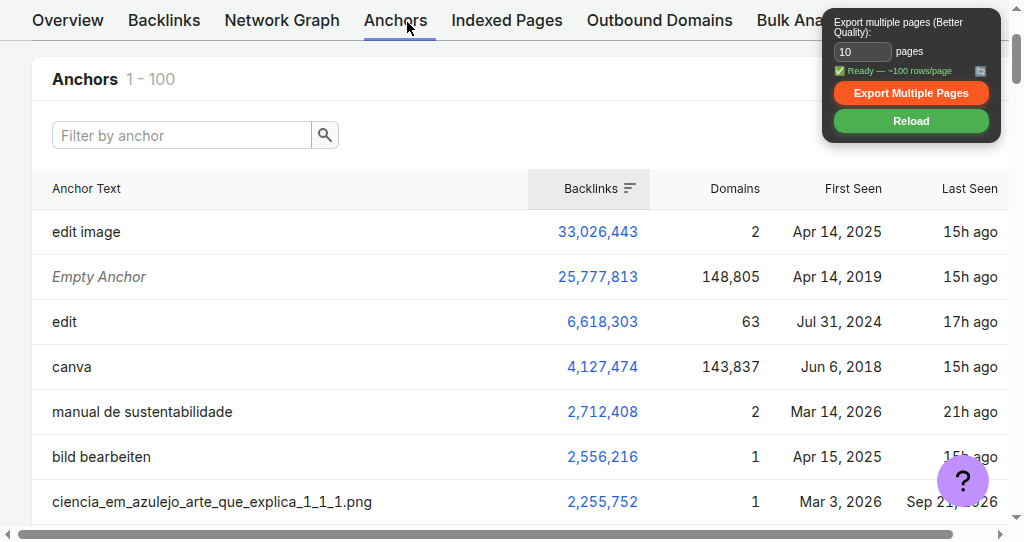
Now compare that to a typical “built” link profile — exact-match keyword anchors, shady directories, comment spam. Canva’s profile screams one thing: real publications writing about a real company.
The editorial proof
Here’s my favorite row in their backlink table: a16z.com (Andreessen Horowitz, one of the most respected VC firms on earth) linked to Canva with the anchor “Canva” in their “Top 100 Gen AI Consumer Apps” feature. That’s not a link anyone built. That’s a journalist-grade editorial team deciding Canva belonged in the story.
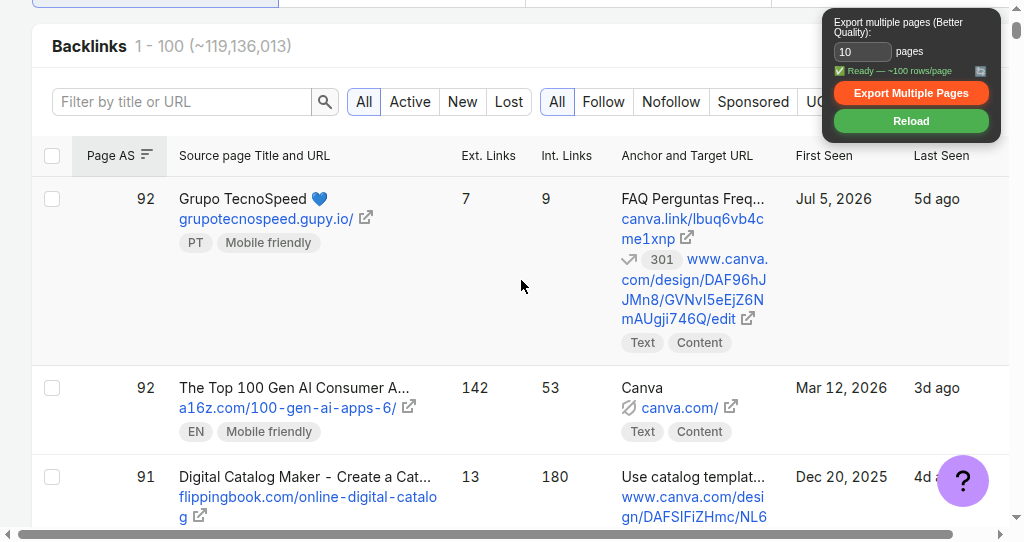
The numbers behind the prestige
- 122 referring domains with Authority Scores of 91–100. One hundred twenty-two of the most powerful sites on the internet.
- 1,500+ Mass Media domains linking in. That’s the press footprint.
- 95% follow rate on 119M links. Editorial links are overwhelmingly followed.
Where the links come from
Canva’s referring domains break down by category: Education 23%, Mass Media 15% (1,500+ domains), Online Services 11%, plus government and software domains. That Mass Media slice is the digital PR footprint — thousands of publications that decided Canva was worth mentioning.
Their most-linked pages tell the same story: the homepage has 152,092 referring domains pointing at it. Not a blog post engineered for links — the homepage. When press covers you, they link your front door.
The honest footnote
I’ll be straight with you: Canva’s raw totals are inflated by automated design-embed links (their “edit image” buttons generate millions of links from a handful of domains). Strip those away and the editorial core remains absurdly strong. The lesson isn’t “get 119M links.” It’s this: when you become newsworthy, links arrive at a scale no manual campaign can match.
Real talk: Canva didn’t get 624K referring domains by sending outreach emails. They got them by building something journalists wanted to write about, then making sure journalists noticed. That’s the entire game.
Chapter 4: 7 Digital PR Strategies That Actually Earn Links in 2026
These aren’t theoretical. Every one of these has earned real editorial links for real brands. Pick the ones that fit your resources.
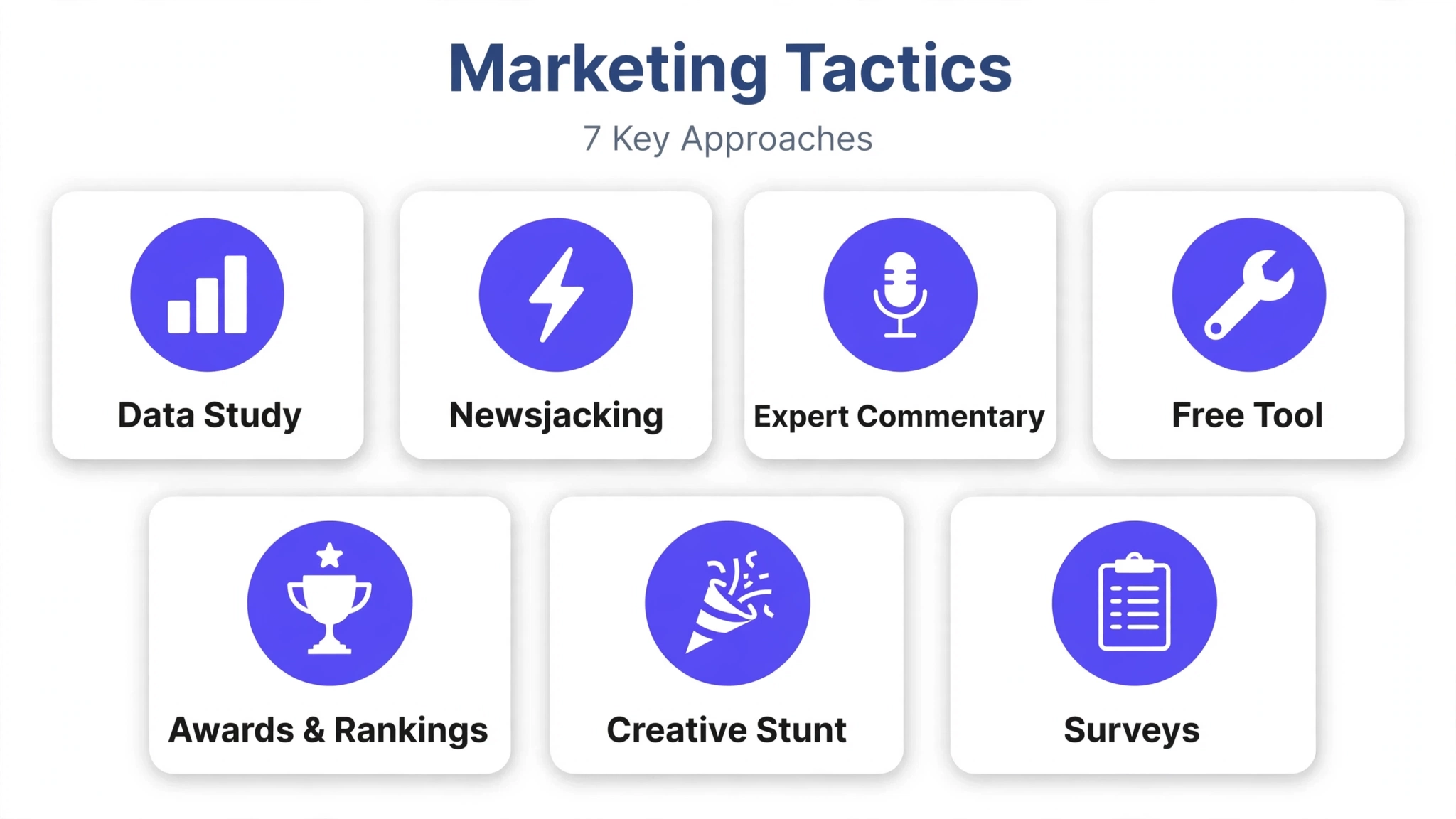
Strategy 1: The data study
What it is: Original research — a survey, a dataset analysis, an industry report — packaged for journalists.
Why it works: Journalists are desperate for fresh statistics. “According to a new study…” is the most-linked sentence format in journalism. Data is the closest thing to a guaranteed link in digital PR.
How to do it: Survey 500–1,000 people in your niche; or analyze your own proprietary data; package findings as 5–7 headline-ready stats; build a landing page with embeddable charts.
Real talk: the data doesn’t need to be groundbreaking. It needs to be new and specific.
Effort: High. Payoff: Highest.
Strategy 2: Newsjacking
What it is: Attaching your brand’s expertise or data to a breaking news story — fast.
Why it works: Journalists writing breaking stories need expert quotes today.
How to do it: Set up news alerts for your niche; draft 2–3 quotable sentences within 2–4 hours of a big story; email journalists already covering it. Speed beats polish.
Effort: Low per attempt. Payoff: High (but unpredictable).
Strategy 3: Expert commentary (HARO-style pitching)
What it is: Responding to journalist requests for expert sources on platforms like HARO, Terkel, Featured, and Qwoted.
Why it works: The journalist has already decided to write the story — they just need a voice.
How to do it: Sign up for 2–3 source platforms; respond within 1–2 hours; write the quote as publishable copy; include a one-line bio.
Real talk: journalists want 2–3 punchy sentences, not your life story. Shorter = more pickups.
Effort: Low. Payoff: Medium-High.
Strategy 4: The free tool or calculator
What it is: A genuinely useful free tool that journalists reference in “best tools” roundups.
Why it works: Roundup articles are link machines, and they need tools to list.
How to do it: Find “best tools for [niche]” articles; build a simple calculator, checker, or generator; pitch the roundup authors.
Effort: Medium-High. Payoff: High (links compound for years).
Strategy 5: Awards and rankings
What it is: Creating your own industry award, ranking, or “top 100” list.
Why it works: Everyone who makes the list shares it. Everyone who doesn’t argues about it. Both generate links.
How to do it: Define clear criteria; notify everyone featured before publishing with badges and embed codes; pitch it to niche press.
Effort: Medium. Payoff: High.
Strategy 6: Creative campaigns and stunts
What it is: Something unusual, funny, or provocative designed to be covered.
Why it works: Boring doesn’t get links.
How to do it: Find the tension in your niche; lead with visuals; time it to a relevant moment.
Real talk: high-variance — most stunts flop, but one hit can outperform a year of guest posting.
Effort: Medium. Payoff: Volatile (low or massive).
Strategy 7: Original surveys and polls
What it is: The data study’s scrappy younger sibling — quicker, cheaper, still newsworthy.
Why it works: “New survey finds…” is catnip for journalists.
How to do it: Ask 5–10 sharp questions; lead with the counterintuitive result; slice the data three ways for three story angles.
Effort: Medium. Payoff: High.
Chapter 5: How to Find Newsworthy Stories in Any Business
“But my business is boring.” I hear this constantly. Here’s the truth: boring businesses get press all the time — because newsworthiness isn’t about your industry, it’s about your angle.
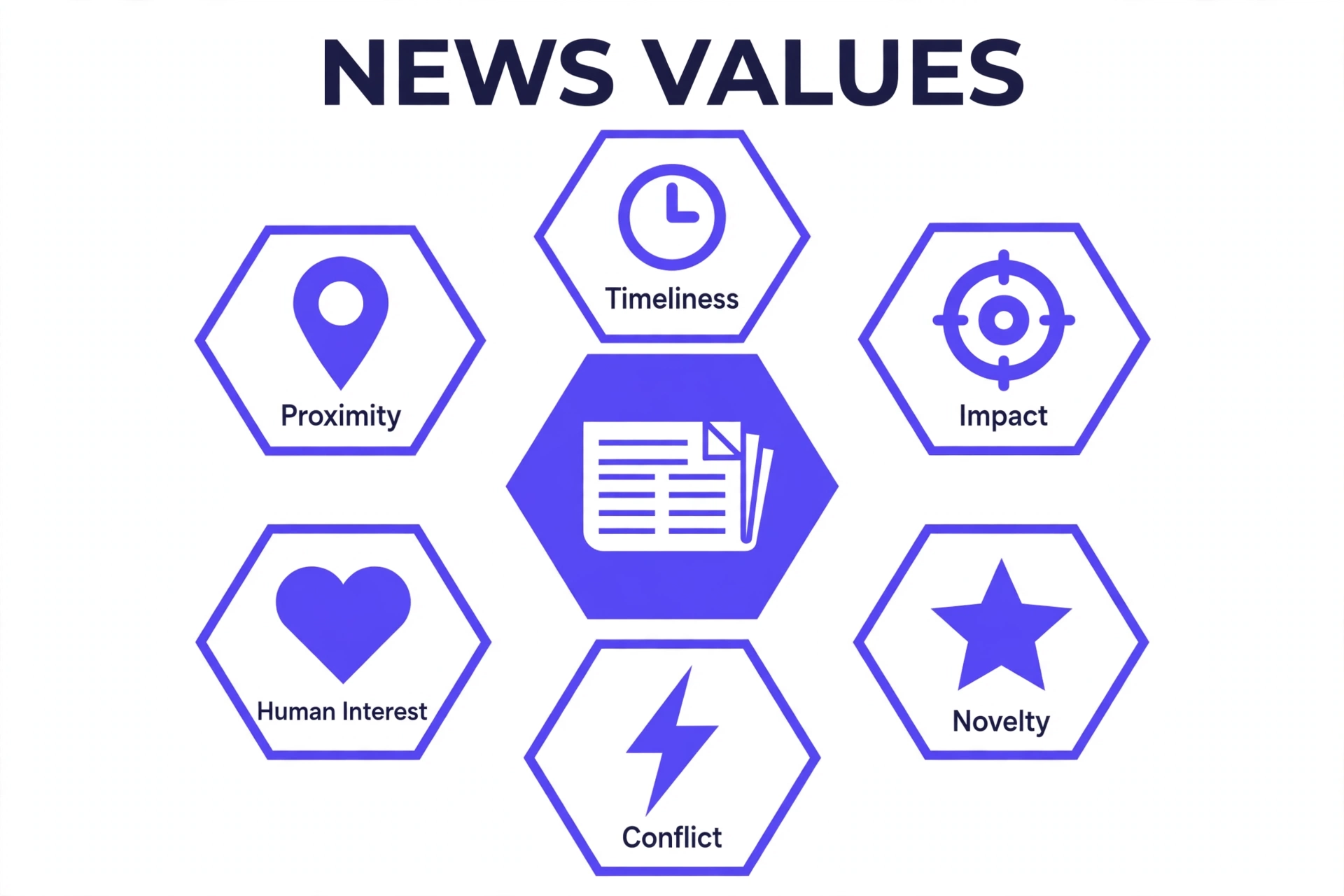
The 6 news values (memorize these)
Journalists decide what’s newsworthy using instincts you can learn. Every story that earns links hits at least one of these:
- Timeliness — tied to something happening now.
- Impact — affects lots of people or lots of money.
- Novelty — surprising, weird, first-of-its-kind.
- Conflict — challenges conventional wisdom or a big player.
- Human interest — real people, real stories.
- Proximity — local angle for local press.
Before pitching anything, score your story against this list. Zero hits? Go back to the drawing board. Two or more? You’ve got something.
The “boring business” playbook
Sell insurance? Survey 1,000 drivers about their weirdest road habits. Run a plumbing company? Analyze which cities have the most emergency callouts. B2B software? Publish salary data for your niche.
The pattern: take your internal data or expertise, aim it at a consumer question, and suddenly the boring business has the most interesting story in the room.
Mine your own backyard
The best stories are usually sitting inside your company already: customer data, founder stories, contrarian opinions, milestones with meaning.
The seasonality calendar
Plan campaigns around predictable news moments: New Year predictions, tax season surveys, back-to-school, Black Friday spending data, awards season. Journalists plan these stories weeks ahead — pitch early.
Digital PR by Niche: SaaS, E-commerce, Local & More
Digital PR isn’t one-size-fits-all. The stories that earn links in SaaS fall flat in local plumbing. Here’s how to aim it per niche.
SaaS digital PR
SaaS companies sit on product usage data — the single best raw material for digital PR. Best plays: data studies, industry benchmarks, free micro-tools. Target: TechCrunch, The Verge, SaaS Mag, niche vertical press.
E-commerce digital PR
E-commerce brands win with consumer data and creativity — gift guides, seasonal surveys, weird product stories. Target: lifestyle publications, deal and roundup sites, local news.
Local business digital PR
Local press is starving for local stories — and local links move local rankings fast. Best plays: community data, charity tie-ins, local rankings. Target: city newspapers, local TV sites, neighborhood blogs.
iGaming, adult & other tough niches
Mainstream press won’t touch some niches — so aim at industry press and adjacent verticals. Best plays: industry data reports, expert commentary in trade publications, affiliate co-marketing studies. Real talk: in restricted niches, one link from the #1 trade publication beats ten mainstream mentions you were never going to get anyway.
Chapter 6: The Media Pitch — Anatomy of a Pitch That Gets Opened
Your story can be brilliant and still die in an inbox. The pitch email is where campaigns live or die. Here’s the anatomy of one that works.
Subject lines: 6 words or fewer
Journalists get hundreds of pitches daily. Your subject line has one job — earn the open. Lead with the story, not your brand. No clickbait. Never use “story idea” or “press release.”
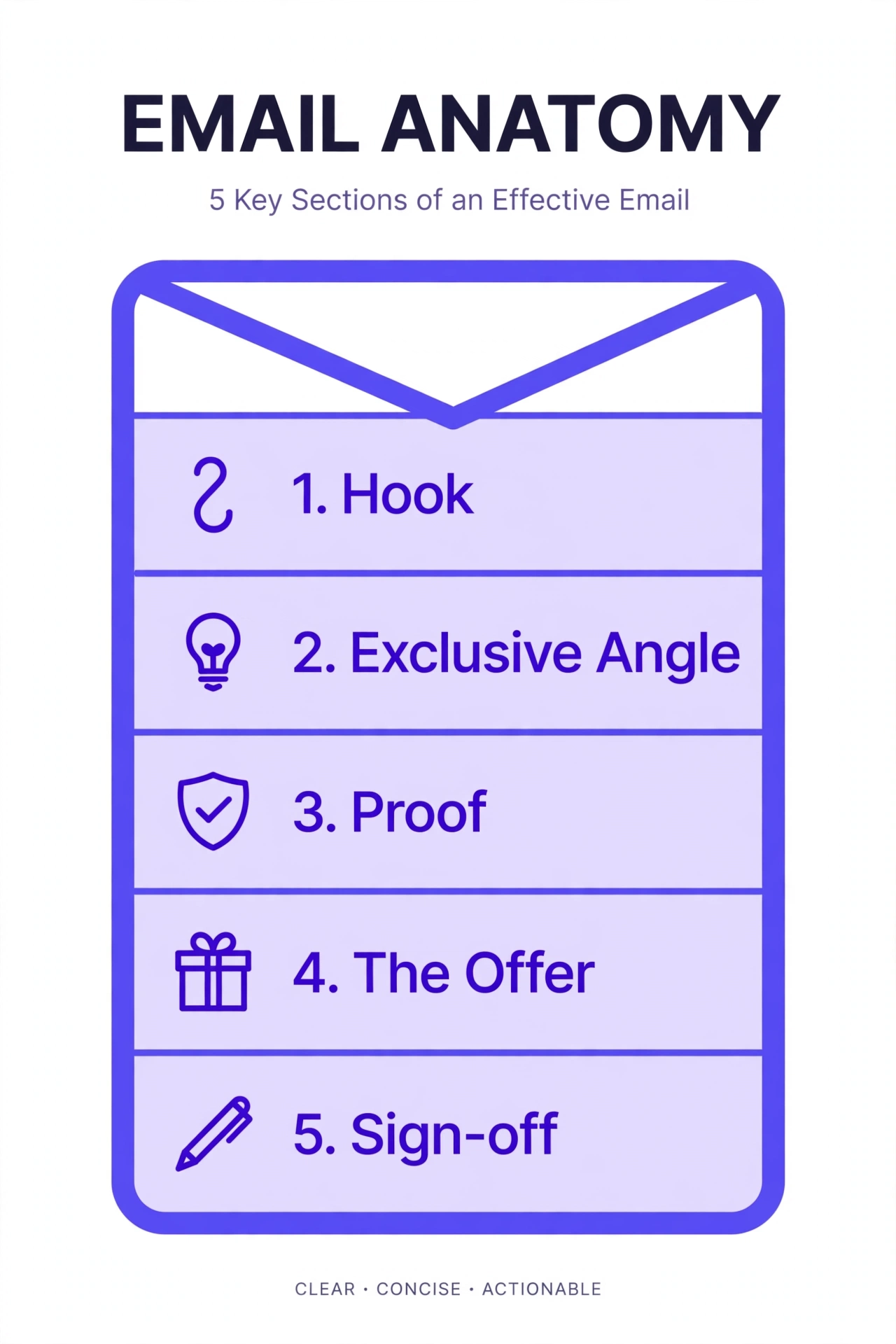
The 5-part pitch structure
1. The hook (1–2 lines). Why this story, why now. 2. The exclusive angle (2–3 lines). What’s new — the stat, the finding, the twist. 3. The proof (1 line + link). Link to your landing page or data. 4. The offer (1 line). Offer the dataset or an interview. 5. The sign-off (2 lines). Name, title, company, phone.
Total length: under 150 words. If your pitch needs scrolling, it’s too long.
Personalization that isn’t fake
“I loved your recent article” is the “Dear Sir/Madam” of PR. Real personalization: reference a specific story they wrote, pitch the right desk, match their format. Real talk: 10 deeply personalized pitches beat 500 spray-and-pray emails. Every time.
Timing: when to hit send
Tuesday–Thursday mornings get the best open rates. Never pitch Friday afternoon. For newsjacking, speed beats everything. For features, pitch 2–3 weeks ahead.
What never to do
Don’t attach files — link instead. Don’t follow up the same day. Don’t pitch rival journalists at the same publication simultaneously. Don’t lie about exclusivity.
Two pitch templates that work
Template 1: The data study pitch. Subject: 73% of [audience] admit [surprising finding]. Body: Hi [Name], saw your recent piece on [topic]. We just surveyed 1,000 [audience] and found [one surprising stat]. Full findings + charts here: [link]. Happy to share the raw dataset or set up a call with [spokesperson]. Best, [Your name]
Template 2: The newsjack quote. Subject: Quick quote on [breaking story]? Body: Hi [Name], following your coverage of [story] — I’m [title] at [company], here’s a take: “[2-3 punchy sentences.]” Happy to expand. [Your name], [phone]
Short, specific, and the journalist’s job is already half done.
Chapter 7: Journalist Outreach — Finding Them and Following Up
Where to find the right journalists
Google News search your topic and note repeat authors. Follow beats on Twitter/X. Check publication author pages by desk. Tools: Muck Rack, Prowly, Roxhill. Quality rule: 50 relevant journalists beat 5,000 database contacts.
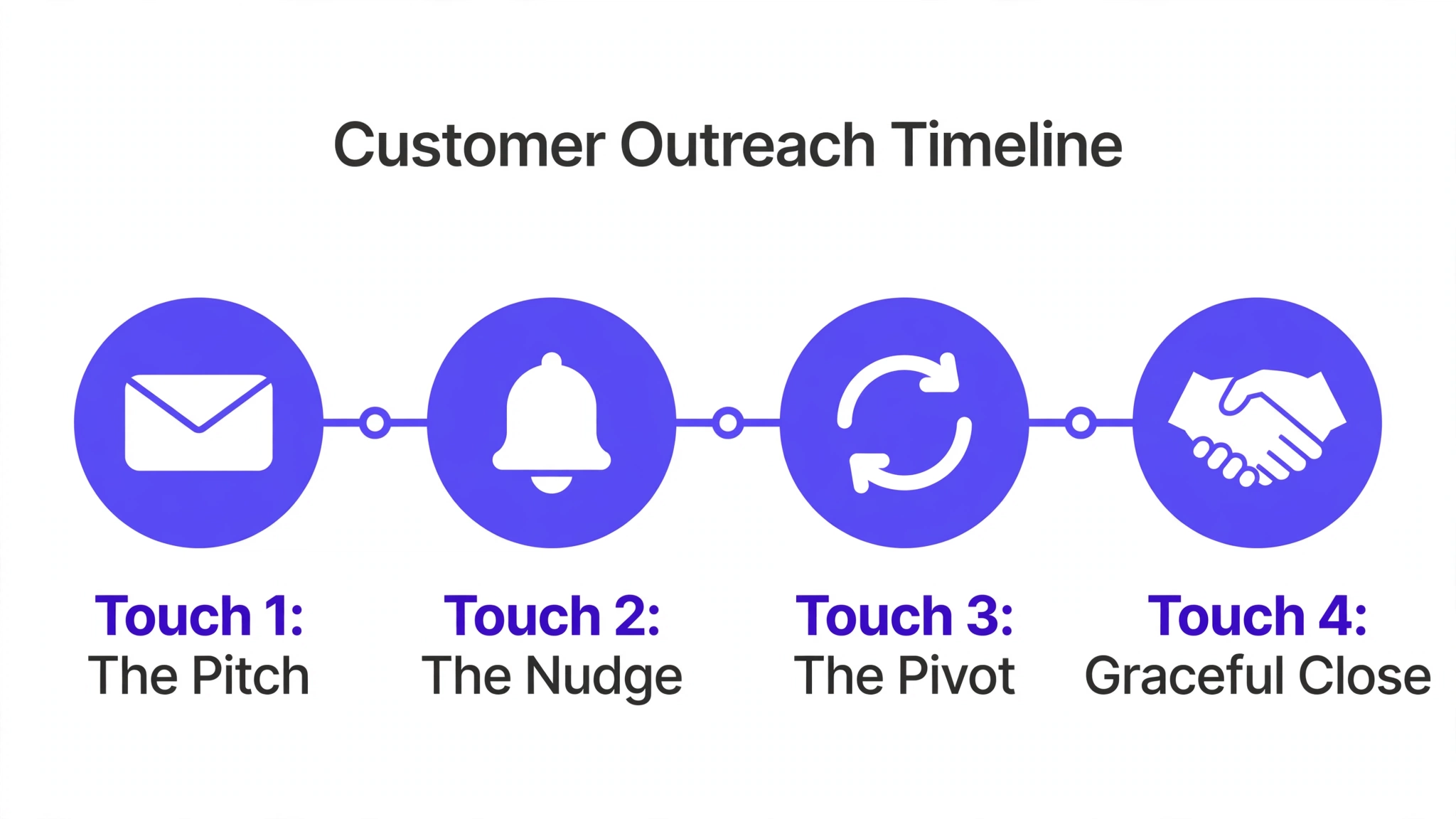
The 4-touch follow-up framework
Touch 1 — The pitch (Day 0). Touch 2 — The nudge (Day 3–4). Add something new — never “just checking in.” Touch 3 — The pivot (Day 7–8). Offer a different angle. Touch 4 — The graceful close (Day 12–14). Keep the relationship warm for next time.
After touch 4, stop. Move on.
Building relationships, not transactions
The dirty secret of digital PR: the best practitioners barely pitch. They feed 20–30 journalist relationships useful material consistently. Give three times before you ask once.
Chapter 8: Measuring Digital PR — Metrics That Actually Matter
Vanity metrics vs. money metrics
Kill the sacred cows: impressions/reach (inflated), AVE (fiction), social shares (not a business outcome).
What to measure instead
Referring domains earned (the core KPI), authority of those domains, follow vs. nofollow split, referral traffic, branded search lift, rankings movement at 30/60/90 days, syndication multiplier.
The reporting template
One page per campaign: pitches sent → responses → features → total links; top 5 placements; total referring domains + average authority; referral traffic + branded search lift; cost per link.
Real talk: report cost-per-authority-point instead of cost-per-link, and digital PR wins the budget argument.
Attribution honesty
Don’t claim your campaign alone caused a ranking jump. Report the correlation, show the timeline, let the pattern speak.
Your First Campaign: The 6-Week Timeline
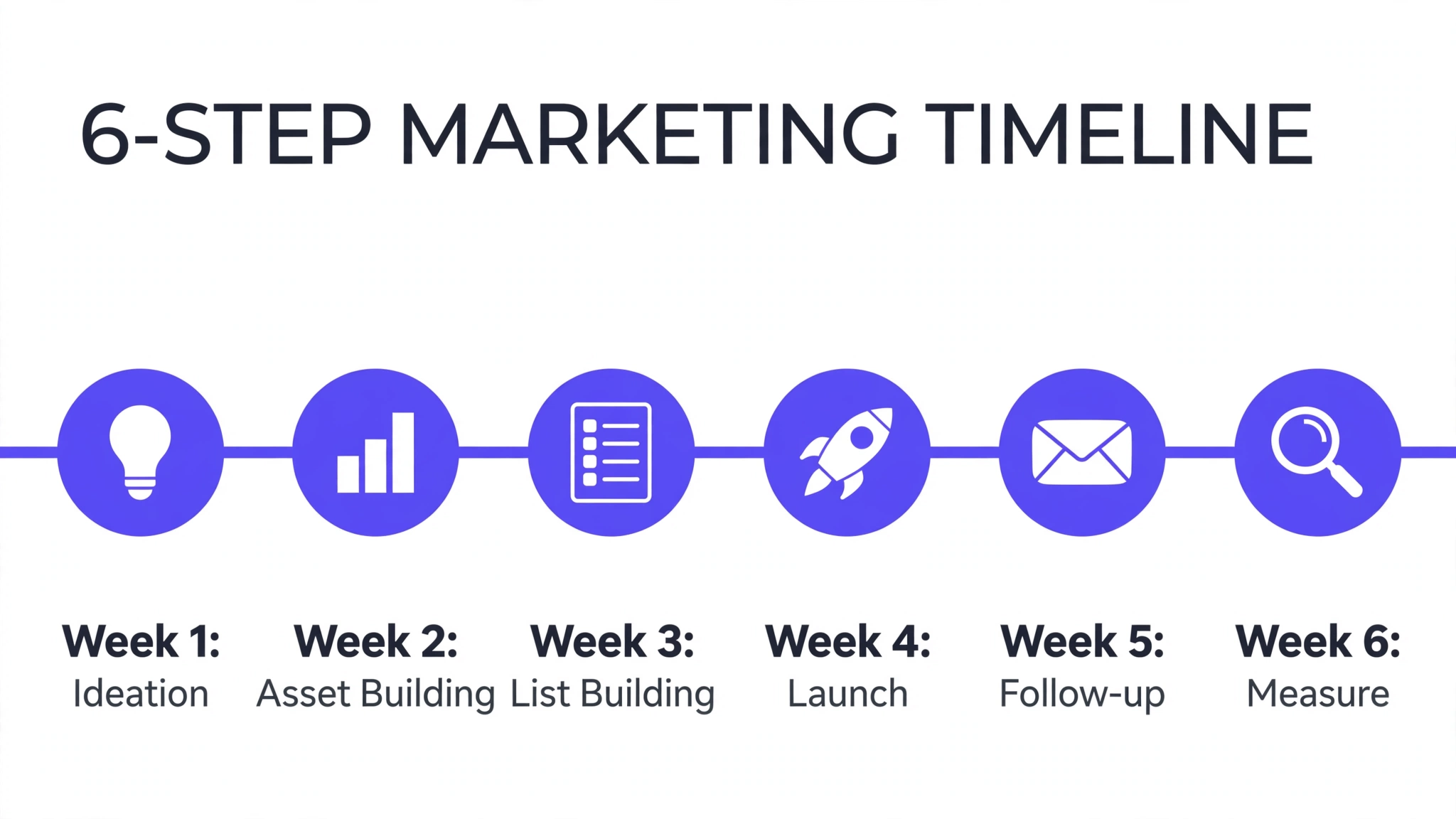
Week 1: Ideation. Brainstorm 5–10 ideas, score against the 6 news values, pick ONE winner. Week 2: Asset building. Run the survey or build the tool; get the landing page live. Week 3: List building. 50–100 journalists who cover this beat. Week 4: Launch. Pitch Tuesday–Thursday morning. Week 5: Follow-up + syndication. “As covered in [publication]…” Week 6: Measure + systematize. Save everything as templates.
The tools stack (2026)
Surveys: Pollfish, Prolific, Google Forms. Journalist finding: Muck Rack, Prowly. Outreach: BuzzStream, Pitchbox. Monitoring: Google Alerts, Mention. Reporting: Semrush/Ahrefs, Google Search Console. Real talk: tools don’t earn links — stories do.
Chapter 9: What Digital PR Actually Costs in 2026
The DIY route
Survey/data: $300–$2,000. Media database: $0–$300/month. Landing page + visuals: $0–$500. Your time: 20–40 hours per campaign. DIY total: roughly $500–$3,000 per campaign. Realistic output: 3–15 links per campaign for a first-timer.
The agency route
Freelancers: $1,500–$4,000 per campaign. Boutique agencies: $4,000–$10,000/month. Big agencies: $10,000+/month. What you’re buying: journalist relationships, creative ideation, execution bandwidth.
Digital PR vs. buying links — the risk math
Buying links is faster and cheaper per link — and it’s what Google explicitly calls a link scheme in its spam policies. Digital PR links are essentially penalty-proof by construction: there’s nothing to detect. One manual action can erase years of bought-link gains overnight. When finance asks why PR costs more — you’re buying immunity.
The math that justifies it
Compare cost per authority-weighted link, not cost per link. A $5,000 campaign earning 10 links averaging AS 65 crushes fifty $100 guest posts on AS 25 blogs. Real talk: in low-competition niches guest posting might be enough. Digital PR earns its keep where authority gaps decide rankings.
Chapter 10: 7 Mistakes That Kill Digital PR Campaigns
Mistake 1: Pitching your product, not a story
“We launched a feature” is not news. Wrap the product in a story — or don’t pitch at all.
Mistake 2: Targeting the wrong journalists
One irrelevant pitch can end a relationship before it starts. Match the beat, every time.
Mistake 3: Burying the lead
Lead with the single most surprising thing. Everything else is supporting cast.
Mistake 4: No asset behind the pitch
Have the page, the charts, and the methodology live before the first email goes out.
Mistake 5: Giving up after one email
Most coverage comes from follow-ups. One pitch and silence is an incomplete campaign.
Mistake 6: Ignoring nofollow reality
A nofollow link from a major news site still drives traffic, brand searches, and secondary followed links. Don’t turn down coverage over link attributes.
Mistake 7: Measuring like it’s 2015
Report referring domains, authority, traffic, and ranking movement — the language the business speaks.
Bonus mistake: Treating digital PR as a one-off
The brands winning at digital PR run a program — one story per quarter, minimum. Journalist relationships compound like interest.
Turn One Campaign Into Three (The Multiplier)
Repurpose 1: The data → the report → the tool. One dataset becomes a press story, an industry report PDF, and an interactive calculator. Repurpose 2: Slice by segment. National angle for national press, regional cuts for local press, industry cuts for trade press. Repurpose 3: The annual edition. Journalists who covered year one expect year two.
Real talk: one good idea, executed three ways, beats three mediocre ideas every time.
Digital PR and E-E-A-T: Why Google Trusts Press Links
Google’s Search Quality Rater Guidelines talk about E-E-A-T: Experience, Expertise, Authoritativeness, Trustworthiness. Digital PR feeds all four. Press mentions strengthen your brand as an entity in Google’s Knowledge Graph — the hidden compounding return that never shows up in a link count.
Real talk: brands with strong press footprints outrank equally-optimized competitors. The mechanism barely matters — the outcome does.
A brief history: how we got here
Digital PR was born around 2012–2014, when SEOs realized traditional PR tactics could be aimed at links. Infographics died, the industry grew up: real data, real stories, real journalism. The 2026 version looks more like a newsroom than a link farm — and that’s exactly why it still works.
When Digital PR Is the Wrong Move (Honest Talk)
Skip it when: your site has technical SEO fires (fix the foundation first — that’s what a proper audit is for); you need links this month (digital PR is a 6–12 week play); you have no story and no budget for data; your niche has zero press. Notice what’s not on this list: “we’re too small.”
Don’t Be the 99%
Here’s the uncomfortable truth: 99% of businesses will never do digital PR. They’ll keep buying the same guest posts, from the same vendors, on the same networks — and wonder why nothing changes.
The 1% will do the harder thing. They’ll run the survey. They’ll write the 150-word pitch. They’ll follow up three times. And one morning they’ll wake up to a link from a publication their competitors can’t even email.
Canva didn’t get 624,000 referring domains by accident. They became worth writing about. That’s a choice — and it’s available to you too.
Start small. One data study. Fifty personalized pitches. Measure everything. Then do it again, better.
The links are out there. Go earn them.
Keep Reading
- White Hat Link Building: The Complete 2026 Guide — the full playbook this strategy fits into.
- Free Website Audit — find out if your link profile is ready for digital PR.
Frequently Asked Questions
What is digital PR in link building?
Digital PR is the practice of creating newsworthy stories, data studies, or assets and pitching them to journalists and online publications to earn editorial backlinks. Unlike traditional PR, which targets brand awareness, digital PR specifically aims to earn high-authority referring domains that improve search rankings.
How is digital PR different from traditional link building?
Traditional link building asks website owners for links directly (guest posts, outreach, niche edits). Digital PR earns links indirectly by creating something journalists want to cover — data, stories, tools, or campaigns. The links come from editorial decisions, not link requests, which makes them harder to earn but far more powerful.
How long does digital PR take to show results?
A typical digital PR campaign runs 4-8 weeks from ideation to coverage. Links usually start appearing 2-6 weeks after pitching begins. Ranking impact follows 1-3 months later as Google discovers and values the new referring domains. It’s slower than buying links but the results compound.
How much does digital PR cost?
DIY digital PR costs roughly $500-$3,000 per campaign plus 20-40 hours of work. Freelancers charge $1,500-$4,000 per campaign, boutique agencies $4,000-$10,000/month. Measure cost per authority-weighted link rather than cost per link — digital PR usually wins on that metric in competitive niches.
Do digital PR links help SEO?
Yes. Digital PR earns editorial backlinks from high-authority news and industry publications — exactly the link type Google’s algorithms reward most. These links are nearly impossible to manipulate at scale, which is why they carry exceptional ranking power compared to guest posts or directory links.
Can small businesses do digital PR?
Absolutely. Digital PR rewards creativity and data, not budget. A small business with original survey data or a contrarian industry take can earn the same caliber of press links as a large brand. Start with expert-commentary pitching (HARO-style platforms) and one small data study — both are low-cost entry points.