White Hat Link Building: The Complete 2026 Guide
Let me tell you a secret about link building.
Most people treat it like a chore — like flossing. They know they should do it. They buy a course, send 12 emails, get zero replies, and quietly give up.
Then they watch a competitor — with worse content, uglier design, half the effort — outrank them for every keyword that matters. And they have no idea why.
Here’s why: backlinks are still the closest thing SEO has to a cheat code. Not a hack. Not a loophole. A cheat code — the kind that works because Google wants it to work.
I’ve spent years in the trenches building links — the outreach, the rejections, the 2 AM “holy grail, we got the link” moments. This guide is everything I know, no fluff, no theory from someone who’s never sent a pitch email in their life.
You’re getting real Semrush data, Google’s actual rules translated into human language, 15 battle-tested strategies, and the exact outreach framework I use. Buckle up — this is the long one, and it’s worth it.
Chapter 1: What White Hat Link Building Actually Is
Quick definition, then I’ll show you the good stuff:
White hat link building = earning backlinks the way Google wants you to. Real outreach. Real content. Real relationships. Real press coverage.
What it’s not: buying 500 links for $50, running a private blog network from your basement, or blasting automated comments across the internet like it’s 2009.
Simple enough. But here’s where it gets interesting — Google has literally written down where the line is. Most people just never bother reading it.
What Google Actually Says (In Human Language)
Google’s spam policies are public. They’re dry. I’ve read them so you don’t have to. Here’s what matters:
Paid links aren’t automatically evil. Google gets it — buying and selling links is normal web economics (ads, sponsorships). The rule? If money changed hands, the link must carry rel="nofollow" or rel="sponsored". Pay for a link that secretly passes ranking credit, and congratulations — that’s link spam.
Mass article campaigns are a red flag. Google specifically calls out publishing keyword-stuffed articles across tons of sites just to build links. Their message to sites accepting these: vet your contributors. Is this person actually knowledgeable? Is the content genuinely useful? If not, you’re part of the problem.
And Google’s ultimate link building advice? Make your content better, and links will follow. (Yeah, I know — easier said than done. That’s what the rest of this guide is for.)
Why This Matters MORE in 2026 (The AI Plot Twist)
Here’s the plot twist nobody saw coming: AI made white hat link building more valuable, not less.
Think about it. Anyone with a laptop can now generate 500 articles before lunch. Content isn’t scarce anymore — it’s a flood. So when everyone has “great content,” how does Google decide who to trust?
It looks for the signal that’s hardest to fake at scale: a diverse profile of editorial backlinks from real, independent websites.
You can generate infinite articles. You can’t generate thousands of real publishers independently deciding to vouch for you. That’s the moat. That’s why the sites winning in 2026 aren’t the ones publishing the most — they’re the ones trusted the most.
Proof: What 434,000 Websites Vouching for You Looks Like
Enough theory. Let me show you receipts.
I pulled up hubspot.com in Semrush’s Backlink Analytics. HubSpot practically invented inbound marketing — their backlink profile is what decades of doing content right looks like:
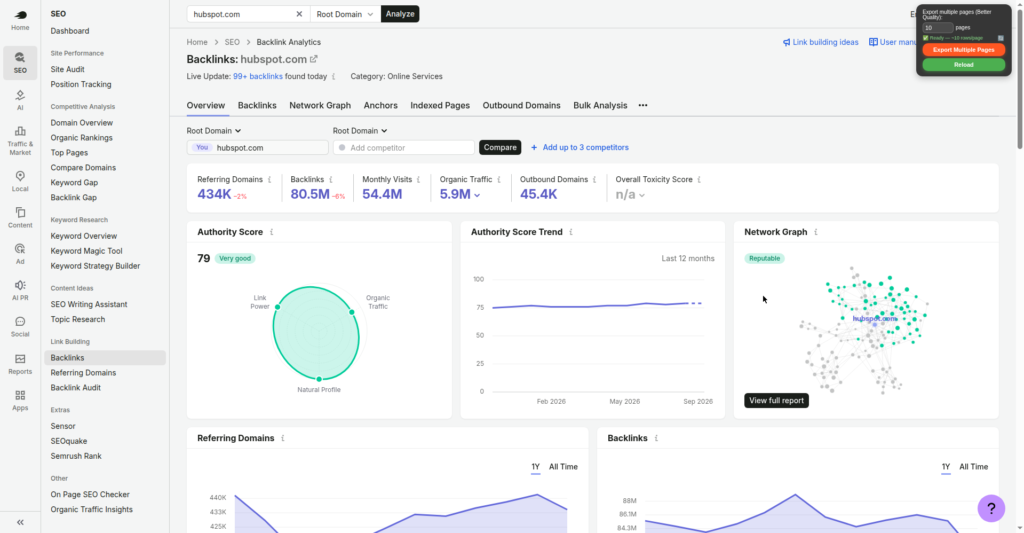
Let that sink in: 434,000 referring domains. Authority Score of 79 — “Very good.” 5.9 million monthly organic visitors.
Nobody bought that. Nobody hacked that. Hundreds of thousands of independent publishers looked at HubSpot’s content and thought: “my readers need to see this.” That’s white hat link building at scale — thousands of tiny editorial decisions, compounding over years.
The takeaway? Every backlink is a vote. White hat link building is the art of earning votes you actually deserve — and there’s no shortcut to being voteworthy.
Chapter 2: How to Spot a White Hat Backlink
Here’s a skill that’ll save you thousands of dollars: learning to tell a great backlink from garbage in 30 seconds flat.
After auditing hundreds of link profiles, I’ve boiled it down to 5 signs. Master these and you’ll never waste money on a bad link again.
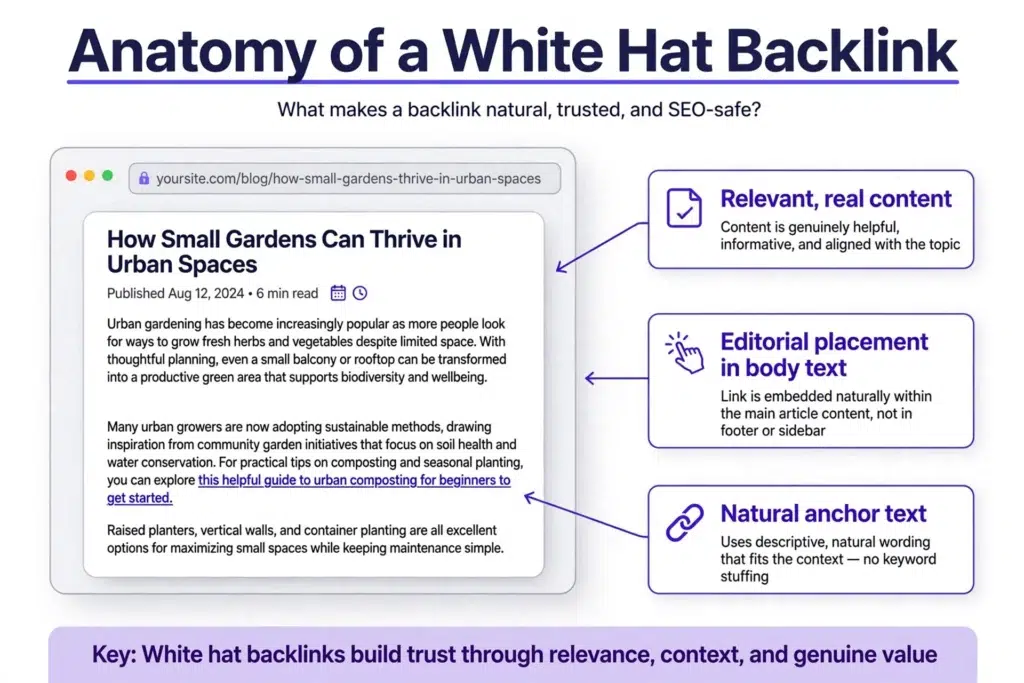
Sign 1: A Human Editor Put It There on Purpose
The link lives inside the body of a real article — placed by someone who thought “this will help my readers.” Not buried in a footer. Not crammed in a sidebar. Not in some author bio that reads like a keyword salad.
My 5-second test: remove the link mentally. Does the article still make sense? If yes — editorial. If the entire article exists only to host that link — you’ve found a link farm with extra steps.
Google’s gotten scary good at understanding page structure, by the way. Footer and sidebar links? Barely a whisper compared to an in-content editorial link. And those “500 backlinks!” from one site’s footer? Google consolidates them. You’re getting credit for one.
Sign 2: It Actually Makes Sense Topically
A fitness blog linking to a protein brand? Natural. That same fitness blog linking to an online casino? That’s not a backlink — that’s a cry for help.
Relevance works on three levels, and the best links nail all three:
- Domain relevance: the site itself covers your world
- Page relevance: the specific article is about something adjacent to yours
- Contextual relevance: the paragraph around your link is discussing exactly what you’re being cited for
One link with triple relevance will outperform five random links every single time. When I’m evaluating a placement, relevance is the first filter — before authority, before traffic, before anything. A relevant DR 30 beats an irrelevant DR 70. Fight me.
Sign 3: The Anchor Text Looks Human (Real Data Inside)
This is where most link builders get exposed. Ready for something wild?
Same Semrush analysis of hubspot.com. Look at their top anchors:
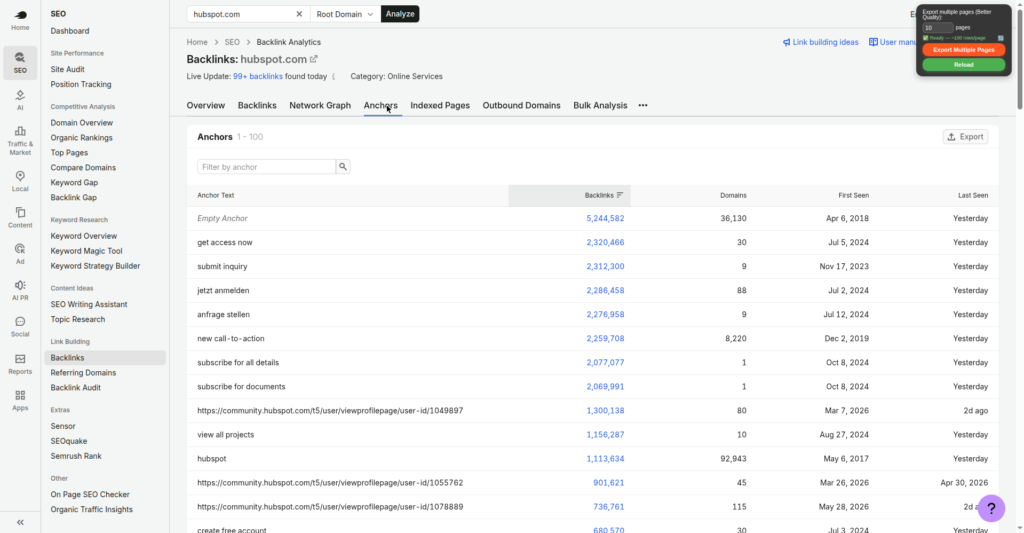
“Empty Anchor” — 5.2 million backlinks. (That’s image links with no text at all.) Then “get access now” (2.3M) and “submit inquiry” (2.3M) — button text from HubSpot’s embedded forms living on other people’s websites. The branded anchor “hubspot” has 1.1 million backlinks from 92,943 domains.
See what’s not there? “Best CRM software 2026.” “Top marketing platform.” Zero keyword stuffing.
Real anchor profiles are gloriously messy — empty anchors, button text, brand names, raw URLs, “click here.” Because that’s how actual humans link. If your anchor profile reads like a keyword research spreadsheet, Google knows exactly what you did.
Sign 4: The Linking Page Has a Pulse
A link from a page nobody visits is like a billboard in the desert. Technically it exists. Practically? Nobody’s seeing it — including Google’s quality signals.
Before I get excited about any placement, I check two things:
- Does the domain get real organic traffic? (Instantly kills 90% of PBNs and dead blogs.)
- Does the specific page rank for anything or get visits? (A link on a ranking page is worth 10x one on an orphan page nobody reads.)
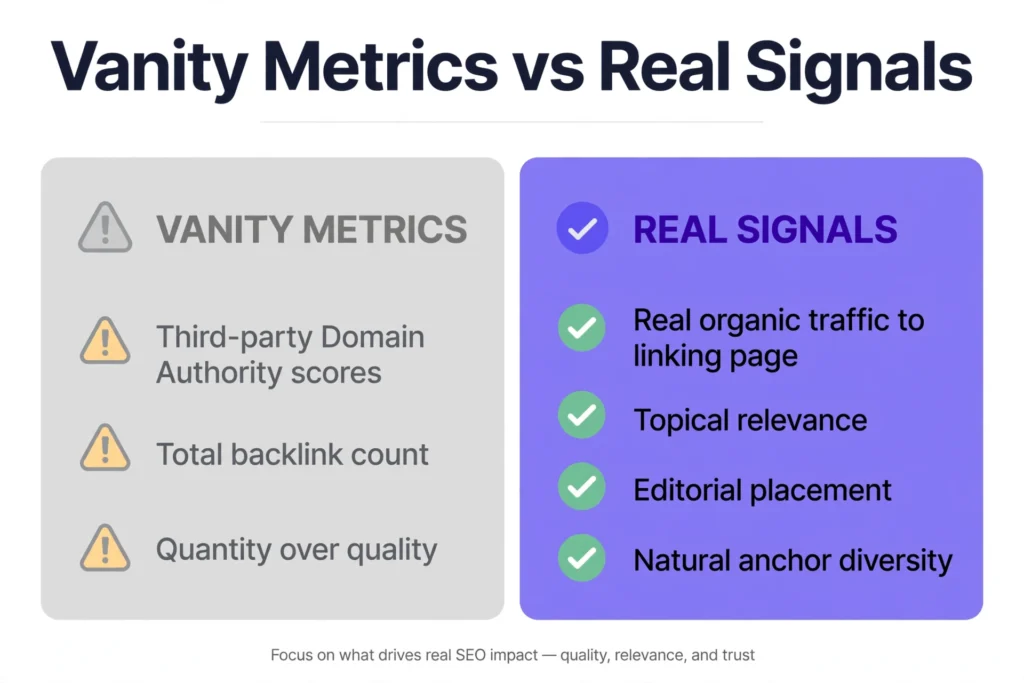
And please — stop worshipping Domain Authority. DA, DR, AS — they’re estimates made by SEO tools, not Google. A “DA 30” site with 50,000 real monthly visitors in your niche will crush a “DA 60” ghost town every time. Traffic and relevance first. Vanity metrics last.
Sign 5: It Arrived One by One, Not by the Truckload
White hat links accumulate like snowfall — a few here, a few there, gradually building up. They don’t arrive like an avalanche on a Tuesday.
Dead giveaways of manufactured links:
- 200 links appearing in a single week from unrelated sites
- Identical anchor text across dozens of domains (“someone copy-pasted”)
- Linking sites with zero topical connection to you
- Domains sharing IPs, templates, or ownership footprints (hello, PBN)
Someone offering “500 DA 50+ backlinks for $50” isn’t selling you SEO. They’re selling you a future penalty — or more likely, links Google will simply ignore while you light money on fire.
Bonus: Audit Your Own Profile in 5 Steps
Before building a single new link, know where you stand. Here’s my exact process:
Step 1: Pull everything. Semrush, Ahrefs, or Google Search Console’s free Links report. Export it all.
Step 2: Interrogate your anchors. Sort by anchor text. If exact-match money keywords exceed ~10-15%, you’ve got a risk flag. The fix isn’t panic — it’s dilution: earn branded and natural anchors going forward.
Step 3: Hunt for junk domains. Zero traffic? Irrelevant topic? Foreign spam? Obvious PBN? A couple of junk links won’t kill you — Google’s SpamBrain ignores most automatically. Patterns will.
Step 4: Check your velocity. 200 links in one month, then silence for a year? That spike deserves an explanation.
Step 5: Disavow only if you must. Google’s disavow tool is for manual penalties or massive spam patterns you can’t remove. For most sites? Unnecessary. Disavowing carelessly can hurt more than the junk links ever did.
Bottom line: a white hat backlink looks like a human made it — because one did. Now let’s go earn some.
Chapter 3: 15 Strategies That Actually Work in 2026
Alright, this is the main event. Fifteen strategies, ranked roughly by ROI, each with the full playbook. No “just create great content and pray” nonsense — these are the actual mechanics.
Strategy 1: Original Data & Studies (The Link Magnet)
Want links on autopilot for years? Publish something nobody else has: original data.
Here’s the psychology: writers are desperate for statistics. Every article needs that “according to…” line. When you’re the only source for a killer stat, you become uncitable-around — journalists and bloggers have to link you.
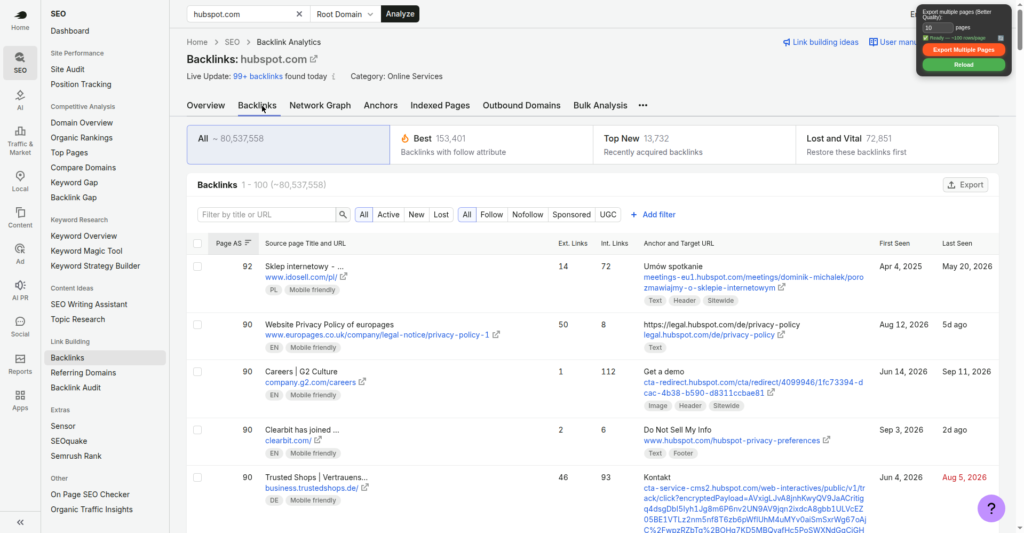
Look at HubSpot’s real backlinks below — tech blogs citing their knowledge base, GitHub projects referencing their guides, international publishers linking their research. That’s what happens when you are the source:
The playbook:
- Find a question your industry argues about but nobody’s measured. (“How long does SEO really take?” “What do customers actually complain about?”)
- Get the data: survey your audience, mine your own product analytics, or analyze public data.
- Publish with sharp charts, a methodology section (trust builder), and 3-5 quotable headline stats.
- Pitch journalists BEFORE publishing with an embargo — exclusivity creates urgency.
Real talk: you don’t need 10,000 responses. Some of the most-linked studies ever had 200-500 respondents. What matters is a surprising, quotable finding. “73% of X do Y” beats “we surveyed 50,000 people and found nothing interesting” every time.
Effort: High. Payoff: Links for 3+ years. The closest thing to passive income in SEO.
Strategy 2: Digital PR (The Nuclear Option)
If link bait is a magnet, digital PR is a nuke. One great story in a major publication can trigger a chain reaction — dozens of outlets picking it up, each with a link.
The playbook:
- Find your angle: original data, a contrarian expert take, or a trend you’re seeing before anyone else.
- Build a surgical journalist list — 10-30 writers who actually cover your beat. Not a 500-person blast. Ever.
- Pitch like a news tip, not a press release: what’s the story, why now, why their readers care.
- Follow up once. Journalists get 200 pitches a day — brevity and relevance are your weapons.
Real talk: the best angles combine data with money or emotion. “New data shows X” = meh. “New data shows X is quietly costing small businesses millions” = coverage. Find the stakes.
Effort: High. Payoff: The strongest editorial links money can’t buy (because you didn’t buy them).
Strategy 3: Guest Posting (The Reliable Workhorse)
Guest posting is the Toyota Corolla of link building — not flashy, absurdly reliable. Write genuinely useful articles for real publications, earn an editorial link.
The playbook:
- Find targets you actually respect. Google
[niche] + "write for us"— or better, pitch blogs you already read. - Vet like your rankings depend on it (they do): real traffic? Real engagement? Would you brag about this placement? If the site’s business model is selling guest posts, run.
- Pitch 2-3 specific headlines tailored to their audience. “I’d love to write for your blog” gets deleted. “3 headline ideas for [their audience]” gets opened.
- Write the best article you can. The link is the bonus; the article is the product.
- One natural contextual link. That’s it. Don’t get greedy.
Real talk: Google explicitly warns against large-scale article campaigns with keyword-stuffed links. Translation: one thoughtful post on a great site beats ten thin posts on content farms. This isn’t 2012 anymore.
Effort: Medium. Payoff: Steady, predictable, compounds with relationships.
Strategy 4: Niche Edits (The Shortcut That Isn’t Cheating)
Why write a new article when you can get linked from one that already ranks? Niche edits = getting your link inserted into existing, traffic-getting content.
The playbook:
- Find ranking articles in your space:
[topic] + inurl:blog, look for listicles and guides. - Spot the gap — a paragraph where your content genuinely adds value or updates something outdated.
- Email the owner with surgical precision: “Your section on X could use Y — our guide covers it in depth. Worth adding for your readers?”
- Suggest the exact sentence and placement. Make saying “yes” effortless.
Real talk: target page 2-3 articles, not page 1. Their owners are hungry — they know they’re close, and your suggestion genuinely helps them compete. Page 1 owners don’t need you.
Effort: Medium. Payoff: Some of the fastest-moving links I’ve ever built.
Strategy 5: Broken Link Building (The Good Deed)
Find dead links on resource pages. Tell the owner. Offer your content as the replacement. You’re basically doing them a favor that happens to earn you a link.
The playbook:
- Find resource pages:
[topic] + inurl:resourcesor[topic] + "useful links". - Scan for broken outbound links (link checker extensions make this fast).
- Make sure your replacement content is as good or better than what died. Non-negotiable.
- Email under 100 words: broken link location + your replacement + thanks.
Real talk: conversion rates run 3-5x higher than cold guest post pitches, because you’re leading with help, not an ask. Human psychology 101: reciprocity is powerful.
Effort: Low-medium. Payoff: Best beginner strategy in the game.
Strategy 6: HARO & Journalist Requests (The Slow Burn)
Journalists need expert quotes daily. Platforms like Connectively (formerly HARO) match them with sources. One quote in a major outlet = a DR 80+ link that money can’t buy.
The playbook:
- Filter for queries matching your actual expertise. Faking it wastes everyone’s time.
- Speed matters — journalists often pick from the first solid responses.
- Lead with the quotable insight, not your life story. Give them the sentence they’d print.
- 100-150 words. Conversational. One specific detail. Done.
Real talk: expect a 5-10% hit rate. It’s a grind. But treat it like brushing your teeth — a daily habit, not a campaign — and the links stack up beautifully over months.
Effort: Low per pitch. Payoff: Highest-quality links available, eventually.
Strategy 7: Resource Page Outreach (The Easy Win)
Resource pages exist for one reason: to link out. You’re asking for exactly what the page is for. It’s almost unfair.
The playbook:
- Find them:
[topic] + intitle:resources. - Be brutally honest: is your content genuinely among the best on this topic? If not, go make it better first.
- Email the curator. Mention what makes your resource different from what’s already there.
Real talk: .edu resource pages are the holy grail — universities maintain link lists for students. But only pitch genuinely educational content. Pitching your pricing page to a university is how you get blacklisted from academia.
Effort: Low. Payoff: Great for new sites with one killer piece of content.
Strategy 8: Unlinked Brand Mentions (The Free Money)
Someone mentioned your brand but didn’t link? That’s a link sitting on the table. Pick it up.
The playbook:
- Set up Google Alerts for your brand (free, 2 minutes).
- Search
"your brand" -site:yourwebsite.comfor existing mentions. - Three-sentence email: thanks for the mention + would you mind linking it + here’s the URL.
Real talk: highest conversion rate of any outreach I do. They already decided you’re worth mentioning — you’re just completing the citation. Do this before literally everything else.
Effort: Near zero. Payoff: The easiest links you’ll ever earn.
Strategy 9: Podcast Guesting (The Underrated Goldmine)
Podcast hosts need guests constantly. Show notes almost always link to guests. You do the math.
The playbook:
- Find shows: Apple Podcasts / Spotify search, or
[niche] + podcast + "be a guest". - Pitch 2-3 specific episode angles — what their audience hasn’t heard before.
- After recording, actually share the episode. Hosts remember who promotes.
- Repurpose everything: blog post, clips, quote graphics. More assets = more links.
Real talk: start small (50-500 listeners). They’re easier to book, the conversations are better, and ten small podcast links beat zero big ones. Everyone wants Joe Rogan; smart people start with niche shows.
Effort: Medium. Payoff: Links + audience + content, triple win.
Strategy 10: Free Tools (The Compound Interest)
Build something useful and free — a calculator, a checker, a template, a generator. People link to tools the way they cite research: constantly, and for years.
HubSpot wrote the playbook here — their free CRM, Website Grader, and template library have earned them millions of backlinks. Millions. From a “free” product.
The playbook:
- Find a repetitive task your audience hates (calculations, audits, formatting).
- Build the simplest version that works. Ugly but functional beats beautiful but broken.
- Launch with outreach to bloggers who write about that task.
- Maintain it. A dead tool hemorrhages links.
Real talk: “tool” doesn’t have to mean software. A killer spreadsheet template or interactive checklist can earn hundreds of links. Solve one annoying problem well.
Effort: High upfront. Payoff: Passive links for years. Compound interest, but for SEO.
Strategy 11: Expert Roundups & Ego Bait (The Flattery Play)
Feature experts in your content. Tell them. Watch a percentage share and link it. It’s not manipulation — it’s human nature. People promote things that make them look good.
The playbook:
- Ask a specific question to 10-20 real practitioners (operators > influencers for quality answers).
- Publish beautifully: headshots, pull quotes, links to their sites. Be generous.
- Notify everyone with a pre-written share snippet. Remove all friction.
Real talk: “50 experts share one tip” is dead — everyone’s done it. But “How do SaaS CFOs cut churn in the first 90 days?” That’s specific enough to get real responses from real experts. Specificity is the whole game.
Effort: Medium. Payoff: Links + relationships that outlast the campaign.
Strategy 12: Testimonials (The 15-Minute Link)
Use a tool you love? Write them a killer testimonial. Companies are desperate for social proof, and featuring customers with a backlink is standard practice.
The playbook:
- List every tool/service you genuinely use and like.
- Write something specific: what problem it solved, what changed. Specifics > superlatives.
- Send it with your headshot and URL. Offer a case study interview for bigger vendors.
Real talk: only testify for products you’d recommend to a friend over coffee. Fake enthusiasm is transparent, and your name is attached to it forever.
Effort: 15 minutes. Payoff: Absurd ROI for the time invested.
Strategy 13: Strategic Partnerships (The Alliance)
Team up with complementary (not competing) brands. Co-create something — research, a webinar, a report. Both audiences see it. Both sites link it. Nobody pays a cent.
The playbook:
- Find brands serving your audience with different products.
- Propose shared effort + shared promotion. Agree on promotion commitments upfront.
- Each partner publishes on their own domain, linking the shared asset.
Real talk: start with brands slightly smaller than you. They’re hungrier, more responsive, and the relationship often becomes more valuable than the links.
Effort: Medium. Payoff: High-trust links + actual business relationships.
Strategy 14: Community Participation (The Long Game)
Reddit. Industry forums. Slack groups. Quora. Be genuinely helpful for weeks, and links follow naturally — because people reference helpful people.
The playbook:
- Pick 2-3 communities. Participate for weeks before linking anything.
- Answer thoroughly. Link your content only when it’s genuinely the best answer.
- Obey self-promotion rules like your account depends on it (it does).
- Create content specifically answering recurring questions, then reference it.
Real talk: the link isn’t the goal — the reputation is. Links follow reputation like shadows follow objects. Anyone treating communities as link dumps gets banned, and deservedly so.
Effort: Ongoing. Payoff: Diverse links + authority that compounds.
Strategy 15: Educational Content for .edu Links (Handle With Care)
.edu links are among the most trusted on the web. But Google has explicitly warned against scholarship schemes built purely for links. So here’s the honest version:
The playbook (the right way):
- Create genuinely educational content — in-depth guides, free courses, research worth teaching from.
- Reach out to professors and university resource pages in related subjects.
- Never offer money or incentives for links. That’s exactly what Google warns against.
Real talk: if your “scholarship” exists for links, don’t. If your content is good enough to teach from, the .edu links follow. The intent is everything.
Effort: High. Payoff: The most trusted links in existence, earned honestly.
Chapter 4: Outreach That Actually Gets Replies
Here’s an uncomfortable truth: most link building doesn’t fail because the content is bad. It fails because the emails are terrible.
I’ve sent thousands of outreach emails. Deleted hundreds of terrible ones I’ve received. The difference between a 2% reply rate and a 20% reply rate isn’t luck — it’s framework.
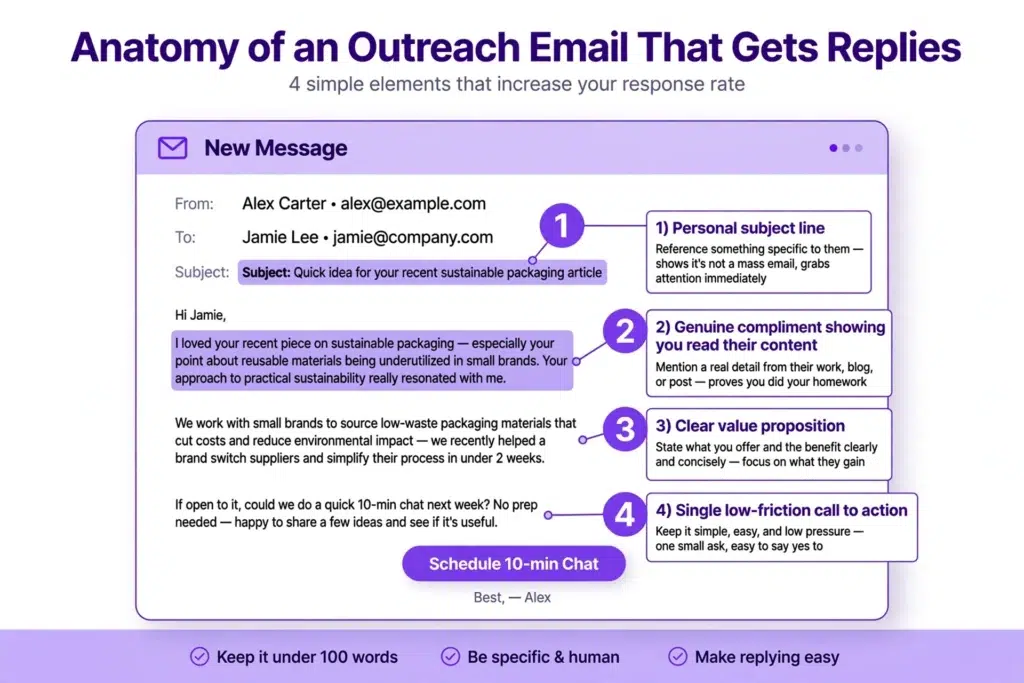
The 4-Part Framework
1. Subject line that proves you’re human. Reference something specific — their article, their company, a shared connection. “Quick idea for your [topic] piece” beats “LINK BUILDING OPPORTUNITY!!!” so hard it’s not even a contest. And never use fake “Re:” prefixes. That’s not clever. That’s a one-way ticket to the spam folder.
2. A compliment with receipts. Not “I love your blog!” — every spammer on earth writes that. Instead: “Your point about X in [specific article] changed how I think about Y.” One concrete detail proves you actually read their work. It takes 3 minutes of research. It 10x’s your reply rate.
3. Value first, ask second. What’s in it for them? A better resource for their readers? A fix for their broken link? A fresh stat for their article? Lead with their win, not your need. People can smell “what’s in it for me” from the subject line.
4. One tiny ask. A single, low-friction CTA: “Worth a look?” “Open to it?” Never stack asks. One email, one ask. Make “yes” the easiest word they’ll say today.
The Follow-Up: Where the Magic Actually Happens
Nobody tells beginners this, so I will: most of your positive replies will come from follow-ups, not first emails.
People are drowning in inbox. Your brilliant first email got buried under 47 others. A polite bump 4-7 days later isn’t annoying — it’s a rescue mission.
My rules:
- One follow-up for cold, two max for warm. Then walk away with grace.
- Shorter than the original. Two to three sentences. Respect their time.
- Add something new if possible — a fresh angle, a tighter version, a different ask.
- Never guilt-trip. “Bumping this for the third time!!” is how you get blocked, not linked.
The Hall of Shame (Don’t Be This Person)
- The Mass Blaster: 5,000 identical emails. Congratulations, you’re now spam — legally and reputationally.
- The Liar: “I just read your article!” (You didn’t.) Fake flattery is detected instantly by anyone who’s received 100 of these.
- The Negotiator: They ask for payment; you haggle like it’s a bazaar. Decide your policy before you outreach. (Ours: no paid links passing ranking credit. Google’s rules, not ours.)
- The Stalker: Seven follow-ups in ten days. There’s persistent, and then there’s a restraining order.
Bottom line: outreach is sales, but you’re selling genuine value. Treat every email like the start of a relationship — because the best link builders I know get half their links from relationships, not cold emails. Play the long game.
Chapter 5: Tiered Link Building, Explained Simply
Here’s a power-user move: building links to your links. Sounds weird. Works beautifully.
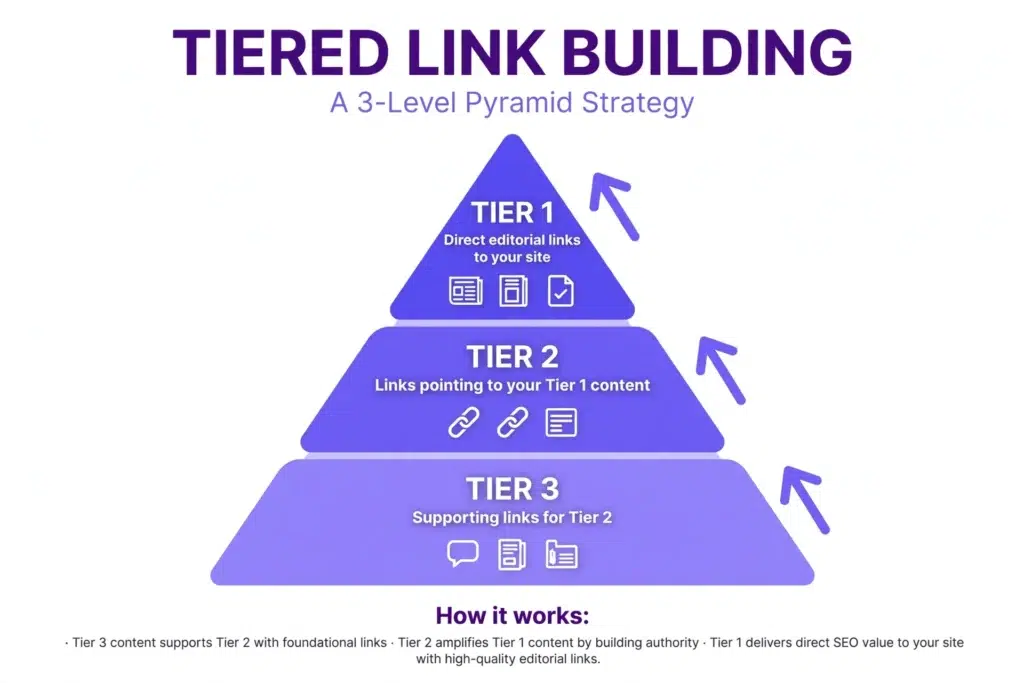
The idea: your best backlinks (Tier 1) pass more authority when they have links pointing to them (Tier 2). It’s like giving your soldiers better weapons — they fight harder for you.
The Three Tiers
- Tier 1: Your money links. Guest posts, niche edits, PR hits — pointing directly at your site. Highest quality only. If you wouldn’t frame it and hang it on the wall, it doesn’t belong here.
- Tier 2: Links to your Tier 1 content. Links pointing at the guest post that links to you. They get Tier 1 pages indexed faster and supercharge what flows upward.
- Tier 3: The support crew. Social shares, forum mentions, directory listings — lighter signals backing up Tier 2. Never pointed at your money site directly.
Where the Line Is (Don’t Cross It)
Tiers are a spectrum. Smart amplification on one end, black hat laundering on the other. My rules:
- Tier 1 is sacred. 100% white hat, no exceptions. These touch your domain directly.
- Tier 2 gets more latitude — social signals, forum posts, web 2.0s — because they point at other people’s sites. The risk is buffered by distance.
- Never automate anything pointing at your domain. The second a bot builds a link to your site, you’ve crossed over.
- Intent matters. Amplifying quality = smart. Disguising junk = a scheme, regardless of how pretty your pyramid diagram is.
Bottom line: water the garden around your best links. Don’t use tiers as a laundry machine for spam.
Chapter 6: Anchor Text — The Silent Killer
Anchor text is the assassin of link building campaigns. Invisible until it strikes. Get it wrong and your rankings die quietly, with no warning and no obvious cause.
Dramatic? Sure. Also true.
What 80 Million Backlinks Teach Us
Back to HubSpot’s real data. Their anchor profile:
- “Empty Anchor” (image links, no text): 5.2M backlinks — the web’s most common “anchor” is silence
- “get access now” / “submit inquiry” (button text): 2.3M each — embedded forms doing their thing
- “hubspot” (brand): 1.1M backlinks from 92,943 domains
- Naked URLs: hundreds of thousands more
The pattern? Glorious, human mess. Empty anchors, button text, brand names, raw URLs. What you don’t see: “best CRM software” repeated 10,000 times. Because real humans don’t link like SEOs having a keyword panic attack.
The Five Flavors of Anchors
- Branded (“Rankestra,” “hubspot”) — safest, most natural. Your bread and butter.
- Naked URL (“rankestra.com”) — very natural, very safe. The web’s default.
- Generic (“click here,” “this guide”) — natural filler. Every profile has them.
- Partial match (“this link building guide”) — topical signal without the risk.
- Exact match (“white hat link building”) — powerful, dangerous in excess. Handle like nitroglycerin.
My Working Ratios
Google publishes no formula, so here’s what I use after auditing hundreds of profiles:
- Branded + naked URL + generic: 70-80% — your foundation. Boring. Safe. Beautiful.
- Partial match: 10-15% — relevance without recklessness.
- Exact match: 5-10% max — enough to signal, not enough to get flagged.
Starting fresh? Earn branded anchors first. They’re bulletproof, they build brand signals (which Google increasingly loves), and they make your later exact-match links look innocent by comparison. It’s camouflage, but the honest kind.
Bottom line: when in doubt, go branded. Nobody in history has been penalized for too many people linking their brand name.
Chapter 7: White Hat vs Black Hat — The Honest Math
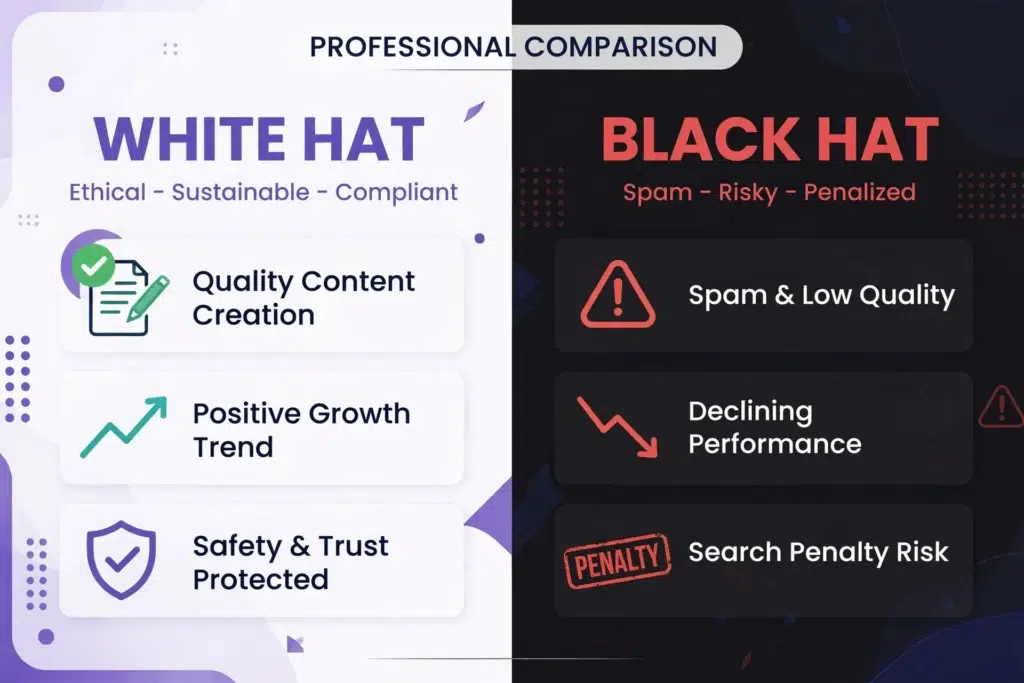
Let’s address the elephant in the room. You’re thinking it. Everyone thinks it:
“But black hat is faster…”
You’re right. It is. Buying links, PBNs, link farms — they can move rankings in weeks. I’ve watched it work.
And then I’ve watched what happens next. Usually within months, one of three funerals:
- The Silent Death. Google’s SpamBrain just… stops counting your links. No penalty notice. No drama. Your money’s gone, rankings evaporate, and you’re left wondering what happened. This is the most common outcome now — Google doesn’t even bother penalizing; it just ignores.
- The Overnight Collapse. Manual penalty. Rankings fall off a cliff at 3 AM. Recovery means finding every bad link, removing or disavowing them, begging for reconsideration. Months of work. No guarantees.
- The Network Apocalypse. The PBN gets deindexed. Every link vanishes simultaneously. If your rankings were built on it, they go with it. All of them. At once.
What’s Explicitly Banned (Google’s Naughty List)
- Buying/selling links that pass ranking credit without disclosure
- Mass article campaigns with keyword-stuffed anchors
- Automated link building (bots, scripts, comment spam)
- Private blog networks and link farms
- Industrial-scale link exchanges
- Site reputation abuse — hijacking authoritative sites’ trust with parasitic content
The Expected Value Argument (Why Smart People Choose White Hat)
Forget morality. Let’s talk math.
A white hat link: costs more, takes longer, lasts years, compounds as the linking page gains authority, carries zero penalty risk, and often sends real human traffic too.
A black hat link: cheap, fast, lasts months, carries risk that can nuke everything — not just the gains, but your entire site’s rankings.
One link lasting five years beats ten links lasting five months. And that’s before accounting for the nightmare scenario: waking up to find your business invisible on Google.
White hat isn’t the moral choice. It’s the profitable choice. The tortoise doesn’t just win — the hare gets disqualified.
Chapter 8: The Timeline (Or: Why Everyone Quits Too Early)
The #1 reason link building “doesn’t work”? People quit in month two. It’s like planting a tree, digging it up after three weeks, and declaring arboriculture a scam.
Here’s the honest timeline:
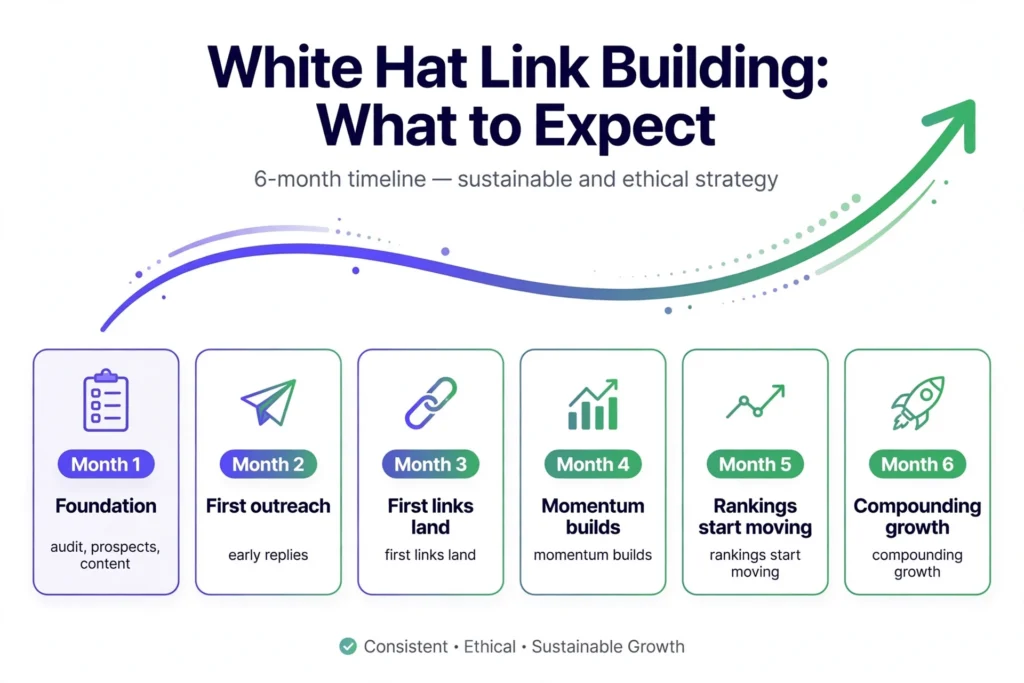
Month 1: Foundation (The Boring Part That Matters Most)
Audits, prospect lists, fixing your linkable assets. Zero links. This feels like failure — it’s actually the highest-ROI month. Skipping foundation is why most campaigns die.
Month 2: Outreach (The Rejection Phase)
Emails go out. Replies trickle in. Rejections pile up. Still few live links. You’re building pipeline, not results. Track reply rates, refine your pitch, don’t panic.
Month 3: First Links Land (The Dopamine Hit)
Guest posts publish. Resource pages add you. Broken link replacements get accepted. 3-10 quality links go live. The machine is warming up.
Month 4: Momentum (The Flywheel Creaks to Life)
Your process is dialed in. Month 2’s follow-ups convert. Strangers start finding your content organically. Link velocity climbs. You’re no longer pushing the boulder — it’s starting to roll.
Month 5: Rankings Move (The Payoff Begins)
Google has crawled, evaluated, and credited your links. Target pages climb — long-tails first, then the competitive terms. This is the month skeptics become believers.
Month 6: Compounding (The Promised Land)
Higher rankings → more visibility → more organic citations → more links without outreach. The flywheel spins on its own. This is where white hat leaves every shortcut in the dust — because shortcuts never survive long enough to get here.
Bottom line: budget six months minimum. Anyone promising page one in 30 days is selling you something Google repossesses in 60.
Chapter 9: What It Actually Costs in 2026
No sales pitch. Just the real numbers I see in the market:
DIY: Free (Plus Your Sanity)
Cost: $0 and 10-20 hours per quality link when starting out. Drops to 5-8 as you get good.
Best for founders and bloggers with more time than budget. Also the best education — you’ll feel what quality means before you ever pay for it.
Freelancers & Boutique Services
- Quality guest post: $70-$300 (depends on the site’s real traffic and authority)
- Niche edit in ranking content: $150-$500+ (you’re renting existing authority)
- Digital PR campaign: $800+ (scales with ambition)
Agencies: $2,000-$10,000+/month
You’re buying systems, relationships, content creation, and someone else’s scars from years of trial and error. One non-negotiable: they must show you every placement with a live URL. “Proprietary network, can’t disclose” = they’re hiding PBNs. Walk away.
Red Flags (The “Too Cheap” Hall of Fame)
- “DA 90 backlinks for $5” — pick two: fabricated metrics, PBN links, or both
- “1,000 backlinks in 7 days” — automation. Guaranteed worthless or harmful.
- No reporting, no URLs, “trust us” — no.
- “Guaranteed #1 rankings” — no honest SEO guarantees positions. Ever.
Bottom line: pay with time (DIY) or pay with money (services). Just never pay with risk.
Chapter 10: 7 Ways to Set Your Campaign on Fire
I’ve watched more campaigns implode than I can count. It’s never the strategy — it’s always one of these:
Mistake 1: Pitching Thin Content
No outreach survives contact with content nobody wants to link to. Brutal question before you pitch anyone: is this genuinely among the best resources on this topic? If the answer is “meh,” fix the content first. Outreach amplifies quality — it can’t manufacture it.
Mistake 2: Worshipping DA Instead of Traffic
Third-party scores are estimates, not Google data. A “DA 25” page with 20,000 real monthly visitors will embarrass a “DA 55” ghost town. Traffic and relevance first. Vanity metrics last. Tattoo it somewhere.
Mistake 3: Anchor Text Suicide
Twenty links, all anchored “best CRM software.” That’s not a strategy — that’s a confession. Diversify from day one (Chapter 6 exists for a reason).
Mistake 4: Quitting at Day 30
See Chapter 8. Pulling out at week four because “it’s not working” is like turning off the oven after five minutes and declaring baking a myth.
Mistake 5: The Spray-and-Pray Outreach
1,000 generic emails = spam folder + burned domain. 50 deeply personal emails = links + relationships. Outreach quality determines link quality. There are no shortcuts to giving a damn.
Mistake 6: Building on a Toxic Foundation
New links while old toxic ones drag you down = pouring water into a leaking bucket. Audit first (Chapter 2). Then build.
Mistake 7: Calling Paid Links “White Hat”
Paying for PageRank-passing links without disclosure isn’t a gray area — it’s explicitly banned. Sponsored content with proper rel="sponsored" is fine for traffic, but it won’t pass ranking credit. And it shouldn’t.
Your Next Step (Don’t Just Bookmark This)
Here’s the truth about guides like this: 99% of readers will bookmark it, feel productive, and change nothing.
Don’t be the 99%.
Pick ONE strategy from Chapter 3. Just one. Send five outreach emails this week using the Chapter 4 framework. That’s it. Five emails. You’ll learn more from those five than from re-reading this guide twice.
Or — if you’d rather have someone who’s done this thousands of times handle it — that’s literally what we do at Rankestra: guest posts on real sites with real traffic, niche edits in content that already ranks, digital PR that earns press links. Every placement with a live URL. No mysteries, no “proprietary networks.”
Start with a free audit — we’ll run the Chapter 2 process on your site and show you exactly where you stand. Or talk to us about a campaign.
The sites winning in 2026 aren’t the ones with the most content. They’re the ones with the most trusted content. Go earn your trust — one white hat link at a time.
What is white hat link building?
White hat link building means earning backlinks through Google-compliant methods — editorial outreach, quality content, and digital PR — rather than buying links or using manipulative schemes. It’s slower than black hat shortcuts but the results last and carry zero penalty risk.
How do I get .edu backlinks?
Earn them legitimately: offer scholarships, publish research useful to academics, create free tools or resources for students, or partner with university programs. Never buy .edu links — institutions that sell them lose trust fast.
How can I find .gov backlinks?
Government sites link to genuinely useful public resources: data, tools, guides, and research. Create something a government agency would be proud to reference, then let the relevant department know it exists.
How do I get backlinks from high-authority sites?
High-authority sites link to exceptional content: original data, expert analysis, and stories with news value. Digital PR — turning your data or expertise into journalist-friendly stories — is the most reliable path.
What is a backlink gap analysis?
Backlink gap analysis compares your backlink profile against competitors’ to find sites linking to them but not you. Those gaps are your highest-probability outreach targets.
Are tier 2 backlinks safe?
Yes, when they’re legitimate links pointing to your tier 1 content (not spam pointed at your own site). They help tier 1 pages get indexed and pass additional authority upward.