Type “buy backlinks” into Google and you’ll find two kinds of people: vendors promising you page one, and SEO forums warning you’ll get burned.
They’re both telling the truth. That’s the problem.
Buying backlinks in 2026 is a real, functioning market — and it’s also the single fastest way to destroy a site’s rankings if you do it the way most buyers do it. Google’s spam policies classify buying or selling links “for ranking purposes” as link spam, and its detection runs continuously now, not in occasional penalty waves. But “safely” isn’t a fantasy: there are compliant ways to spend money in this space, and documented ways the reckless ones end.
This guide gives you the honest version: what the bought-link market actually looks like (five distinct markets, not one), what Google says and how it catches paid links, what happened to the brands that got caught, a full dissection of Fiverr’s 24.5-million-backlink profile showing what the paid-link economy looks like in real data, what links actually cost, and the five safer ways to spend the same budget.
No vendor pitches. No invented prices. Just mechanics, data, and straight talk about risk.
Chapter 1: What “Buying Backlinks” Really Means in 2026
Ask ten SEOs what “buying backlinks” means and you’ll get ten answers, from “$5 Fiverr gigs” to “we paid an agency for digital PR.” That’s the first trap: the term covers at least five different markets with wildly different risk levels, and most advice about it pretends they’re all the same thing.
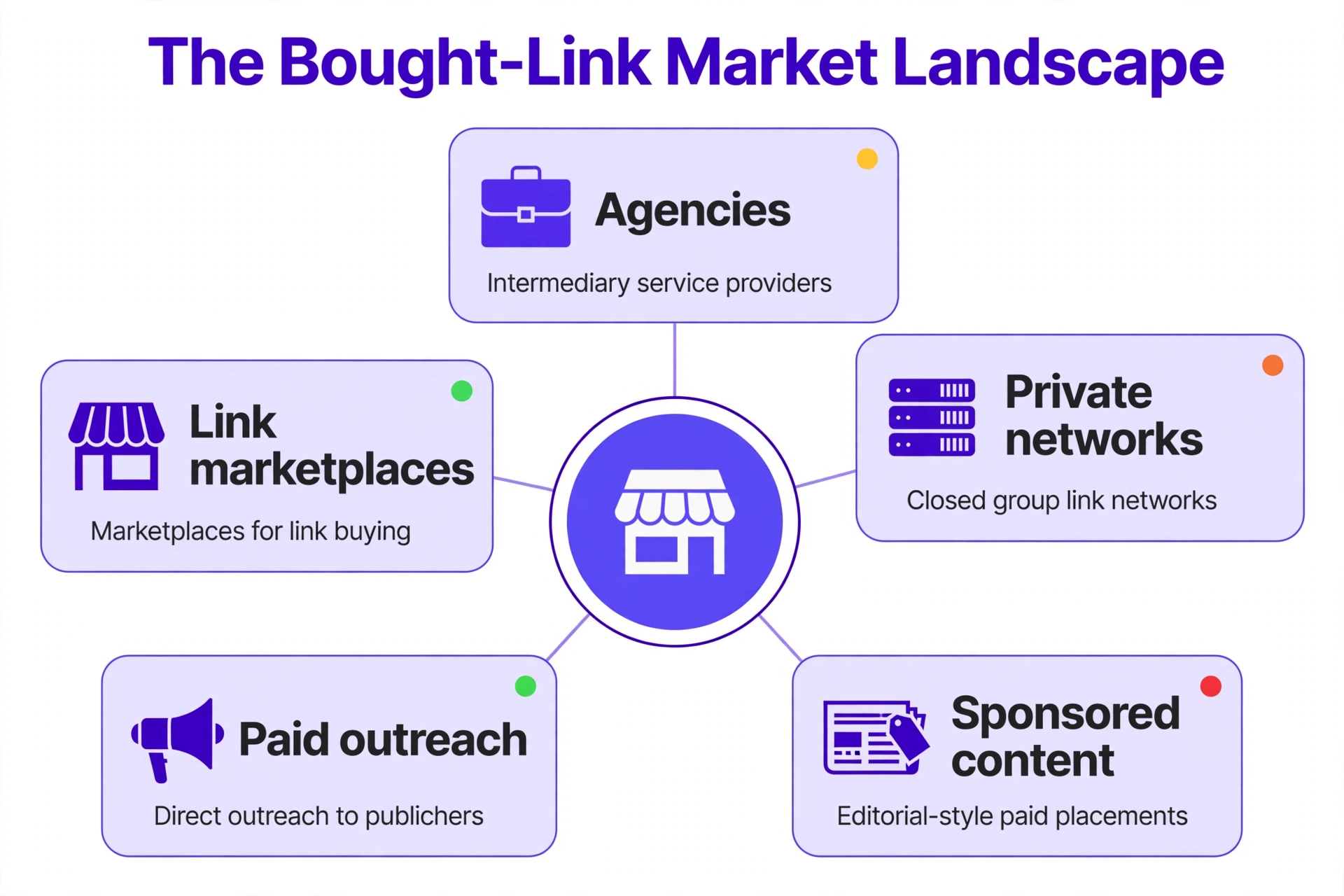
Market 1: Link marketplaces and vendors
This is what most people picture: pay-per-link menus where you pick a site from a list, choose your anchor text, and pay by authority tier. Prices scale with the site’s metrics, turnaround is days, and the whole transaction happens on a dashboard.
It’s also the highest-risk mainstream option. The inventory is shared across hundreds of buyers, the footprints are industrial, and the sites exist to sell links — which is exactly what Google’s systems are built to find. When a marketplace gets mapped, everyone holding its links holds the same smoking gun.
Market 2: Agencies selling “placements”
The respectable cousin of marketplaces: agencies that sell guest posts, niche edits, and editorial placements on real sites with real traffic. The honest distinction — the one that actually matters — is editorial standards plus real audiences versus networks dressed up as outreach.
An agency placing your article on a site with genuine readership, editorial review, and disclosure where appropriate is doing something meaningfully different from a marketplace selling footer links on a site nobody visits. Same word (“placements”), different universe. This is also where Rankestra’s own services live — which is exactly why this guide draws the line so explicitly.
For the foundations of how legitimate placements work, the white hat link building guide covers the principles everything below builds on.
Market 3: PBNs — private blog networks
Networks of sites built or bought solely to sell links. They look like independent blogs, but they share owners, hosting patterns, themes, and — most importantly — a single purpose: passing ranking credit for money.
PBNs are SpamBrain’s prime target, and they have been for years. Google’s AI-driven spam detection is specifically good at finding network structures: shared analytics IDs, hosting clusters, content fingerprints, and linking patterns that no natural set of independent sites would produce. Buying PBN links in 2026 isn’t a strategy; it’s a timer.
Market 4: Sponsored content — the compliant route
Paid, labeled, and carrying rel="sponsored" or rel="nofollow" so it passes no ranking credit. This is the one form of “buying links” that Google explicitly permits — because it’s not buying ranking, it’s buying visibility.
A sponsored article on a major publication can drive real referral traffic, brand exposure, and even downstream editorial links. What it won’t do is directly move your rankings — by design.
Market 5: Paying for outreach, not links
Here’s the distinction that confuses everyone: money buys the labor and the assets; the links come editorially. You pay for the data study, the PR campaign, the content, the outreach specialist’s time — and journalists, bloggers, and resource pages link because the thing is worth linking to.
This is how digital PR, original research, and genuine outreach work. Money changed hands, but no one bought a link — they bought the work that earned links. Google has no problem with this, because there’s nothing manipulative about it: the editorial decision to link happened independently.
The risk ladder: every paid-link method, ranked
Line them up from compliant to catastrophic:
Lowest risk: sponsored content with proper nofollow/sponsored attributes → paying for outreach labor and linkable assets → vetted editorial placements on real sites with disclosure where needed → link marketplaces with shared inventory → highest risk: PBNs and link schemes at scale.
Real talk: most buyers live in the dangerous middle — marketplaces and low-standard “outreach” agencies — while believing they’re on the safe end. The rest of this guide is about knowing exactly where you are on that ladder, and what it costs when you’re wrong.
Why “safe” is the only honest selling point
Notice what this chapter did: it refused to give you a single answer to “should I buy backlinks?” Because there isn’t one. The answer depends entirely on which market you’re buying in, how the links are earned, and what the linking sites look like.
“Safely,” for the rest of this guide, means one of two things: the compliant routes (pay for visibility or labor, not ranking credit), or the documented consequences of everything else. No gray-area promises. Let’s see what the rulebook actually says.
Chapter 2: What Google Actually Says
Before the tactics, the rulebook. Not the forum folklore — the actual policies, paraphrased and attributed so you can verify every word.
The one rule that matters
Google’s Search Essentials spam policies are blunt: buying or selling links “for ranking purposes” is link spam. That’s the entire rule in one clause. It doesn’t matter whether the link is on a great site or a terrible one, whether you paid $5 or $5,000, or whether the vendor called it “outreach.” If the purpose is manipulating rankings, it’s link spam under the policy.
The long-standing guideline language backs it up: links bought or sold to pass PageRank violate the guidelines and can negatively impact a site’s ranking in search results (as reported in Google’s help-page wording by Search Engine Land). Google’s former head of search spam, Matt Cutts, put it in operational terms: selling links or advertorial pages that pass ranking credit violates quality guidelines, and Google takes action — starting with losing trust in the search results plus lower rankings.
Real talk: vendors love to debate what “for ranking purposes” means, as if the ambiguity protects you. It doesn’t. Google’s systems don’t read your intentions; they read your patterns. Which brings us to the only part of the policy that works in your favor.
The escape hatch: nofollow and sponsored
Paid placements are acceptable when they don’t pass ranking credit. That’s not a loophole — it’s the documented policy: mark paid links with rel="nofollow" or rel="sponsored" (or block the intermediate page via robots.txt), and you’re compliant.
This is the entire basis of the sponsored-content market. A brand can pay a publication for an article, the publication labels it and nofollows the links, and everybody’s within policy. The ranking benefit is zero — but the traffic, brand, and downstream editorial links are real. Anyone who tells you a nofollow link “secretly passes value” is selling you a story; the value of nofollow is in the humans who click, not the algorithm.
2026 enforcement: SpamBrain doesn’t sleep
The enforcement side has changed more than the policy. Link-spam detection is now AI-driven — Google’s SpamBrain system — and it works both directions: it catches sites selling outgoing links and sites buying them (cited.so, 2026).
The cadence has changed too. The March 2026 spam update finished rolling out in under 20 hours (editorialge.com). The September 2026 spam update ran from September 24 to October 8 — about thirteen and a half days of active enforcement. There is no “safe window” between updates anymore.
What “real-time” means for you
Since Penguin 4.0 became part of the core algorithm, manipulative links are devalued continuously — in real time — rather than in periodic penalty waves. That’s the detail most buyers miss.
The old model was: buy links, rank for months, get hit by an update, clean up, recover. The current model is: manipulative links get neutralized as they’re found, constantly. You might not get a dramatic penalty notice — the links just quietly stop counting. Which means the buyer who “got away with it” often didn’t get away with anything; they just paid for links that never worked.
Real talk: this is the cruelest part of the modern system. The most common outcome of buying bad links isn’t a penalty — it’s paying full price for zero benefit, while carrying all the risk.
Chapter 3: How Google Catches Paid Links
Google doesn’t need a whistleblower. Paid links leave patterns — and patterns are what machine learning eats for breakfast. Here’s what the detection actually looks at.
Pattern 1: Anchor concentration
Natural link profiles have diverse anchors: branded terms, URLs, generic phrases (“click here,” “this article”), and a long tail of whatever people happened to write. Paid-link profiles skew hard toward commercial exact-match anchors — “best CRM software,” “buy CBD oil online” — repeated across dozens or hundreds of domains.
This is the single most legible signal in the dataset. When one money anchor appears from many unrelated domains with suspiciously similar surrounding text, no human review is needed — the distribution itself is the confession. Chapter 5 shows this pattern live, at scale, in Fiverr’s own anchor data.
Pattern 2: The neighborhood test
Google looks at who else the linking site links to. A legitimate blog links to a mix of sources: news, references, competitors, tools. A link-selling site links to whoever paid — which means its outbound profile is a random grab-bag of commercial pages across unrelated niches: casinos, CBD, crypto, essay writing, all on the same domain.
This is why “check the site’s outbound links” is the first move in any due-diligence checklist (Chapter 9). A site linking out to fifty unrelated commercial pages isn’t a publication — it’s inventory.
Pattern 3: Velocity and footprint
Hundreds of new links appearing in days, from domains that share hosting, themes, analytics IDs, or content fingerprints. Identical article templates across “different” blogs. Author bios that link to the same money pages. These are network fingerprints, and SpamBrain was built specifically to find them.
Even without a network, velocity alone raises flags: a site that earned three links a month for two years and suddenly gains four hundred in a week has a story to tell.
Manual actions: the human layer
Automated detection handles scale; human reviewers handle the edge cases. Google’s webspam team still issues manual actions — and they act on reports, on obvious schemes, and on patterns the algorithms surface for review.
A manual action is the formal version: a notice in Search Console, a ranking suppression tied to specific links, and a reconsideration process that requires documenting what you bought and proving it won’t happen again. It’s slow, it’s humiliating, and it’s all on the public record.
The quiet penalty: silent devaluation
Here’s what replaced the dramatic penalty wave for most buyers: nothing happens. No notice, no drama — the paid links are simply identified and neutralized, and the rankings they were supposed to buy never arrive.
This is the outcome the vendors never mention in their sales calls. You can spend thousands on links that Google devalues on sight, and the only evidence anything went wrong is the invoice. Real talk: the “safest” bad links are the ones that do nothing at all — and they’re also the most expensive kind of nothing you’ll ever buy.
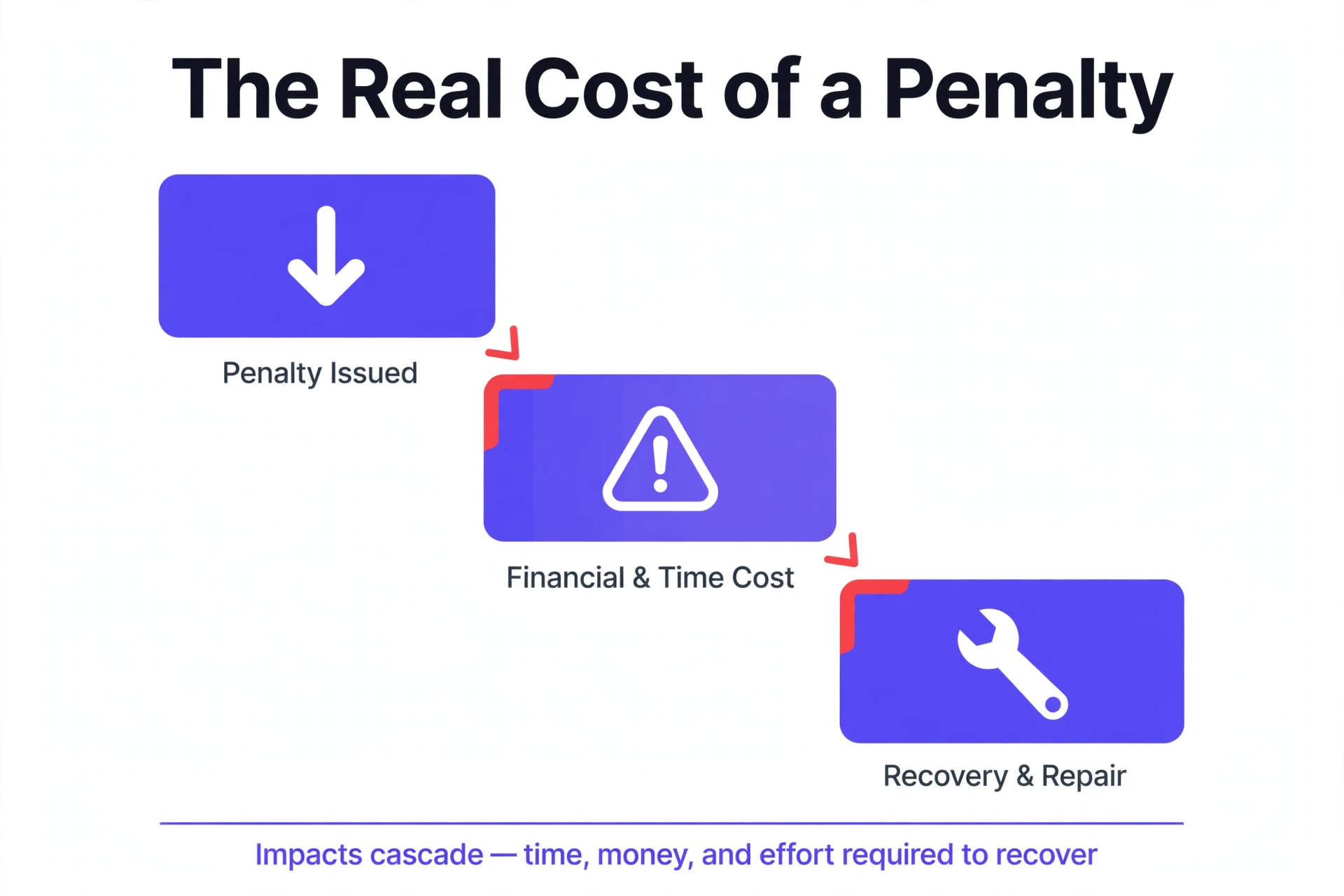
Chapter 4: The Real Cost of Getting Caught
Theory is cheap. These are public, documented cases — names, dates, consequences — reported by the search press. Nobody here is a rumor.
J.C. Penney: the department-store lesson (2011)
In 2011, J.C. Penney — one of America’s largest retailers — was caught with thousands of paid links propping up its rankings for terms like “dresses” and “furniture.” The New York Times investigation documented the scheme; Google acted; the rankings vanished.
Penney cleaned up and regained rankings roughly 90 days later (Search Engine Land). But note the math: months of paid links, a public scandal, an emergency cleanup — all to end up roughly where they started, minus the money and the embarrassment.
Interflora: advertorials have teeth (2013)
Interflora, the UK flower delivery giant, was penalized over paid advertorial links that passed ranking credit. Matt Cutts’s public warning about selling links and advertorials passing PageRank was widely read at the time as the Interflora reminder (Search Engine Land) — Google’s spam chief didn’t even need to name them; the industry connected the dots.
The lesson: advertorials — paid articles on news sites, the “respectable” end of buying links — are explicitly in scope. The format doesn’t protect you. The attribute does.
Forbes and iAcquire: publishers aren’t safe either
The enforcement runs both directions. Forbes was hit in a PageRank penalty wave targeting publisher sites selling links that passed ranking credit. iAcquire, a link-building agency, was banned from Google entirely after link-buying allegations (Search Engine Land) — an agency whose product was links, erased from the index that made those links valuable.
Real talk: if you’re buying from a vendor, ask yourself what happens to your links when the vendor gets caught. The answer is in the iAcquire story: the seller’s penalty becomes the buyer’s problem, because every link they sold you is now mapped.
Chrome: Google penalizes Google
Google’s own Chrome team got penalized over a sponsored post campaign that passed ranking credit. Let that sink in: the company that writes the rules enforced them against itself, publicly.
If the policy applies to Google’s flagship product, it applies to your site.
What recovery actually looks like
The honest version of recovery: it’s slow, it’s manual, and it’s incomplete. Industry analysis of post-update recoveries finds that cleanup rarely restores everything that was lost (editorialge.com) — the rankings bought by the bad links were never really yours, and removing the links doesn’t conjure legitimate authority to replace them.
The recovery playbook is well documented: audit every link, remove what you can, disavow what you can’t, document the effort, and file for reconsideration if a manual action was issued. Then rebuild with the legitimate tactics this series covers.
Chapter 5: The Fiverr Case Study — 24.5 Million Backlinks, Dissected
Now let’s look at the bought-link economy through real data — not a theory, a live profile.
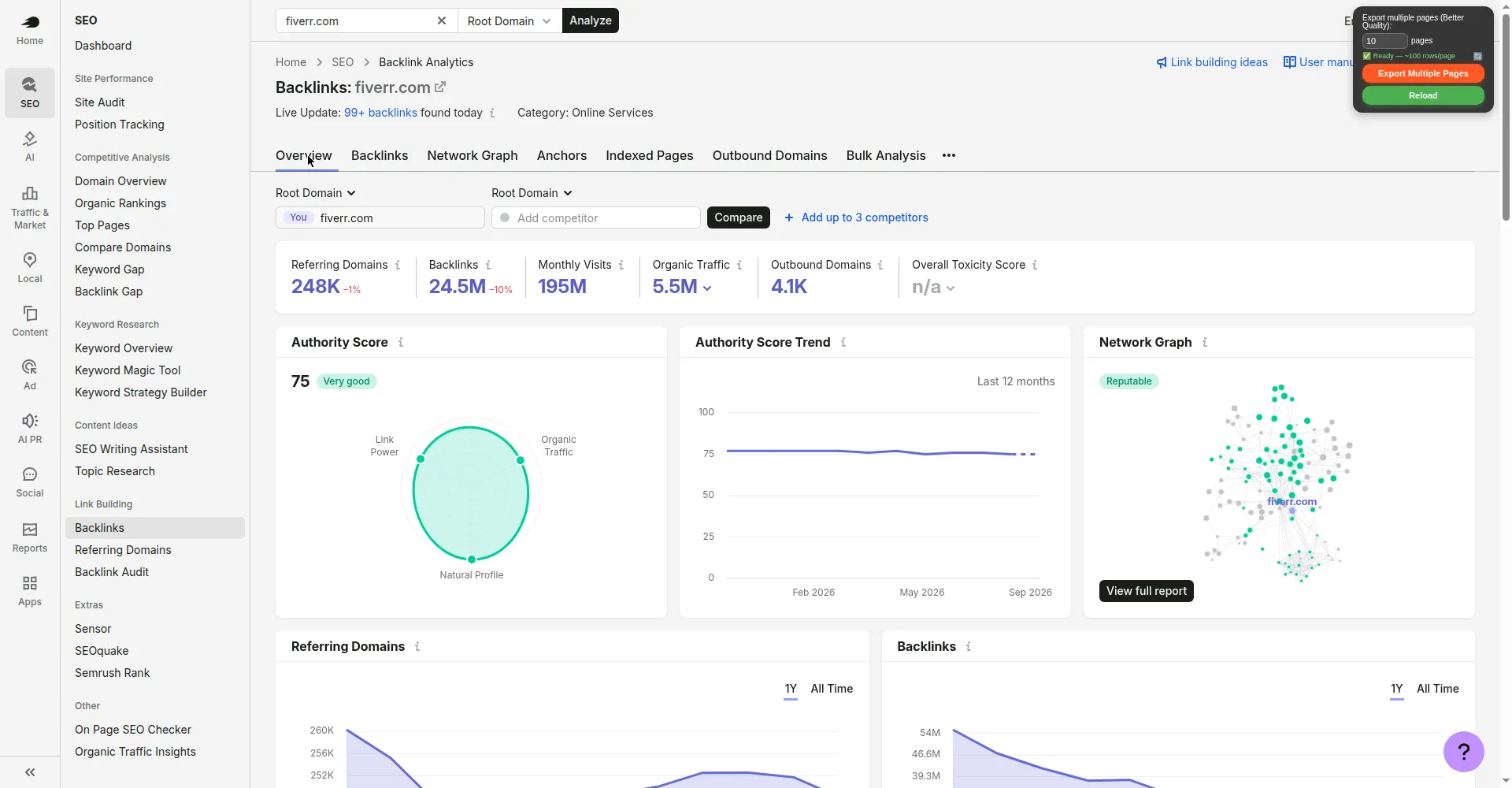
Fiverr (fiverr.com) is the freelance marketplace where backlink gigs are sold for a few dollars. Its own backlink profile, analyzed in Semrush’s Backlink Analytics on 2026-10-11, is a living exhibit of what the paid-link economy looks like at scale: the mass patterns, the gig-selling anchors, the coordinated campaigns — with one genuine editorial link inside for contrast. Every number below is observed data.
The headline numbers
- Authority Score: 75 — rated “Very good” (12-month trend stable around 75; Semrush category: Online Services)
- Referring domains: 248,000
- Backlinks: 24.5 million (trending down 10%)
- Monthly visits: 195 million
- Organic traffic: 5.5 million
- Outbound domains: 4,100
Big numbers. Now look at the shape — because the shape is where the story is.
The follow/nofollow illusion
On the surface, the split looks healthy: 87% follow (21.2 million) vs. 13% nofollow (3 million), with sponsored at 2% (433K) and UGC at 1% (275K). Link types: 61% text (16 million), 15% image (4 million), and a striking 23% frame (6.2 million).
But follow percentage means nothing without asking where the follows come from. A follow link from a scraper domain with zero traffic is worth what the algorithm decides it’s worth — which, per Chapter 3, is increasingly nothing.
205,000 domains nobody’s heard of
Here’s the number that reframes the entire profile. Of Fiverr’s 248,000 referring domains, the Authority Score distribution looks like this: 71 domains at AS 91–100, 122 at 81–90, 367 at 71–80 — and 205,000 domains at AS 0–10.
Read that again: roughly eight out of every ten referring domains are in the lowest authority bracket Semrush measures. That’s not an editorial link profile — editorial links come from real publications with real authority. That’s a mass profile: scrapers, directories, auto-generated pages, and gig-promotion networks by the hundred thousand.
Real talk: this is the first thing to check on any link profile you’re evaluating — bought or otherwise. Don’t ask how many domains link. Ask how many of them anyone has ever heard of.
The gig-selling anchors on .edu pages
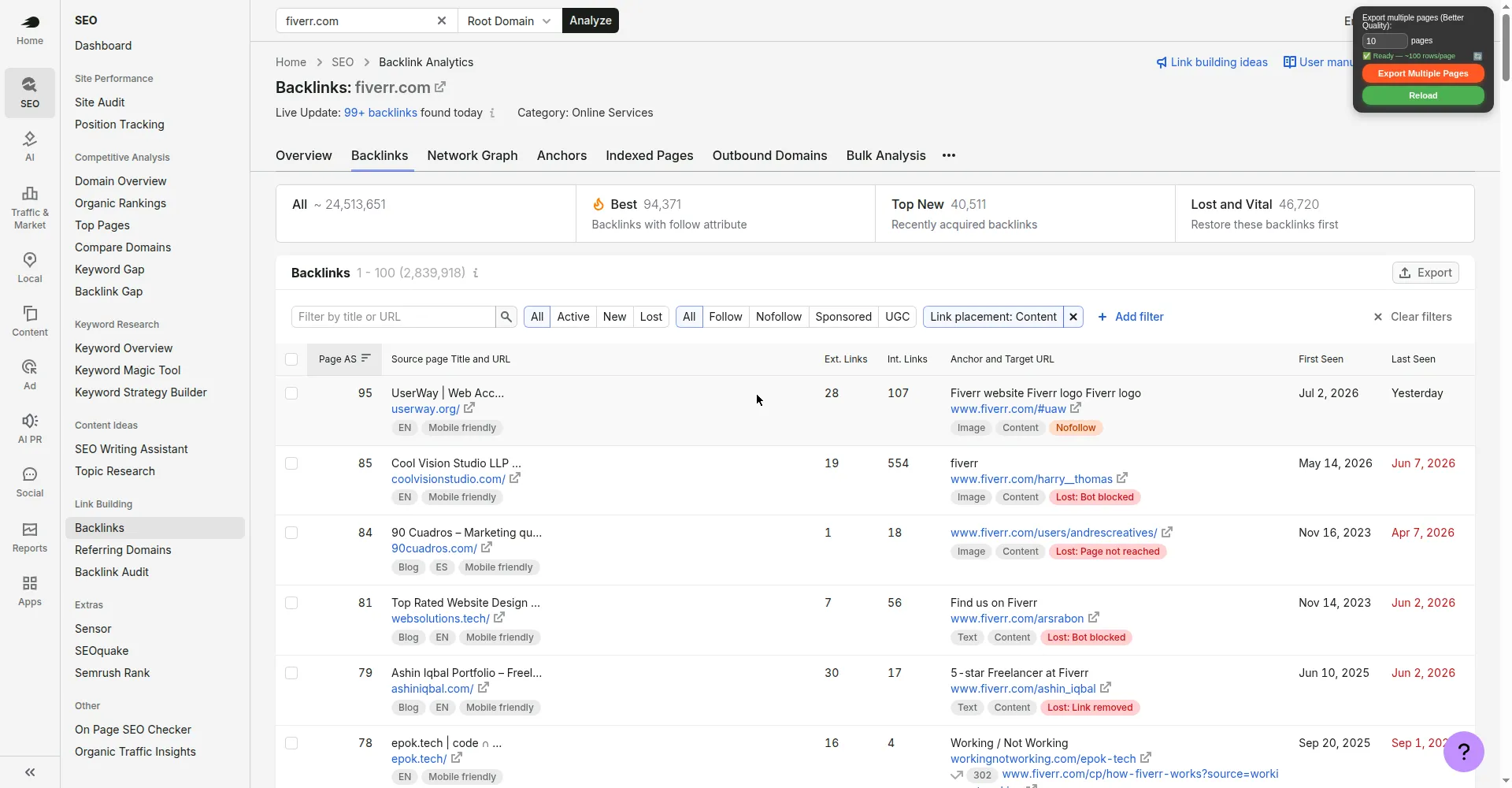
Now the contextual examples — in-content links sorted by Page AS, and they’re remarkable. From pentvars.edu.gh (a .edu blog, Page AS 74): the anchor “Guest Posting” points to a Fiverr gig titled “guest-posting-dofollow-seo-backlinks-high-da-link-building-publish-ar…” — a gig selling guest-post backlinks, linked in-content from a university blog page. Nofollow, UGC, first seen March 6, 2026.
A second .edu page on the same domain links the anchor “Guest Post” to a gig called “500-guest-post-on-high-da-dr-websites-for-seo-backlinks” (first seen March 8, 2026). The .edu halo — the thing link buyers pay premiums for — deployed to promote backlink-selling gigs. The irony writes itself.
“Is buying backlinks a good idea” — pointing at a gig
The single most honest anchor in the dataset: on peoplepulsemediallc.com (Page AS 71), the anchor text “is buying backlinks a good idea” links to a Fiverr gig called “do-contextual-dofollow-backlinks-off-page-seo-high-da-70-quality-link-bu…” — first seen March 20, 2026, nofollow, UGC.
Someone asked whether buying backlinks is a good idea, and the answer was a link to a gig selling backlinks. That is the $5-gig economy in one line: the question and the product, collapsed into a single anchor. If you ever wondered what “buying backlinks” produces at the bottom of the market — this is it.
The directory-network mass pattern
From webranksdirectory.com (Page AS 72): an image anchor, sitewide placement, pointing to the gig “add-guest-post-your-website-in-my-directories” (first seen July 15, 2025). And the same gig URL appears sitewide on six more domains — swpor.com, suohk.com, sabns.com, lnuli.com, fduty.com, apsoz.com — all at AS 68.
Seven domains, identical authority scores, identical sitewide image links, one gig. That’s not seven independent editorial decisions. That’s a directory network promoting a single product in lockstep — the exact footprint Chapter 3 described. When you buy the cheap gig, this is the machinery your link rides on.
The empty anchor: 40% of the profile
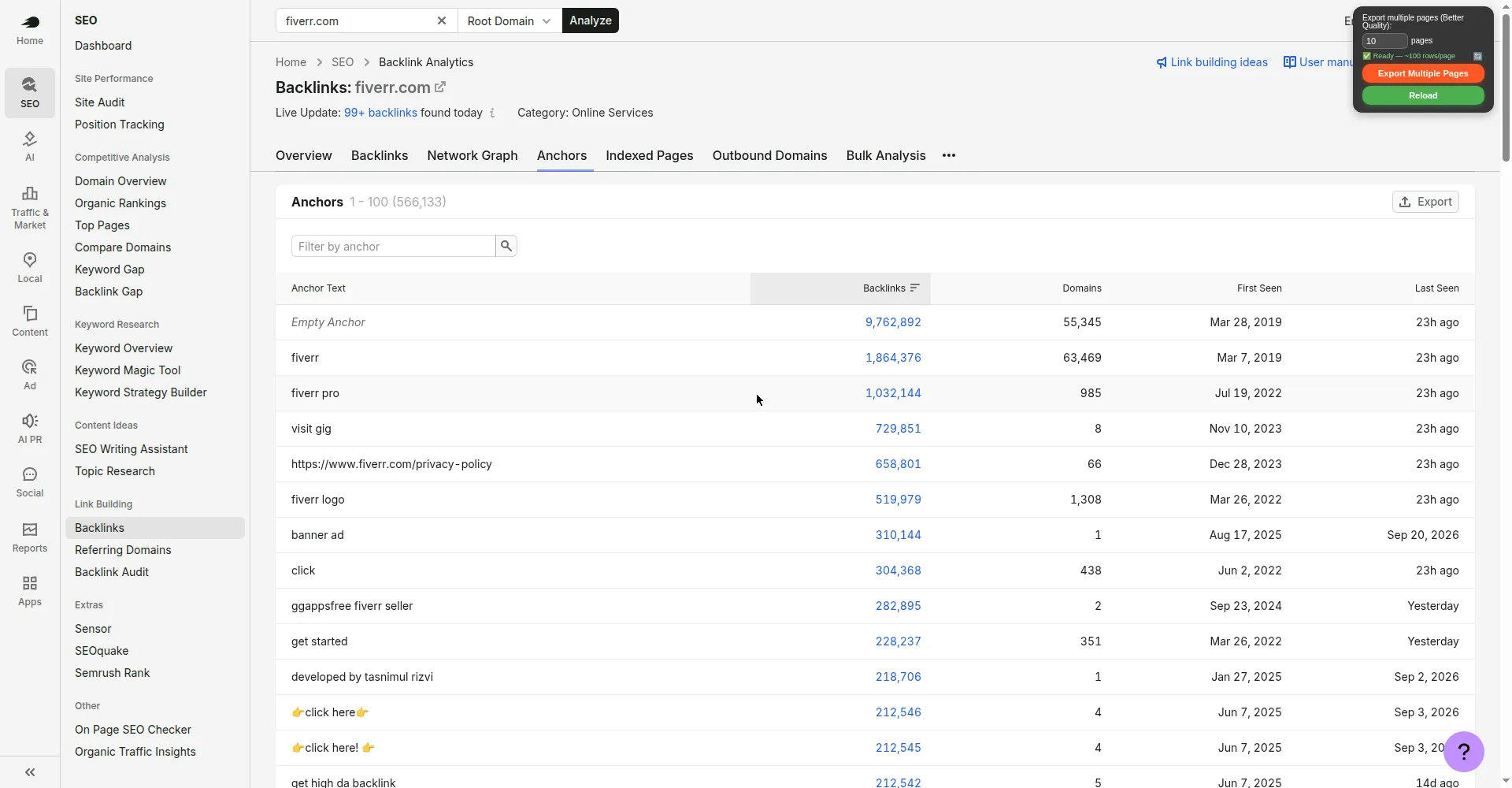
Fiverr’s top anchor overall isn’t a word at all. Empty anchor: 9,762,892 backlinks from 55,345 domains (first seen March 28, 2019) — roughly 40% of all 24.5 million backlinks carry no anchor text whatsoever.
Empty anchors mean image links, badge links, widget links, and embedded frames — links deployed by code, not by editors. A natural editorial profile is mostly text anchors written by humans. A 40% empty-anchor share is the signature of links placed by templates, scrapers, and automated embeds. It’s the shape of distribution, not endorsement.
“Visit gig”: 730,000 links from 8 domains
The hyper-concentration award goes to the anchor “visit gig”: 729,851 backlinks from 8 domains (first seen November 10, 2023). Three-quarters of a million links. Eight domains.
It’s not alone: “banner ad” has 310,144 backlinks from 1 domain (first seen August 17, 2025). “ggappsfree fiverr seller” has 282,895 from 2 domains. “developed by tasnimul rizvi” — a footer credit link — has 218,706 from 1 domain. This is the anchor-concentration pattern from Chapter 3, running at industrial scale: millions of links, a handful of sources, zero editorial diversity.
Real talk: show this to anyone who says “but the gig seller promised 700,000 backlinks.” They delivered exactly that — 700,000 backlinks that all came from the same eight places. The number was real. The value was the illusion.
The emoji campaign
Sometimes the data is almost funny. A coordinated set of anchors all first seen on June 7, 2025: “👉click here👉” (212,546 backlinks, 4 domains), “👉click here! 👉” (212,545, 4 domains), and “get high da backlink” (212,542, 5 domains). Identical counts, identical date, emoji-laden anchors.
That’s a single campaign, deployed across a small network on a single day, leaving a fingerprint so precise you could set your watch by it. SpamBrain doesn’t need to be clever to catch this — it just needs to count.
The link sellers selling links to link sellers
The profile goes meta. Anchors in Fiverr’s own backlink data advertise link-selling services: “telegram @seo_anomaly – seo backlinks, black-links, traffic boost, link indexing” (48,900 backlinks, 710 domains), “tg @bhs_links – best seo links” (33,232 from 369 domains, plus another 31,056 from 587), “dofollow backlinks” (25,404/953), “guest posting service” (23,455/127), “order backlinks” (22,981/21).
Link vendors promoting their services with links pointing at the marketplace where they sell links. It’s backlinks all the way down — and every one of those anchors is a labeled exhibit of the exact behavior Google’s policies prohibit.
The Guardian exception
And then, the contrast: theguardian.com (Page AS 68) links to Fiverr with the anchor “Fiverr,” text, in-content, follow — first seen May 15, 2025, from a books article covering clickfarms and self-publishing.
One genuine editorial link from a real publication. No gig in the URL. No emoji. No network. Just a journalist who mentioned Fiverr because the story required it.
What the shape tells you
Step back and read the whole profile as one statement: 205,000 low-authority domains, 40% empty anchors, hyper-concentrated commercial anchors, coordinated emoji campaigns, gig titles as anchor text, link-sellers advertising in the anchor data — and one Guardian link.
This is what the bought-link economy looks like when you measure it honestly. Not a theory about risk — the risk, rendered as data. Every pattern Google’s systems are built to detect is visible here with the naked eye.
Chapter 6: The “Safely” Playbook
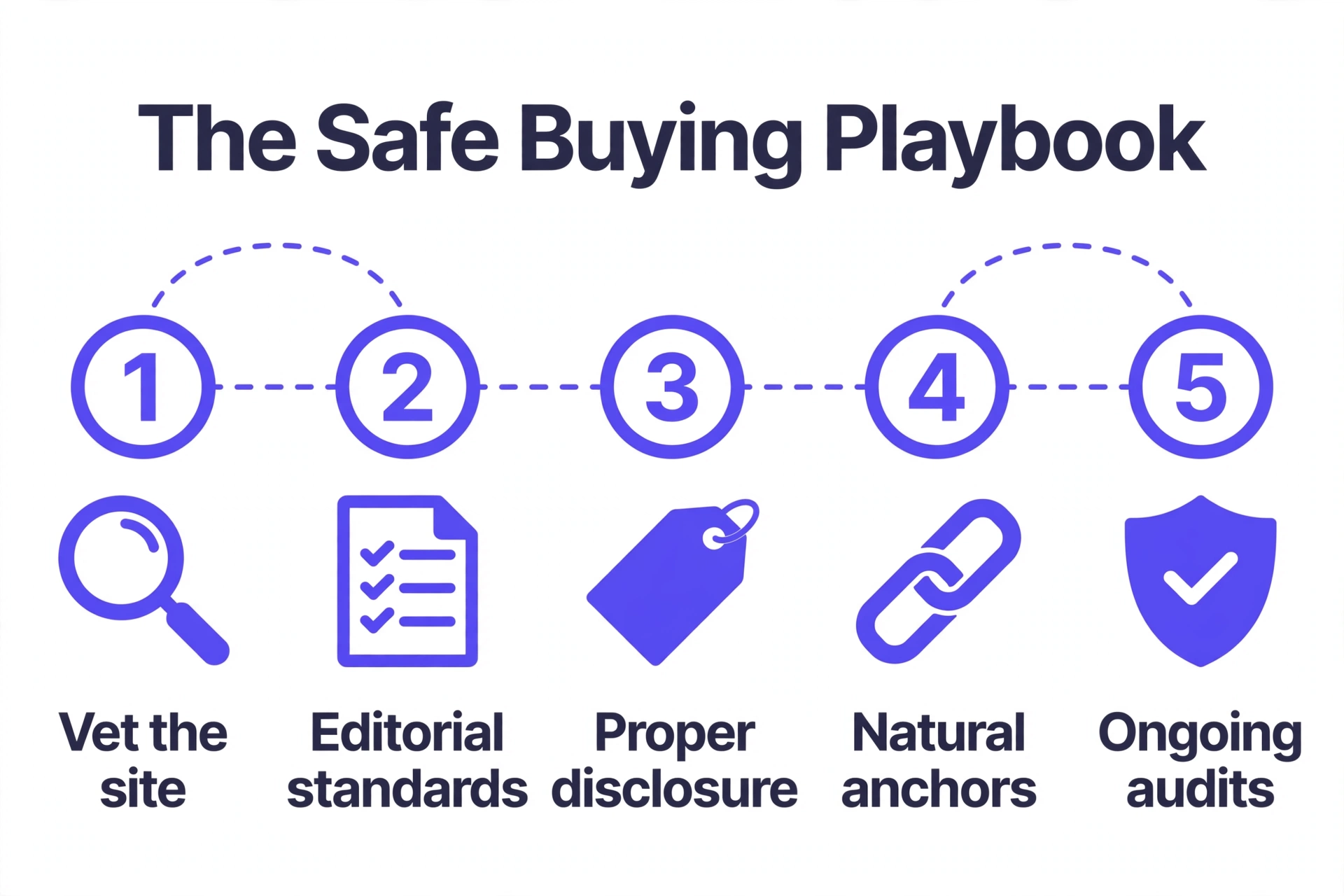
So what does “buying backlinks safely” actually mean, in practice, with money changing hands? Six rules. They don’t make paid links risk-free — nothing does — but they draw the line between a defensible spend and a documented scheme.
Rule 1: Pay for labor and assets, not links
The safest money in link building buys work: the research, the content, the outreach, the data study, the PR campaign. The links that result are earned editorially, by people who chose to link.
This isn’t semantics — it’s the structural difference Google’s policy cares about. When you pay a writer and a journalist links to the article, no ranking credit was purchased. When you pay per link placed, it was. Same budget, opposite risk profiles. Spend on the left side.
Rule 2: Sponsored means sponsored
If you’re paying a publication for placement, the links carry rel="sponsored" or rel="nofollow". Full stop. No “the vendor said their sponsored posts pass value.” No “it’s a special arrangement.”
Yes, this means the links won’t directly move rankings. That’s the price of compliance, and it’s non-negotiable.
Rule 3: Editorial standards or nothing
Whether it’s a guest post, a niche edit, or an agency placement: the linking site must have real editorial standards. Real traffic. Real content people actually read. An editor who can say no.
This is the bright line between Market 2 (agencies with standards) and Markets 1 and 3 (inventory and networks). Ask the vendor: who edits the content? What’s the site’s traffic? Can I see the site before I pay? A “no” to any of those is your answer about the vendor.
If you want placements handled with vetting and standards, Rankestra’s link insertion service exists for exactly this — real sites, real traffic, editorial review. That’s the pitch, stated plainly, so you can hold it to the standard this chapter sets.
Rule 4: Relevance is the receipt
Every paid or placed link must be topically relevant — the linking page’s subject genuinely connects to your page’s subject. Not “both are websites.” Not “the audience might overlap.” A connection a human reviewer would defend.
Relevance is doing double duty: it’s an SEO signal, and it’s your evidence of good faith. The Fiverr data showed what irrelevance looks like at scale — gig links on elder-abuse articles on .edu blogs. Nobody reviewing that profile thinks “editorial judgment.”
Rule 5: Disclosure where it’s required
Paid placements, sponsorships, and affiliate relationships require disclosure — legally in many jurisdictions and by platform policy. Sponsored links use rel="sponsored". Affiliate links get disclosed. This isn’t optional ethics; it’s the law in the markets you’re targeting, and it’s the policy of the platforms you want links from.
Real talk: vendors who resist disclosure aren’t protecting you — they’re protecting themselves, using your site as the shield. The moment a vendor says “don’t worry about the attribute,” you’re not the client anymore. You’re the cover story.
Rule 6: The one question that ends every debate
Would you be comfortable if your link acquisition were described, accurately, on the front page of your industry’s trade press? If yes, proceed. If no, don’t.
This single test resolves nearly every gray area in this guide.
Chapter 7: What Backlinks Actually Cost
The cluster keyword for this pillar is “how much do backlinks cost” — so let’s answer it honestly. No invented price tables. No fake “industry averages.” Just the models, the drivers, and the rules that keep you from getting scammed.
The three pricing models
Per-link / per-placement: you pay for each link placed, priced by the site’s metrics and the vendor’s margin. Simple, legible — and the model closest to “buying links” in Google’s definition, so the compliance burden is highest here. Every placement needs to survive Chapter 6’s rules individually.
Monthly retainer: you pay an agency a flat fee for ongoing link-building work — outreach, content, placements. The risk profile depends entirely on what the retainer actually buys: labor and assets (safer) vs. a quota of links.
Pay for assets and outreach: you fund the data study, the content, the PR campaign, the outreach specialist’s hours. Links are the outcome, not the line item. This is the model this guide recommends — it’s the only one where the thing you paid for and the thing Google rewards are the same thing.
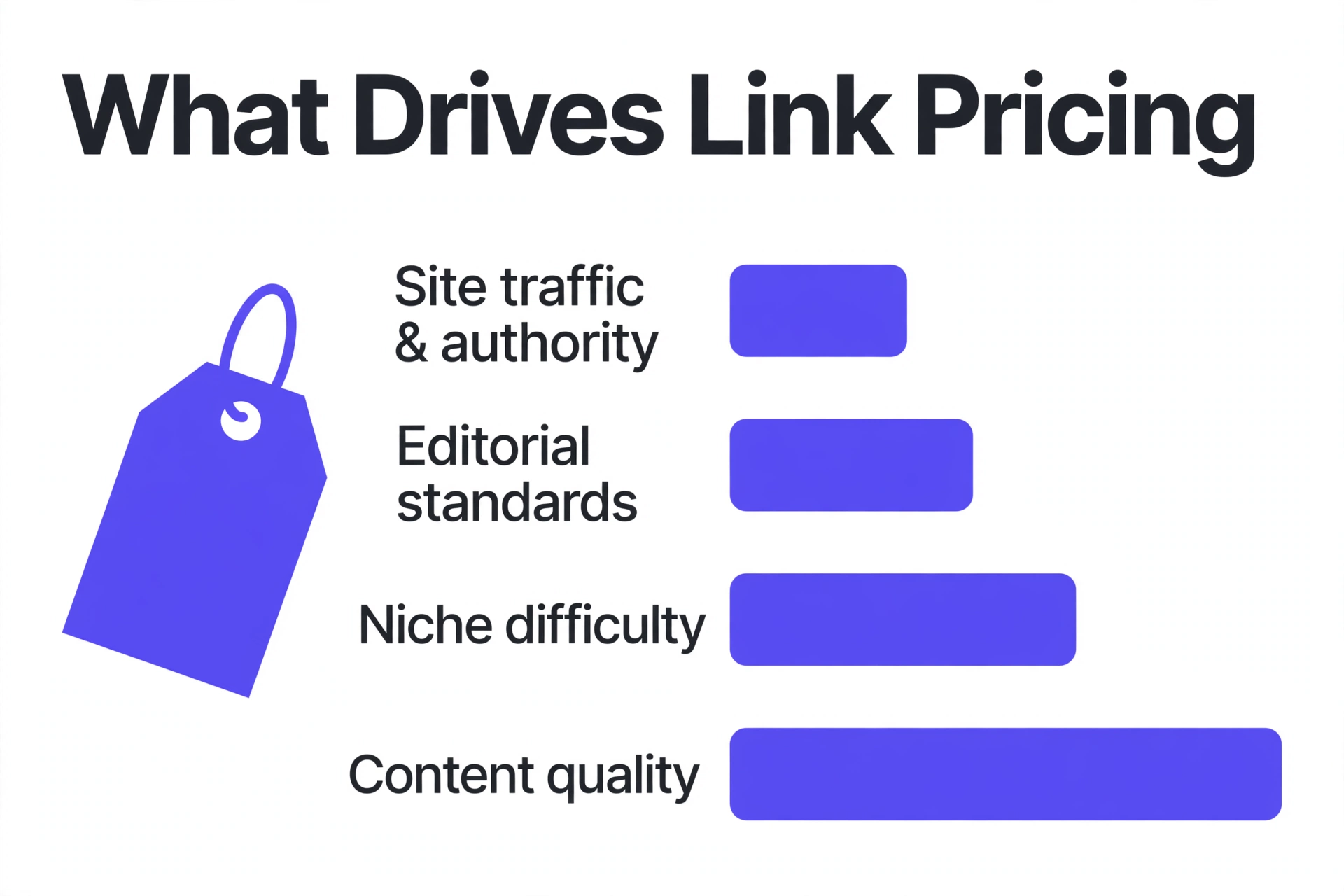
The five price drivers
Why does one placement cost ten times another? Five factors, in rough order of impact:
1. Real traffic. Sites with genuine audiences cost more because their links are worth more — to humans and to algorithms. A link nobody will ever click is cheap for a reason.
2. Editorial standards. Sites with real editors who reject most pitches charge more (or don’t sell at all). Friction is the price of legitimacy.
3. Niche difficulty. Links in iGaming, CBD, crypto, and adult cost more because the supply of willing, quality publishers is smaller. The niche link building guide maps exactly why hard niches command premiums — smaller ecosystems, stricter gatekeepers, higher compliance costs.
4. Content quality required. A placement requiring genuine expertise, original research, or professional writing costs more than a spun 500-word filler post — because one of those is real and the other is inventory.
5. Exclusivity and relationships. Access to publications that don’t sell to everyone costs more. If anyone with a credit card can buy the same placement, you’re buying a commodity — and commodities leave footprints.
Why iGaming and CBD cost more
Worth spelling out, since it’s the most common pricing surprise: in restricted niches, mainstream publishers won’t participate, so the pool of quality link sources is a fraction of the size. Smaller supply, same or higher demand, plus compliance overhead on every placement. Prices follow.
Anyone quoting you SaaS prices for iGaming links is either naive or selling you inventory that no legitimate iGaming publisher would touch. The niche premium is real, and it’s information — it tells you the market is functioning.
The too-cheap rule
Here’s the only pricing rule you need: if the price makes no economic sense, the product isn’t what the label says. A “DA 50” link for the price of a coffee isn’t a bargain — it’s PBN or network inventory wearing a metrics costume. Real sites with real traffic have real costs: hosting, writers, editors, audiences built over years. Nobody sells that for pocket change.
The Fiverr data is the exhibit: gigs advertising backlinks from $5 produced the profile in Chapter 5 — hundreds of thousands of links from scraper domains and coordinated networks. The price was honest. The product was exactly what $5 buys.
What “expensive” actually buys you
Higher prices buy three things: real audiences (humans who might click), editorial friction (standards that keep the neighborhood clean), and uniqueness (placements your competitors can’t buy from the same menu tomorrow).
None of those show up in a DA score. All of them show up in whether the link still counts in two years.
The cost question nobody asks
Real talk: the most expensive link you’ll ever buy is the cheap one that works just long enough to make you dependent on it.
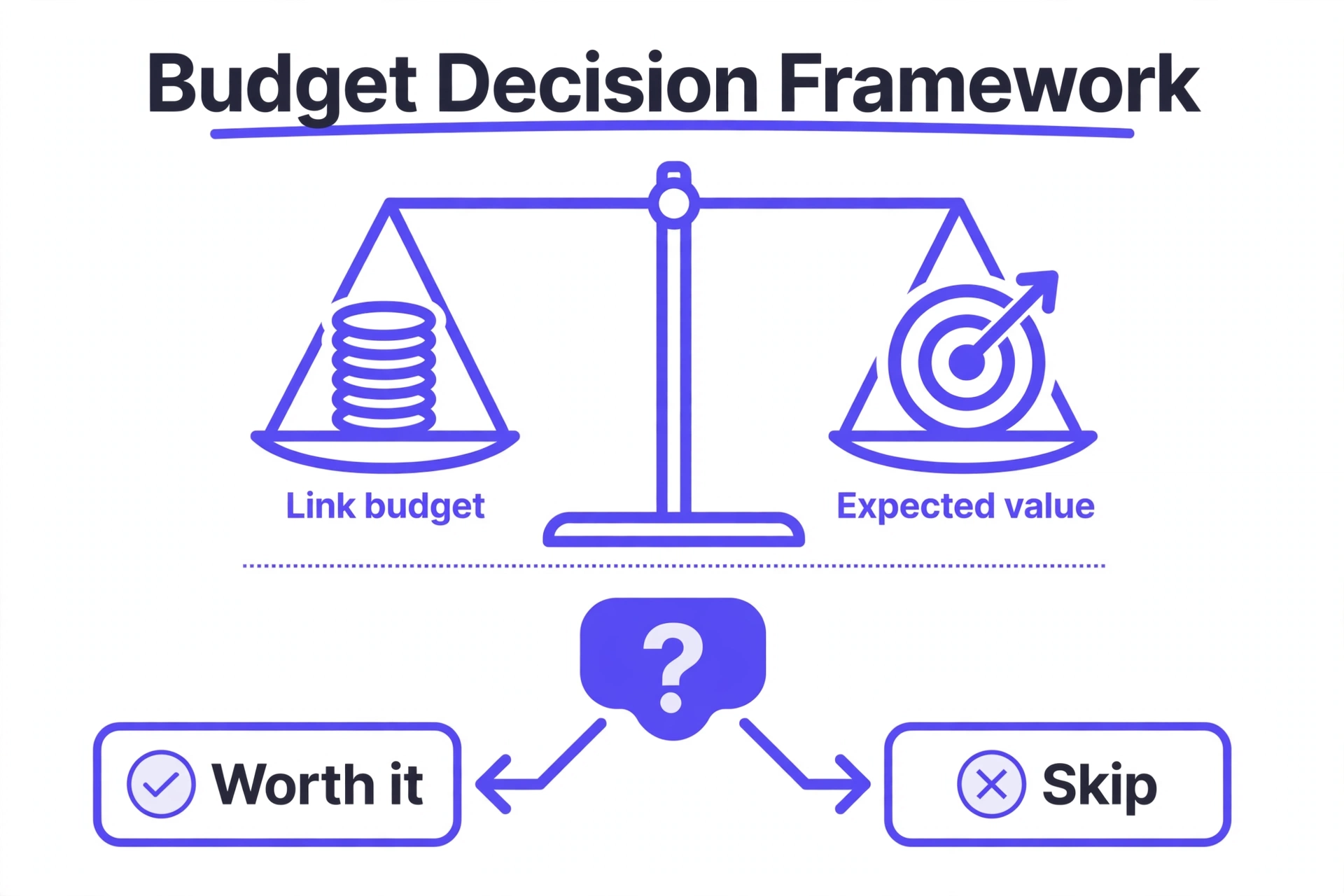
Chapter 8: The 5 Safer Ways to Spend the Same Budget
Whatever you were going to spend on bought links, here’s where the same money buys more — with the risk profile of Chapter 6’s left side instead of its right.
1. Niche edits on real ranking pages
Pay for the outreach and vetting to earn insertions into existing, ranking, relevant articles — not for the link as a line item, but for the skilled work of finding genuine fit and negotiating editorial placement. The page already ranks, already has traffic, already has an audience.
The full mechanics — finding opportunities, quality checks, what separates a real insertion from a paid-link scheme — are in the niche edits and link insertions guide.
2. Digital PR and data studies
Fund original research: a survey, a dataset, an analysis only you can produce. Then pay for the PR outreach to get it covered. Journalists link to data — it’s the most reliable earned-link engine in SEO, and every link is editorial by construction.
This is the highest-upside option on this list and the slowest — see the digital PR playbook. It requires something genuinely newsworthy, which requires genuine work. That’s not a bug; it’s why the links count.
3. Guest posting with standards
Real guest posts on real publications: genuine expertise, editorial review, relevant audience, disclosure where appropriate. Not the marketplace version — the version where the editor can reject you.
The difference between a legitimate guest post and a paid link wearing a guest-post costume is everything in Chapter 6: editorial standards, real traffic, relevance. The guest posting and blogger outreach guide has the complete system.
4. Wikipedia citations
If your content genuinely qualifies as a reliable source, earning a Wikipedia citation is one of the highest-trust placements available — nofollowed, but surrounded by the strongest editorial standards on the web. You can’t buy your way in; Wikipedia’s editors and conflict-of-interest rules see to that.
Which is precisely why it works: the friction is the value — see the Wikipedia backlinks guide in the series library below for what qualifies and how the process actually works.
5. Build something worth citing
The unsexy champion: free tools, definitive guides, original data, reference documentation. Things people link to because they need to, not because you asked.
This is the slowest option and the most durable. A genuinely useful free tool earns links for years with zero ongoing spend — the opposite economics of bought links, which stop working the moment you stop paying.
Real talk: notice that all five options share one trait — the money buys work, and the links are a byproduct of the work being good. That’s not a coincidence. It’s the entire theory of safe link building in one sentence.
Chapter 9: Due Diligence Checklist — Before You Pay Anyone
If you’re going to spend money anywhere near link acquisition, run every opportunity through this checklist first. It’s the audit framework that separates a defensible placement from a future disavow file.
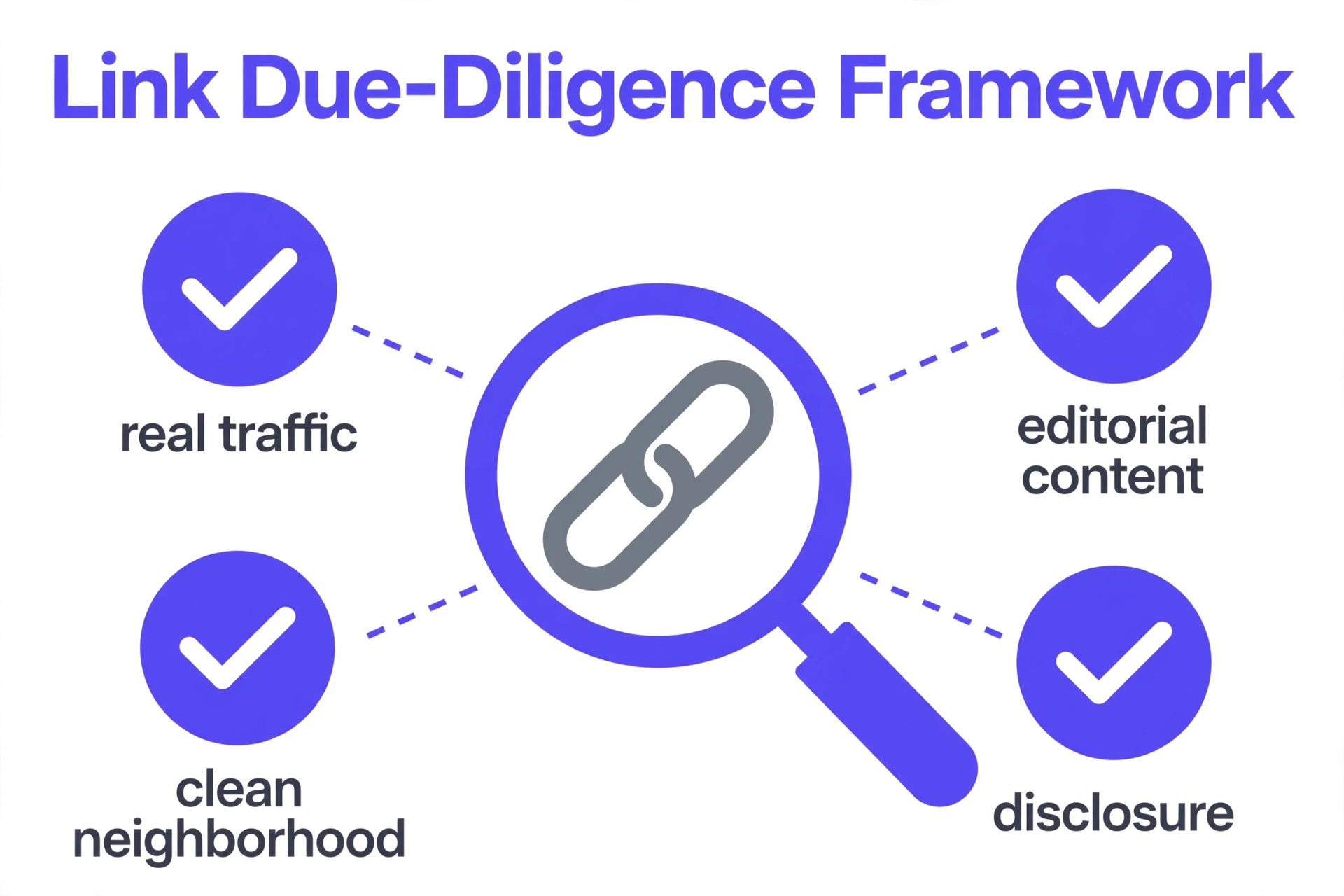
Check 1: Verify real traffic
Check the site’s actual organic traffic in Semrush, Ahrefs, or Similarweb — not the DA/DR score the vendor quoted. Real sites have real visitors. A “DA 50” site with zero organic traffic is a metrics shell: authority scores can be manipulated, but sustained search traffic is much harder to fake.
The Fiverr case showed the alternative: 205,000 referring domains at AS 0–10. Metrics without traffic are decoration.
Check 2: Read the content
Actually read the site. Is the content written for humans? Is it coherent, current, and relevant to its stated topic? Or is it generic filler with a publish date from last week and no author?
This takes five minutes and filters out most inventory. Vendors count on buyers never looking past the metrics screenshot.
Check 3: Inspect the neighborhood
Look at the site’s outbound links — who else are they linking to? A real publication links to a natural mix of sources. A link seller’s outbound profile is a casino/CBD/crypto/essay-writing grab-bag (Chapter 3’s neighborhood test).
If the site’s recent posts link out to unrelated commercial pages across a dozen niches, you’re not buying editorial judgment. You’re renting space on a billboard that sells to everyone.
Check 4: Ask who else they’ve linked
Ask the vendor for examples of past placements — then check whether those same sites link to your competitors, or to anyone who’ll pay. Shared inventory means shared footprints: when one buyer’s links get mapped, every buyer on the same sites is mapped with them.
Exclusivity isn’t just a luxury; it’s risk management.
Check 5: Keep anchor control natural
Resist the urge to exact-match everything. Branded and natural anchors should dominate; commercial exact-match anchors should be rare and varied. The Fiverr anchor data — “visit gig” 730,000 times from 8 domains — is what happens when anchor discipline doesn’t exist.
If a vendor encourages aggressive exact-match anchors on every placement, they’re optimizing for the screenshot they send you, not for your site’s survival.
Check 6: No guarantees is a good sign
Real talk: the most trustworthy thing a vendor can tell you is what they can’t do. No legitimate operator guarantees rankings, guarantees specific placements on publications they don’t own, or promises timelines to the day. Those guarantees are only possible when the vendor controls the sites — which means it’s a network.
A vendor who says “we’ll pitch these ten publications and typically land three to five” is describing outreach. A vendor who says “guaranteed 50 DA-40+ links in 7 days” is describing inventory. Believe the second one literally and act accordingly.
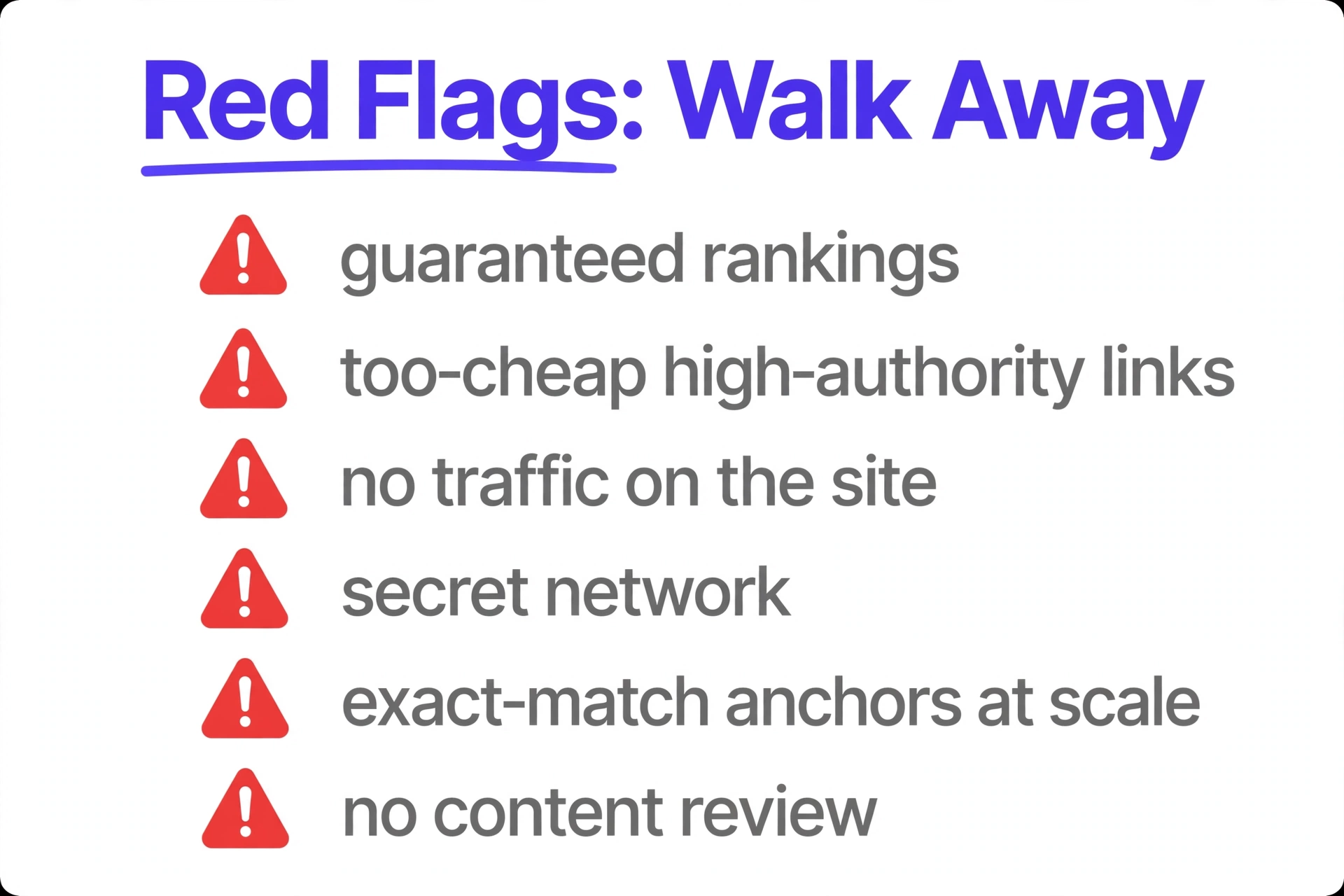
Check 7: Get the terms in writing
What’s the site? What’s the anchor? Is the link follow or nofollow/sponsored? Is there disclosure? What happens if the link is removed? Get it documented before paying.
This isn’t just professionalism — it’s your evidence trail. If you ever need to audit, disavow, or defend the profile, “the vendor promised on a call” is worth nothing. Professional link building is auditable link building.
Check 8: The front-page test
One more time, because it’s the only check that never fails: would you be comfortable if this placement — vendor, price, anchor, and all — were described accurately in your industry’s press?
Every scheme in Chapter 4 failed this test. Every compliant tactic in Chapter 6 passes it. When the checklist gets complicated, this question cuts through all of it.
Chapter 10: The Verdict + FAQs
After nine chapters, here’s the verdict in one paragraph: buying links for ranking purposes violates Google’s spam policies, the detection is continuous and pattern-based, the public record of getting caught is brutal, and the data shows exactly what the cheap end produces. The safe ways to spend money in this space are real — sponsored content with proper attributes, and paying for labor and assets that earn links editorially. Everything else is a documented risk you’re choosing to take with open eyes.
That’s not a moral judgment. It’s the mechanics.
Is buying backlinks illegal?
No — buying backlinks isn’t against the law. But “legal” and “allowed by Google” are different things. Buying links for ranking purposes violates Google’s spam policies, which means the consequences are algorithmic and commercial (lost rankings, traffic, revenue), not criminal. Don’t confuse “nobody will arrest you” with “nothing bad will happen.”
Can Google detect paid backlinks?
Yes — through AI-driven systems (SpamBrain) that analyze anchor concentration, link neighborhoods, velocity, and network footprints, plus human manual reviews. Detection runs continuously since Penguin 4.0 became part of the core algorithm; there’s no safe window between updates. Chapter 5’s Fiverr data shows how legible these patterns are even to the naked eye.
What happens if Google catches you buying links?
Two outcomes: the links get silently devalued (most common — you paid for nothing), or you receive a manual action suppressing your rankings until you clean up and file for reconsideration. Public cases — J.C. Penney, Interflora, iAcquire — show the range from embarrassing to existential. Recovery is slow, manual, and rarely restores everything that was lost.
Are sponsored posts with nofollow links worth it?
For rankings directly: no, by design — nofollow/sponsored links pass no ranking credit. For everything else: often yes. Referral traffic, brand exposure, and downstream editorial links (journalists read publications) are real value. The mistake is paying sponsored prices while expecting ranking results — measure what sponsored content actually delivers.
How much do backlinks cost in 2026?
There’s no honest single number — anyone giving you one is selling something. What determines price: the pricing model (per-placement, retainer, or pay-for-assets), and five drivers — real traffic, editorial standards, niche difficulty, content quality required, and exclusivity. The one reliable rule: prices that make no economic sense mean the product isn’t what the label says. See Chapter 7 for the full breakdown.
What’s the safest way to pay for link building?
Pay for labor and assets, not links: fund the research, content, PR, and outreach, and let links come editorially. If you’re paying for placement itself, use sponsored content with proper rel="sponsored" or rel="nofollow" attributes. And run every opportunity through Chapter 9’s due-diligence checklist before money changes hands.
Continue the Series: The Complete Link Building Library
This guide is the seventh and final pillar in Rankestra’s complete link building series. The full library:
- Pillar 1: White Hat Link Building — The Complete 2026 Guide — the universal foundations everything builds on.
- Pillar 2: Digital PR for Link Building — The Complete 2026 Guide — earning editorial links through newsworthy campaigns.
- Pillar 3: Guest Posting & Blogger Outreach — The Complete 2026 Guide — the outreach system behind earned placements.
- Pillar 4: Wikipedia Backlinks — The Complete 2026 Guide — earning citations on the world’s most trusted reference.
- Pillar 5: Niche Edits & Link Insertions — The Complete 2026 Guide — placing links into content that’s already winning.
- Pillar 6: Niche Link Building — The Complete 2026 Guide — SaaS, iGaming, and the niches with their own rules.
- Pillar 7: Buying Backlinks Safely — you’re reading it.
Don’t Be the 99%: Your Move
Here’s the uncomfortable truth this whole guide — and this whole series — has been building toward: 99% of link buyers take the shortcut. They buy the gig, the marketplace package, the guaranteed DA-50 bundle. And most of them get exactly what Chapter 5 measured: hundreds of thousands of links from nowhere, pointing at a profile Google already knows how to read.
You now know what the 1% does instead. They pay for work, not links. They demand editorial standards. They check the neighborhood, control the anchors, disclose what’s paid, and pass the front-page test on every placement. It’s slower. It costs more per link. And it’s the only approach that still works when the detection is continuous and the patterns are this legible.
So here’s the challenge: this week, audit one thing. Pull your own backlink profile — or your vendor’s sample report — and check it against Chapter 5’s patterns. Anchor concentration? Low-authority domain share? Neighborhoods that look like inventory? If you see Fiverr’s shape in your own data, you already know what to do.
Don’t be the 99%. Read the pattern. Then build the right way — or work with a team that does: Rankestra’s contextual link building is built on the standards this guide sets, not the shortcuts it warns about.
Seven pillars. One honest playbook. Go build.