A generic link building agency will happily sell you the same playbook for a SaaS startup, a casino affiliate, and a CBD brand.
That playbook will fail for at least two of the three.
Niche link building is link building adapted to the specific rules, gatekeepers, and realities of your industry. The tactics that work for a project-management SaaS are nearly useless for an iGaming site. The outreach that lands in SaaS gets you ghosted — or worse, ignored by design — in crypto, adult, or CBD. Every niche has its own linking economy: where links live, who controls them, what earns them, and what gets you penalized or deplatformed.
This guide maps that economy. You’ll get the full breakdown: what separates niche link building from generic tactics, a complete dissection of Atlassian’s 57.2-million-backlink profile showing how a SaaS giant’s niche link engine actually works, the SaaS playbook, the honest reality of iGaming and gambling link building, the difficult niches most guides won’t touch (crypto, adult, CBD), outreach angles that work when nobody wants to link to you, a compliance checklist, and how to measure ROI when results are slow.
No hype. No invented case studies. Just mechanics, data, and straight talk.
Chapter 1: What Niche Link Building Actually Is
The 30-second definition
Niche link building = link acquisition strategies designed around one industry’s specific link ecosystem. Same goal as regular link building — authoritative, relevant backlinks — but the tactics, targets, and constraints are shaped by where your industry’s links actually live and what that industry’s gatekeepers actually respond to.
A generalist approach asks: “How do we get backlinks?” A niche approach asks: “How does this industry hand out backlinks — and who decides?”
Why generic playbooks break in specialist niches
Most link building advice assumes a cooperative web: bloggers accept guest posts, journalists answer HARO-style queries, resource pages welcome submissions, and nobody has a policy against linking to you.
That assumption collapses in regulated or stigmatized niches. Mainstream publications have written policies against linking to gambling and adult sites. Google News and many ad platforms restrict CBD. Crypto sites get lumped in with scams by default. When the standard channels are closed, the standard playbook is decoration.
Real talk: if your niche has ever been called “difficult,” it’s not because links are impossible there. It’s because the links live somewhere different — and the generalist playbook doesn’t know the address.
The three forces that shape every niche
Every industry’s link ecosystem is shaped by three forces. Learn them before you build a single link.
Force 1: Gatekeepers. Who controls the linking pages? In SaaS, it’s developers, product reviewers, and integration directories. In iGaming, it’s affiliates, tipster communities, and sports publishers. In crypto, it’s protocol docs, exchange listings, and security auditors. Your outreach must speak to that gatekeeper’s incentives.
Force 2: Regulation and policy. What are the legal and platform rules? Gambling advertising laws, CBD health-claim rules, crypto securities regulations, adult content age-gating — each one redraws the map of where you can appear and what you can say.
Force 3: Trust economics. How does this industry decide who to trust? SaaS trusts documentation and developer citations. iGaming trusts payout reputation and licensing transparency. Finance trusts credentials and audit trails. Links flow toward whatever each niche’s trust signals are.
Generalist vs. niche link building, side by side
A generalist campaign targets broad authority: news sites, general blogs, directories, and resource pages across topics. It works best for businesses nobody has a reason to avoid — local services, e-commerce, B2B tools with broad appeal.
A niche campaign targets industry-specific authority: the publications, communities, directories, and documentation hubs that your buyers actually read and that your industry’s algorithms and humans respect. The tactics look different because the map is different.
Neither is “better.” They’re different tools. The mistake is using the generalist tool on a niche problem — which is what most agencies do, because generalist tactics are easier to sell at scale.
The honest prerequisite
Niche link building demands one thing generalist link building doesn’t: actual understanding of the niche. You can’t build links in iGaming without understanding affiliates, licensing jurisdictions, and why tipsters matter. You can’t build SaaS links without understanding developers, changelogs, and integration ecosystems.
If that sounds like work, it is. It’s also the moat. Anyone can buy a guest post. Very few people can earn a citation in a developer’s Git tutorial — and that’s exactly the kind of link Chapter 2 dissects.
For the foundations that apply everywhere, the white hat link building guide covers the universal principles. Everything from here on is niche-specific.
Chapter 2: The Atlassian Case — 57.2 Million Backlinks, Dissected
Want to see a niche link engine running at full power? Look at Atlassian.
Atlassian (atlassian.com) — the company behind Jira, Confluence, Trello, and Bitbucket — was analyzed in Semrush’s Backlink Analytics on 2026-10-10. Every number below is real, observed data. And inside those 57.2 million backlinks is a masterclass in how SaaS companies earn links as a byproduct of how their products work.
The headline numbers
- Authority Score: 80 — rated “Industry leader” (Semrush category: Computer Software & Development)
- Referring domains: 184,000
- Backlinks: 57.2 million
- Monthly visits: 47.5 million
- Organic traffic: 7.3 million
- Outbound domains: 19,100
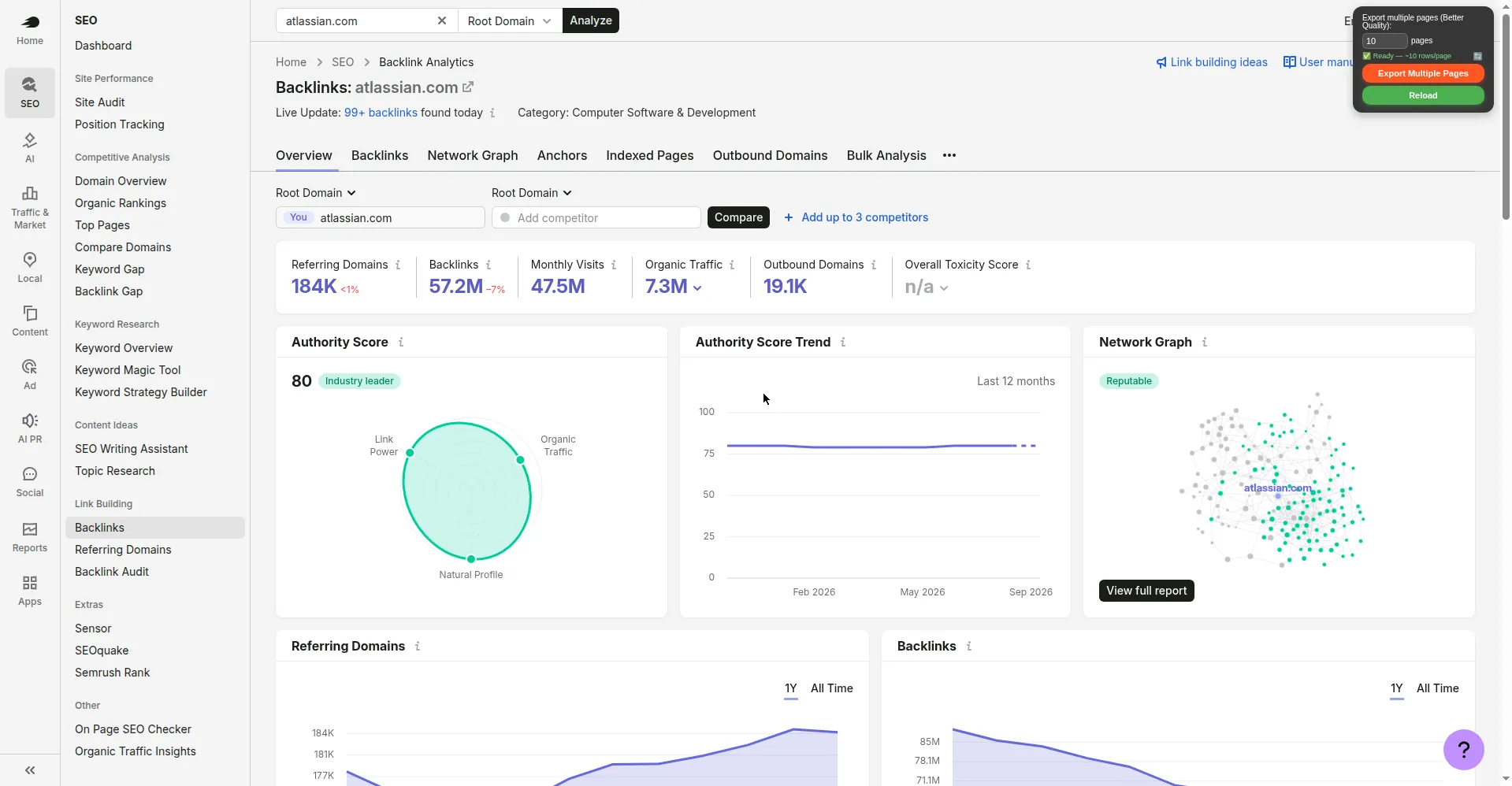
Solid numbers for a SaaS giant. But as always, the interesting part isn’t the size — it’s the shape.
The anatomy of the profile
The follow/nofollow split is healthy: 66% follow (38.4 million) vs. 34% nofollow (20.2 million), with sponsored links under 1% (212K) and UGC links under 1% (95.7K). Two-thirds of the profile passes value — a strong signal of genuine editorial linking rather than spam footprints.
Link types confirm it: 96% text (59.4 million), 3% image (2.3 million). This is a profile built on real text links in real content — citations, references, documentation links — not image badges and footer dumps.
Real talk: compare that 66% follow ratio to what you’d see on a profile inflated by comment spam or forum signatures. Spam-heavy profiles skew nofollow. Atlassian’s skews follow. The shape of a profile tells you more than its size.
The ecosystem engine: cross-links from Trello, Bitbucket and friends
Here’s the first SaaS lesson hiding in the data. Atlassian owns Trello, Bitbucket, and Loom — and those properties link back to atlassian.com with high-authority, in-content editorial links:
- trello.com/home (Page AS 90) — anchor “Learn more.” → atlassian.com’s AI page — Text, Content (first seen Jul 13, 2025; currently marked lost/link removed)
- bitbucket.org/product/code-repository (Page AS 88) — anchor “Jira Software and Bitbucket” → atlassian.com’s Jira–Bitbucket integration page — Text, Content (first seen Mar 28, 2026)
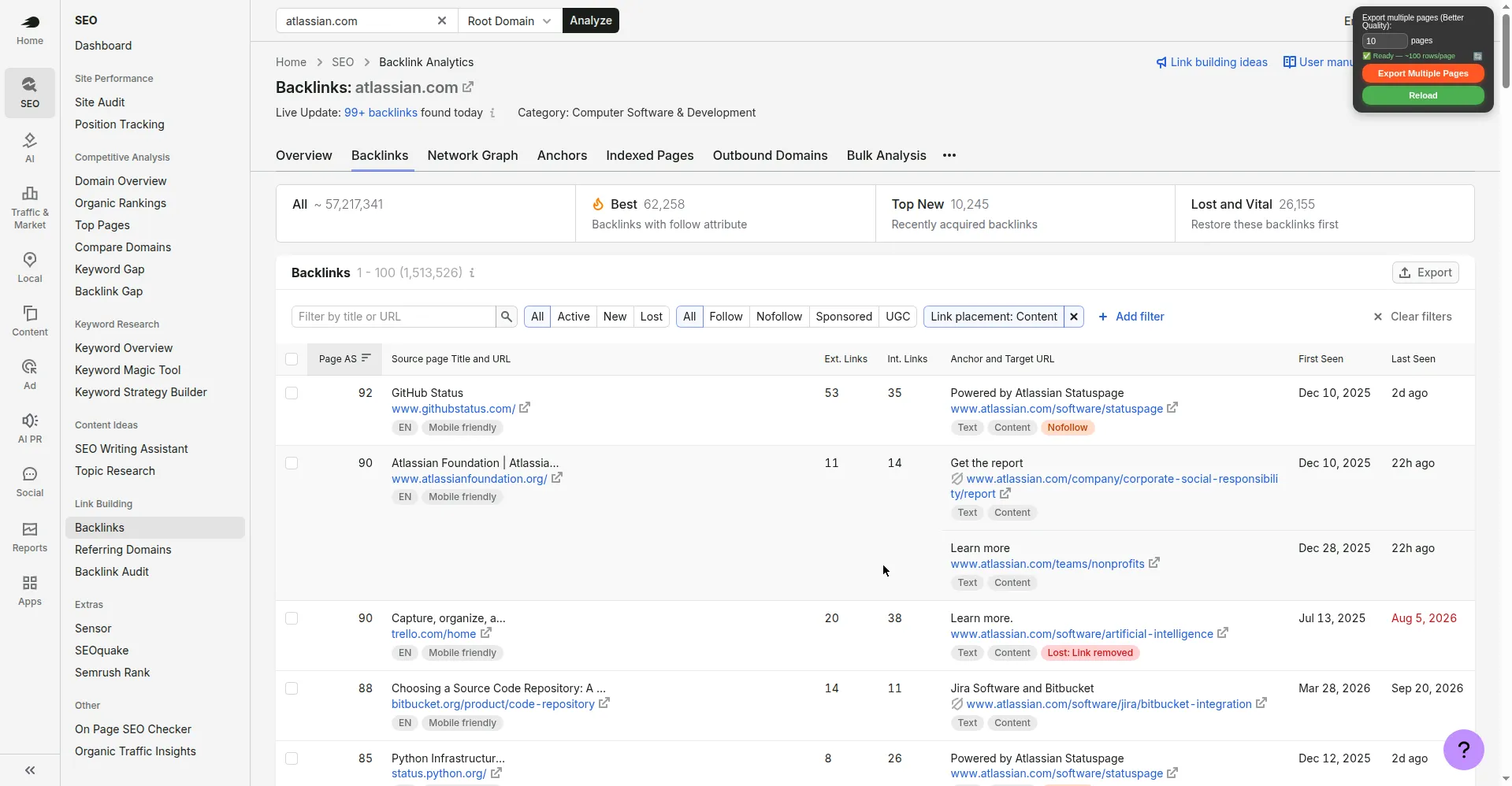
When you acquire products with their own traffic and authority, every cross-link between them is a niche link building win you didn’t have to pitch for. Product ecosystems are link ecosystems. That’s a structural advantage no outreach campaign can replicate — and it’s why SaaS consolidation is, quietly, also a link strategy.
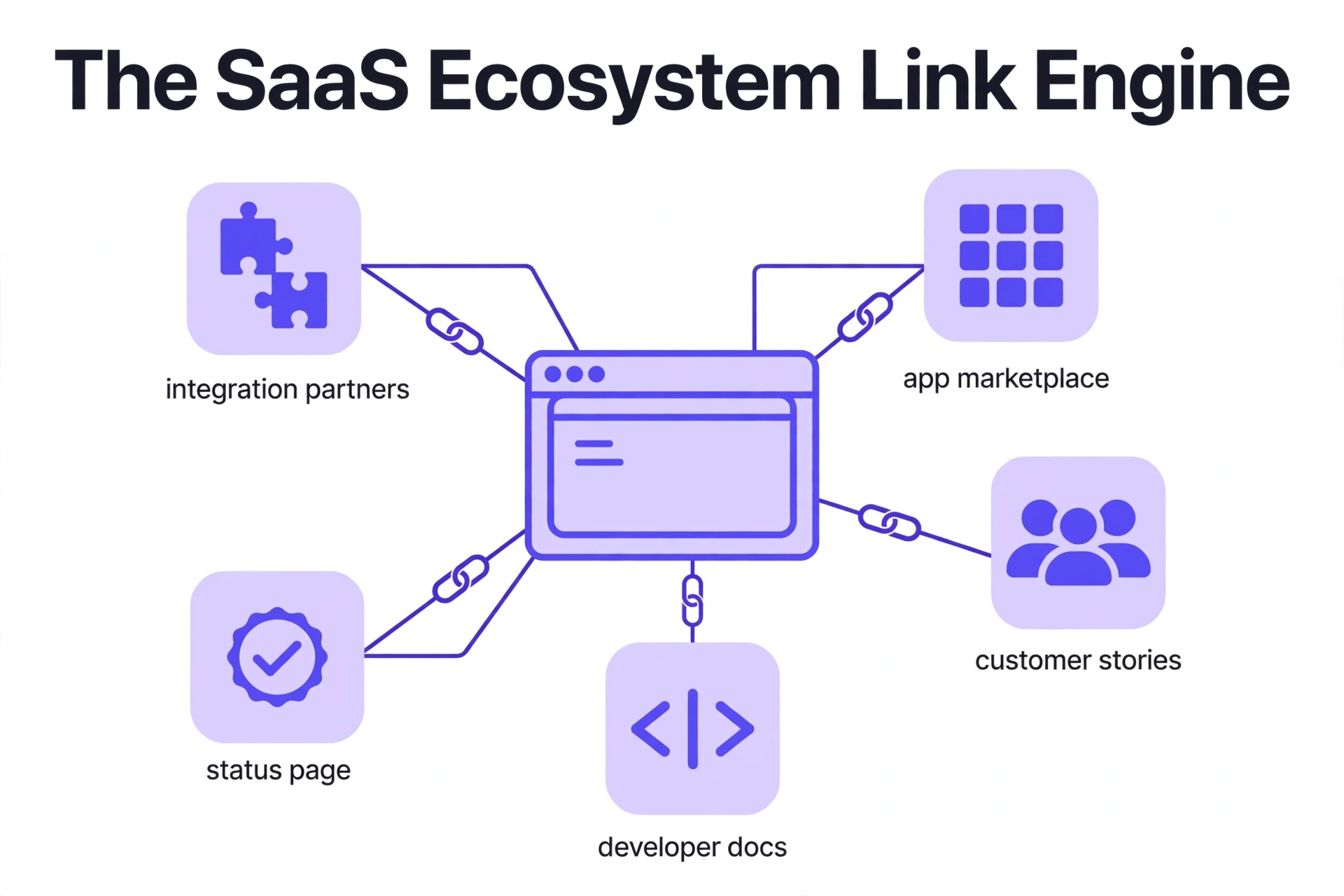
The product-led link engine: “Powered by Atlassian Statuspage”
Now the most elegant pattern in the entire dataset. The single highest-authority contextual row in Atlassian’s backlink data is githubstatus.com (Page AS 92) — anchor “Powered by Atlassian Statuspage” → atlassian.com/software/statuspage — first seen Dec 10, 2025.
That’s a product-embedded badge link. Atlassian’s Statuspage product powers the status pages of GitHub, Cloudflare, Shopify, Python, Vercel, and thousands of other SaaS companies. Every one of those status pages carries a “Powered by Atlassian Statuspage” link back to atlassian.com.
Think about what that means. Atlassian didn’t pitch a single one of those links. The product is the link building campaign. Every new Statuspage customer deploys a backlink on a high-authority domain as a side effect of using the product. That’s a link engine that compounds with revenue — more customers, more links, automatically.
Real talk: this is the SaaS link building endgame, and almost nobody outside SaaS can replicate it. If your product can embed a credit link, a badge, a “powered by” attribution, or a public-facing artifact (status pages, embedded widgets, public dashboards, open-source tools), you have a link engine, not a link campaign. Build the product feature; the links follow.
Developer-content citations: the trust links money can’t buy
The second pattern is quieter but just as instructive. Atlassian’s documentation gets cited the way academic papers get cited — as the authoritative reference:
- contributions.bioconductor.org (Page AS 84) — anchor “Based on: Resolving a merge conflict” → atlassian.com’s Git merge-conflicts tutorial — editorial citation inside a Git tutorial (first seen Dec 9, 2025)
- github.com/resources/articles/devops-tools-comparison (Page AS 81) — anchor “Atlassian certifications” → atlassian.com/trust/compliance — cited in GitHub’s own DevOps comparison article (first seen Sep 21, 2026, flagged “New”)
- matomo.org/privacy-policy/ (Page AS 82) — anchor “DPA” → atlassian.com’s data-processing addendum — cited in a privacy/compliance SaaS document (first seen Dec 7, 2025)
- seclists.org (Page AS 80) — marketplace app URL anchor → an Atlassian Marketplace app page — nofollow, from security advisory content (first seen Jul 18, 2026)
Notice what earned these links: documentation, tutorials, compliance pages, and marketplace listings. Not blog posts. Not press releases. Reference content that other professionals genuinely need to cite.
This is the SaaS niche secret in one sentence: your docs are your link building. The pages developers bookmark, the tutorials other tutorials cite, the compliance pages procurement teams reference — those are the link magnets in software. A single great Git tutorial out-links a hundred blog posts.
The anchor pattern — and the warning inside it
Now the part of the data that should make you pause. Atlassian’s top 5 anchors:
- “find more” — 7,514,414 backlinks from just 25 domains (first seen Feb 21, 2025)
- “atlassian” — 7,156,213 backlinks from 18,005 domains (first seen Sep 9, 2018)
- “project management software” — 4,489,697 backlinks from 1,670 domains (first seen Feb 19, 2019)
- “jira” — 3,581,164 backlinks from 19,389 domains (first seen Feb 19, 2019)
- “atlassian confluence” — 2,274,909 backlinks from 2,707 domains (first seen Dec 25, 2021)
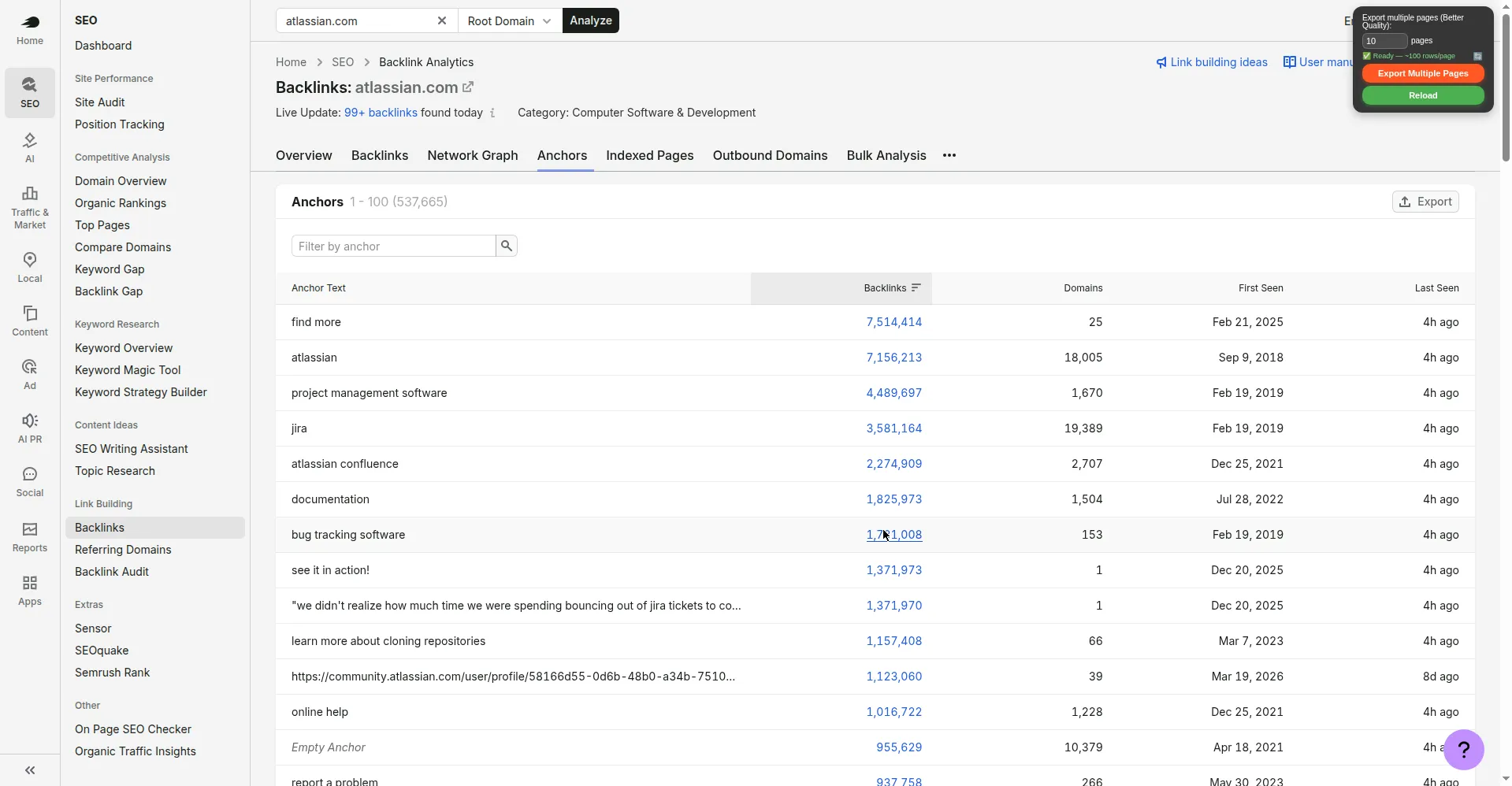
See the split? Branded anchors (“atlassian,” “jira,” “atlassian confluence”) come from thousands of domains — that’s natural editorial diversity. But “find more” has 7.5 million backlinks from 25 domains. “See it in action!” has 1.37 million links from 1 domain. “Bug tracking software” has 1.73 million from 153 domains.
That hyper-concentration is the fingerprint of badge, widget, and documentation-link patterns — sitewide template links, partner badges, embedded CTAs repeated across thousands of pages on a handful of domains. It’s not “natural editorial diversity,” and anyone auditing this profile can see it.
Real talk: this is a warning, not a template. Sitewide, template-driven anchor patterns are exactly the kind of footprint that looks fine until it doesn’t. Atlassian can absorb it — they’re an industry leader with 184K referring domains of genuine diversity underneath. A smaller site copying this pattern (thousands of identical anchors from a handful of domains) is building a footprint, not a profile. Learn the lesson (product-led links compound), skip the shortcut (don’t mass-deploy identical sitewide anchors).
What the Atlassian profile teaches niche link builders
Three lessons, applicable far beyond SaaS:
1. Your product can be your link builder. Statuspage’s “Powered by” badges, public-facing tools, embeddable widgets — anywhere your product appears publicly is a potential link source. Design for it deliberately.
2. Reference content out-earns marketing content. Docs, tutorials, compliance pages, and comparison resources attract the citations that matter in technical niches. Invest link-building energy in content people need to reference.
3. Watch your anchor concentration. The moment one anchor has millions of links from a handful of domains, you have a pattern, not a profile. Diversity of referring domains matters more than raw backlink counts.
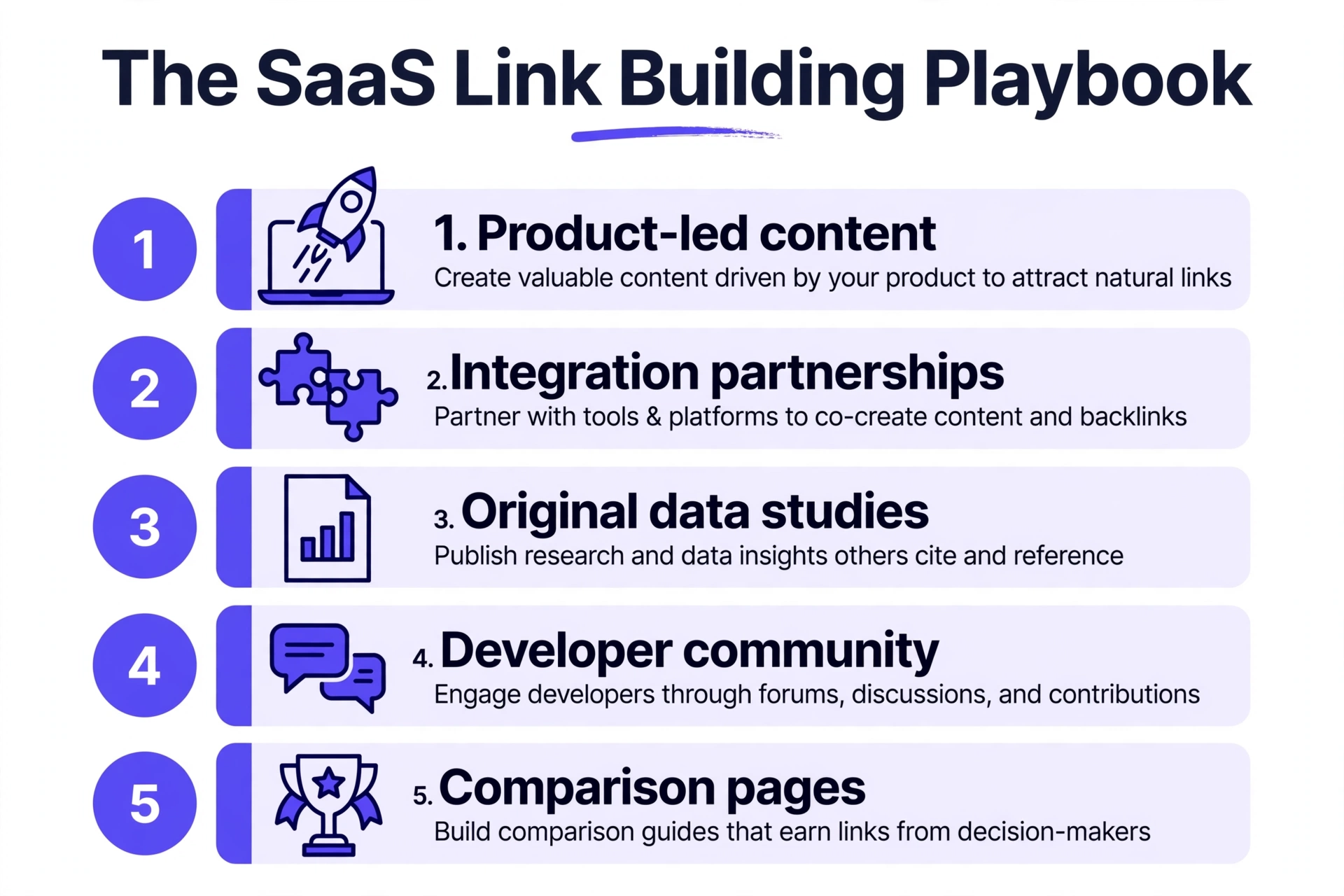
Chapter 3: The SaaS Link Building Playbook
SaaS is the friendliest niche in this guide — cooperative gatekeepers, technical audiences that cite sources, and products that can generate links on their own. Here’s the full playbook.
Play 1: Documentation as link bait
The Atlassian data proved it: tutorials and docs earn the citations. The playbook is straightforward — identify the questions your industry’s developers and users ask repeatedly, then write the single best reference answer on the internet.
Git tutorials. API references. Migration guides. “How X works under the hood” explainers. Troubleshooting databases. These pages get bookmarked, shared in Slack channels, cited in Stack Overflow answers, and linked from other companies’ docs. One definitive guide can out-earn your entire blog.
Real talk: most SaaS blogs chase thought-leadership fluff while their docs rot. Flip the budget. A boring, complete, accurate reference page is a better link asset than ten opinion pieces.
Play 2: The integration ecosystem
Every integration you ship is a link opportunity in both directions. Integration directories (think app marketplaces, “works with” pages, partner listings) link to you. Your integration docs link to partners. Co-marketing announcements earn press and blog links.
Atlassian’s Marketplace shows the pattern: app listing pages attract links from security advisories, review content, and directory pages. Your integration partners have audiences, blogs, and changelog pages — each one a potential linking page that already trusts you.
The move: treat every integration launch as a link event. Co-authored announcement, partner blog mention, directory listing, docs cross-link. None of this is “outreach” — it’s relationship infrastructure that happens to produce links.
Play 3: Product-led links (badges, embeds, public artifacts)
The Statuspage pattern, generalized. Anywhere your product creates a public artifact, there’s a link opportunity:
- “Powered by” badges on customer-facing pages (status pages, embedded widgets, forms)
- Public dashboards and reports users share (with attribution links)
- Embeddable tools — calculators, widgets, badges, browser extensions
- Open-source releases — GitHub repos earn links from awesome-lists, tutorials, and package directories
The key constraint: keep it honest and optional. Forced, hidden, or deceptive embedded links cross into manipulation territory. Attribution that users can see and remove is fine; sneaky injected links are not. Google’s spam policies are clear about manipulative link schemes — when in doubt, the white hat foundations draw the line.
Play 4: Comparison and alternative pages
“Your product vs. competitor” and “best tools for X” pages are link magnets in SaaS — when they’re honest. Buyers link to comparisons during evaluation. Affiliates and reviewers cite them. Competitors’ customers find them during switching research.
The honest version works better and lasts longer: genuinely compare, acknowledge where competitors win, and earn the reputation of the trustworthy source. A comparison page everyone trusts becomes the page everyone links.
Play 5: Data studies and original research
SaaS companies sit on proprietary data — usage patterns, benchmarks, industry surveys. Package it as original research and you have the single highest-earning link asset in the niche. Journalists cite data. Bloggers embed charts. Competitors reference your benchmarks (with links).
This is where digital PR for link building overlaps with SaaS: a good data study pitched to tech press earns the kind of editorial links outreach alone can’t buy.
Play 6: Developer relations and community
Sponsor the newsletters developers actually read. Contribute meaningfully to open source. Answer questions where developers ask them. Speak at the meetups and conferences in your stack’s ecosystem.
None of this is “link building” in the transactional sense — which is exactly why it works. Developer communities link generously to companies that genuinely contribute. The links are a byproduct of being a good citizen in the ecosystem.
The SaaS outreach reality
SaaS gatekeepers — bloggers, newsletter authors, documentation maintainers — are technical, busy, and allergic to fluff. Outreach that works here is specific, useful, and short. Lead with the value: the data, the tool, the fix for their broken link, the genuinely better resource.
For the mechanics of outreach that lands, the guest posting and blogger outreach guide covers the full system.
Chapter 4: iGaming & Gambling Link Building — The Honest Reality
Now the niche everyone asks about and nobody explains honestly.
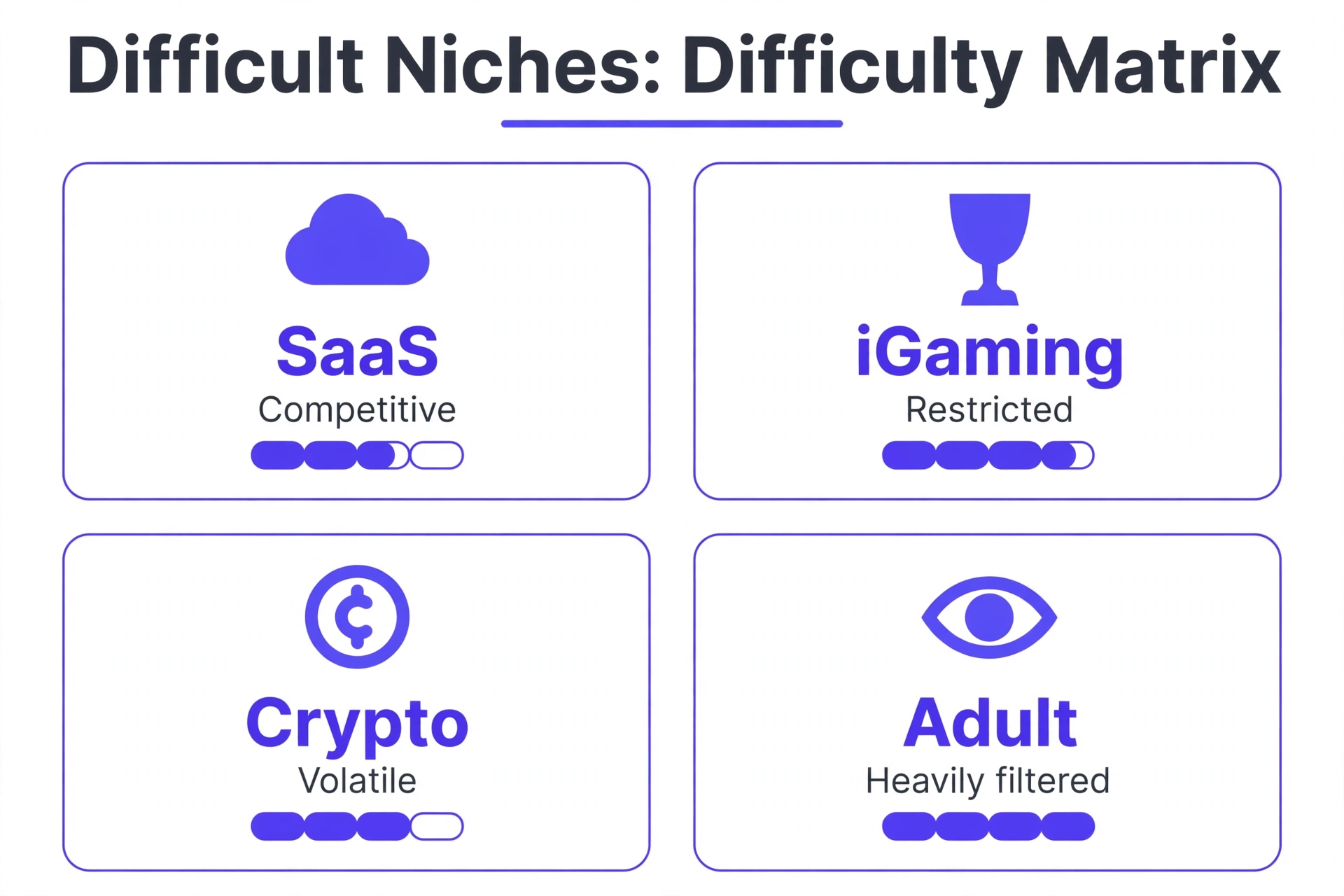
iGaming — online casinos, sportsbooks, poker, affiliates — is one of the most competitive SEO verticals on earth, and one of the hardest to build links in. Not because links don’t exist, but because the entire ecosystem operates under constraints most SEOs have never encountered.
Everything below is factual and professional. This is a guide to how link building works in a regulated niche — not an endorsement of gambling, and not a shortcut around the rules.
Why iGaming links are hard: the three walls
Wall 1: Publisher policies. Most mainstream publications, news sites, and high-authority blogs have explicit policies against linking to gambling sites. It’s not personal — it’s brand safety, advertising policy, and in some cases legal exposure. The standard outreach targets are simply off the table.
Wall 2: Regulatory fragmentation. Gambling law differs by country, state, and sometimes city. What’s legal content in the UK may be illegal to promote in another market. Link building has to respect jurisdictional boundaries — a link from a market where you can’t operate is worse than useless.
Wall 3: Trust deficit. The industry’s history of spam, cloaking, and black-hat tactics means gatekeepers default to suspicion. Even legitimate outreach gets filtered through the assumption that you’re running a link scheme. You start every conversation at a credibility disadvantage.
Where iGaming links actually live
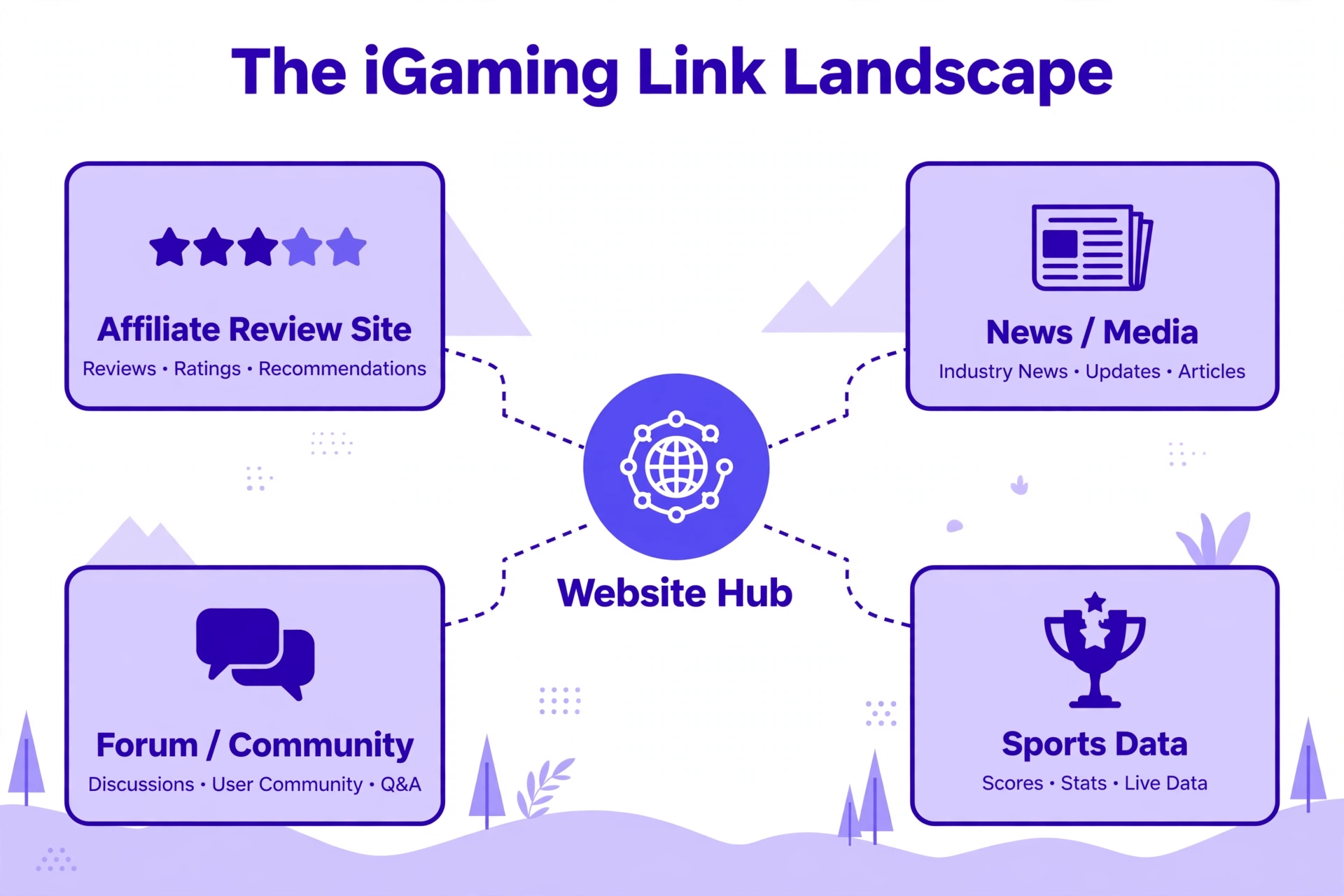
Since mainstream press is largely closed, iGaming links concentrate in industry-native channels:
- Affiliate sites and review portals — the backbone of the niche. Comparison and review sites rank for “best casino” queries and link to operators. Relationships here are commercial and long-term.
- Tipster and betting communities — forums, Discord servers, Telegram groups, and prediction communities where engaged audiences gather. Links here are earned through genuine participation, not dropped.
- Sports publishers and fan media — sports content sites, fan blogs, and data providers that cover the sports bettors follow. Sponsorships and content partnerships are the standard entry point.
- Industry news and B2B press — iGaming has its own trade press covering regulation, M&A, and product launches. B2B credibility here trickles into consumer trust.
- Streamers and content creators — casino streamers and sports-betting creators command large audiences. Partnerships are heavily regulated in most markets — disclosure and compliance aren’t optional.
Tactics that work (within the rules)
Data and odds content. Original data — payout reports, odds analysis, market trends — earns citations from sports media and affiliate content. Same principle as SaaS data studies, applied to a different audience.
Expert commentary. Regulatory changes, market entries, and industry events create news cycles. Operators and analysts who provide genuine expert commentary earn links from iGaming trade press.
Responsible-gambling and compliance content. Counter-intuitive but real: thorough, honest responsible-gambling resources get linked by regulators, help organizations, and even mainstream outlets that won’t link to your commercial pages. It’s also simply the right thing to publish.
Sponsorships with disclosure. Sports sponsorships — teams, leagues, events, podcasts — are a standard iGaming link and brand channel. They must follow advertising regulations in each market, with proper disclosure. Sponsored links should carry the appropriate attributes.
Affiliate relationship building. In iGaming, affiliates aren’t just a marketing channel — they’re the link graph. Long-term, transparent affiliate partnerships produce the review and comparison links that power rankings.
What doesn’t work (or gets you burned)
Private blog networks, hacked links, comment spam, and mass guest-post schemes are rampant in iGaming — and they’re the reason the niche has its reputation. Google’s spam policies apply fully here, and gambling sites are among the most scrutinized.
Real talk: the operators who survive long-term in iGaming SEO are the ones who built compliance into their link building from day one. The ones chasing shortcuts churn through domains. In a niche where trust is already scarce, a penalty isn’t a setback — it’s an extinction event.
The licensing-link connection
One underappreciated reality: in iGaming, licensing transparency is a link factor. Sites that clearly display licensing information, publish RTP (return-to-player) data, and maintain honest terms earn links from review portals and watchdog communities. Sites that hide this information don’t — regardless of outreach effort.
Your compliance posture is your link building foundation in this niche. No outreach tactic compensates for a site reviewers don’t trust.
Chapter 5: Other Difficult Niches — Crypto, Adult & CBD
iGaming isn’t alone. Three more niches where standard link building hits walls — handled briefly and professionally.
Crypto & Web3: guilty by association
Crypto’s link problem is reputation. Years of scams, rug pulls, and hype cycles mean mainstream publishers treat crypto sites as guilty until proven innocent. The links that exist concentrate in native channels: protocol documentation, exchange listings, security audit reports, developer communities, and crypto-native press.
What works: technical credibility. Audited smart contracts, open-source code, genuine protocol documentation, and security research earn links from the developers and analysts who matter. What doesn’t: hype content, token shilling, and paid “news” that every serious participant discounts.
The trust economics here mirror SaaS more than you’d expect — developers cite what works. Build something real, document it honestly, get audited, and the links follow the credibility.
Adult: the deplatformed niche
Adult is the most restricted niche in link building: mainstream publishers won’t link, ad platforms won’t touch it, and many standard tools and platforms exclude adult content entirely. The link ecosystem is almost entirely industry-internal — adult directories, industry trade press, performer and studio networks, and niche communities.
What works: industry-native authority. Trade publications, award bodies, performer platforms, and established directories carry the trust signals in this niche. Compliance — age verification, consent documentation, legal operation — is the price of admission to any legitimate link source.
Professional note: this guide covers the mechanics factually. The same white-hat principles apply — relevance, editorial standards, no manipulation — adapted to the channels that actually exist in the niche.
CBD & cannabis: legal gray zones
CBD sits in a regulatory patchwork: legal in some markets, restricted in others, with advertising and health-claim rules that vary wildly. Mainstream health publishers avoid it. Google restricts CBD advertising. The link ecosystem leans on wellness publications, industry press, research citations, and retail/directory listings.
What works: science and compliance. Third-party lab results, honest educational content (no disease claims — those invite regulatory action), and citations from actual research earn the links that matter. Wellness publications link to brands that act like responsible health companies, not hype merchants.
Real talk across all three: the pattern is identical. When mainstream channels close, links concentrate in industry-native ecosystems, and trust signals specific to the niche become the currency. The tactics differ; the principle doesn’t: go where your industry’s trust already lives.
Chapter 6: Outreach Angles That Work in Tough Niches
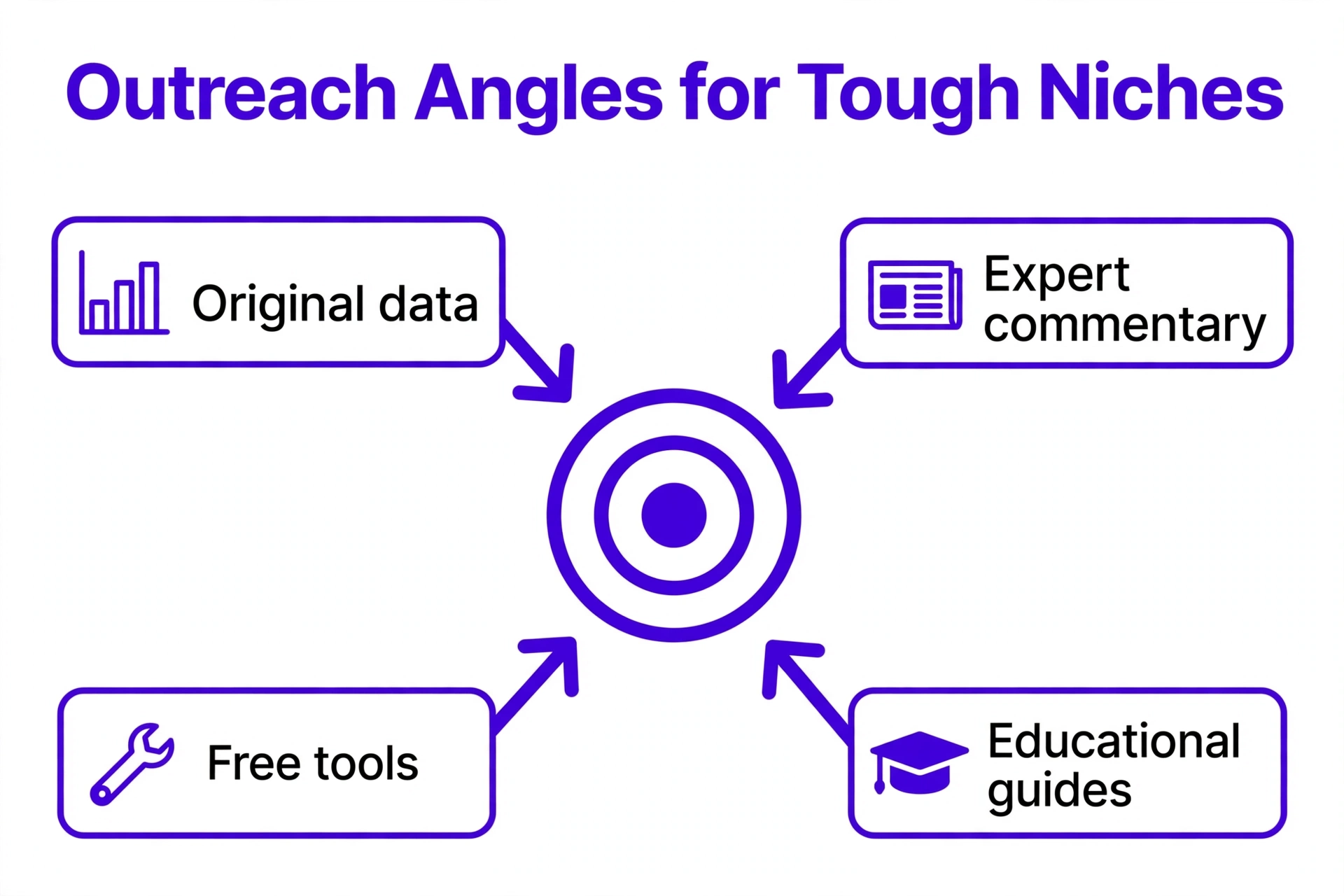
When nobody wants to link to you, the pitch matters more than ever. These angles work specifically because they give gatekeepers a reason that survives their policy filter.
Angle 1: Lead with data, not with asks
The highest-converting outreach in difficult niches doesn’t ask for links at all — it offers data. Original research, benchmarks, survey results, market analysis. Gatekeepers who would never link to your homepage will cite your data.
The ask is implicit: here’s something genuinely useful for your audience. The link follows because citation is the natural response to useful data. This works in every niche on this page, including the difficult ones.
Angle 2: The free tool gambit
Build something the niche’s audience actually uses — a calculator, a comparison tool, a checker, a template. Free tools earn links from resource pages, forums, and “useful tools” roundups that would never feature a commercial page.
This is the small-budget version of Atlassian’s Statuspage engine. You don’t need a product suite — one genuinely useful free tool, properly attributed, can outperform a year of outreach.
Angle 3: Fix their problems first
Broken link building, unlinked brand mentions, outdated statistics, factual errors in their content — find a problem on the gatekeeper’s site and offer the fix. Your link is the solution, not the ask.
In tough niches this angle has a special advantage: it leads with competence, which is exactly what skeptical gatekeepers are screening for. A precise, helpful fix demonstrates you’re a professional, not a spammer.
Angle 4: Borrow credibility through experts
When your brand carries a trust deficit, borrow someone else’s. Expert roundups, interviews, and quoted commentary put credible names next to your content — and experts share and link to content that features them.
The experts get exposure; you get association and links. In regulated niches, a compliance lawyer or industry analyst quoting your data is worth more than a hundred directory links.
Angle 5: The niche edit conversation
Sometimes the most honest pitch is the direct one: a site already ranks for your topic, your resource genuinely improves their article, and you’re offering an update, not begging for charity. Done transparently and selectively, this is legitimate outreach.
The full mechanics — finding opportunities, pricing, quality checks — are in the niche edits and link insertions guide. If you need done-for-you placement, Rankestra’s link insertion service handles the outreach and vetting.
What never to do in outreach (any niche)
Mass templated blasts. Fake flattery. Fake names. Promising links in exchange for links (reciprocal schemes at scale). Offering payment without disclosure where disclosure is required. These don’t just fail — in difficult niches, they confirm every negative assumption the gatekeeper already had about your industry.
Real talk: in a tough niche, your outreach is your brand. Every bad pitch doesn’t just lose a link — it trains another gatekeeper to auto-delete anything from your industry. Outreach quality is a collective reputation problem. Don’t be the reason the wall gets higher.
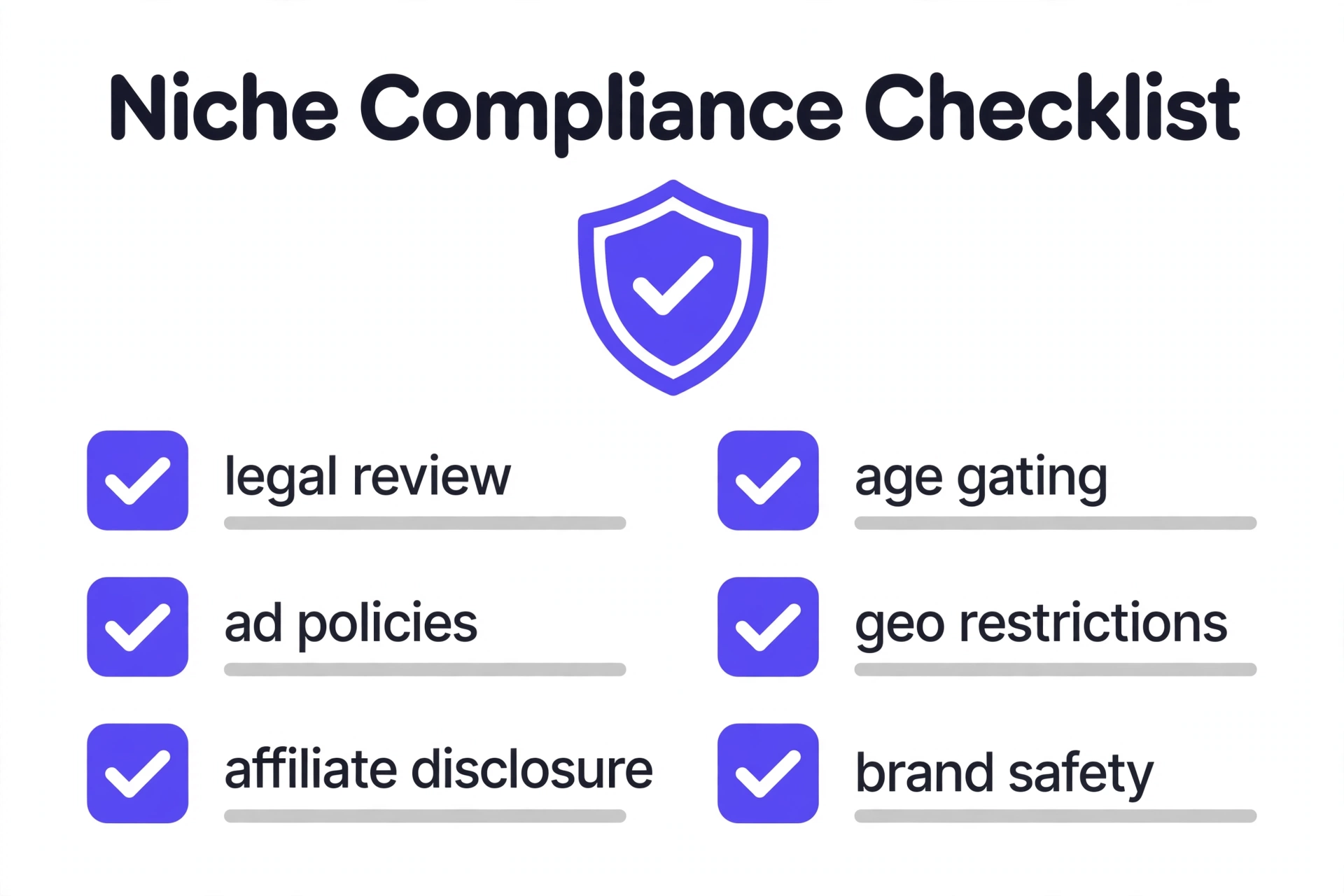
Chapter 7: Compliance + Quality Checklist
Every niche has lines you don’t cross. This chapter draws them.
Check 1: Relevance is non-negotiable
The linking page’s topic must genuinely relate to your page’s topic. Not “both are websites.” Not “the audience might overlap.” Real topical relevance a human reviewer would defend. In niche link building, relevance is doing double duty — it’s both an SEO signal and your defense against looking manipulative.
Check 2: Disclosure where it’s required
Paid placements, sponsorships, and affiliate relationships require disclosure — legally in many jurisdictions (FTC guidelines, EU consumer law, UK ASA rules) and by platform policy. Sponsored links should use rel="sponsored". This isn’t optional ethics; it’s the law in the markets you’re targeting.
Check 3: Know the niche’s platform policies
Before any campaign, map the policies: Google’s spam policies on link schemes, advertising policies for your vertical, the content policies of your target publications. A tactic that’s fine in SaaS (say, a press release blast) may be restricted in gambling or CBD. Verify current policies before publishing — they change.
Check 4: No manipulative patterns at scale
Sitewide template links with identical anchors, private blog networks, link exchanges at scale, automated link injection — these are the patterns spam systems are built to detect. The Atlassian anchor data showed what concentration looks like; don’t build a miniature version of the risky part of that pattern.
For the full breakdown of what Google considers manipulation, the white hat guide’s policy section covers it.
Check 5: Anchor text sanity
Keep branded and natural anchors as the backbone. Exact-match commercial anchors should be a small minority of your profile, varied naturally. If an audit of your anchors shows one phrase dominating from few domains, you have a footprint — fix it before it fixes you.
Check 6: Jurisdictional fit
In regulated niches, every link source should be checked against the markets you serve. A link from a site targeting a jurisdiction where your product is restricted creates legal exposure, not SEO value. Geo-relevance isn’t just an SEO nicety in these niches — it’s compliance.
Check 7: The “front page” test
Would you be comfortable if your link building tactics were described on the front page of your industry’s trade press? If the answer is no, don’t do it. This single test filters out nearly every tactic that eventually causes problems.
Check 8: Vet the linking site’s own standing
Check the linking domain’s own health before pursuing: real traffic, real content, real audience. Links from penalized, deindexed, or spam-ridden neighborhoods don’t help and can associate you with the wrong crowd. In difficult niches especially, one bad neighborhood link costs more than ten good ones earn.
Check 9: Content quality on your end
The page receiving the link must deserve it. Thin, misleading, or non-compliant content on your side undermines every link pointing at it — and in regulated niches, it can trigger regulatory scrutiny directly. Fix the destination before building the road.
Check 10: Document everything
Keep records of every placement: the site, the page, the anchor, the date, whether it was paid (with disclosure), and the contact. If you ever need to audit, disavow, or defend your profile, this log is invaluable. Professional link building is auditable link building.
Chapter 8: Measuring ROI in Niche Link Building
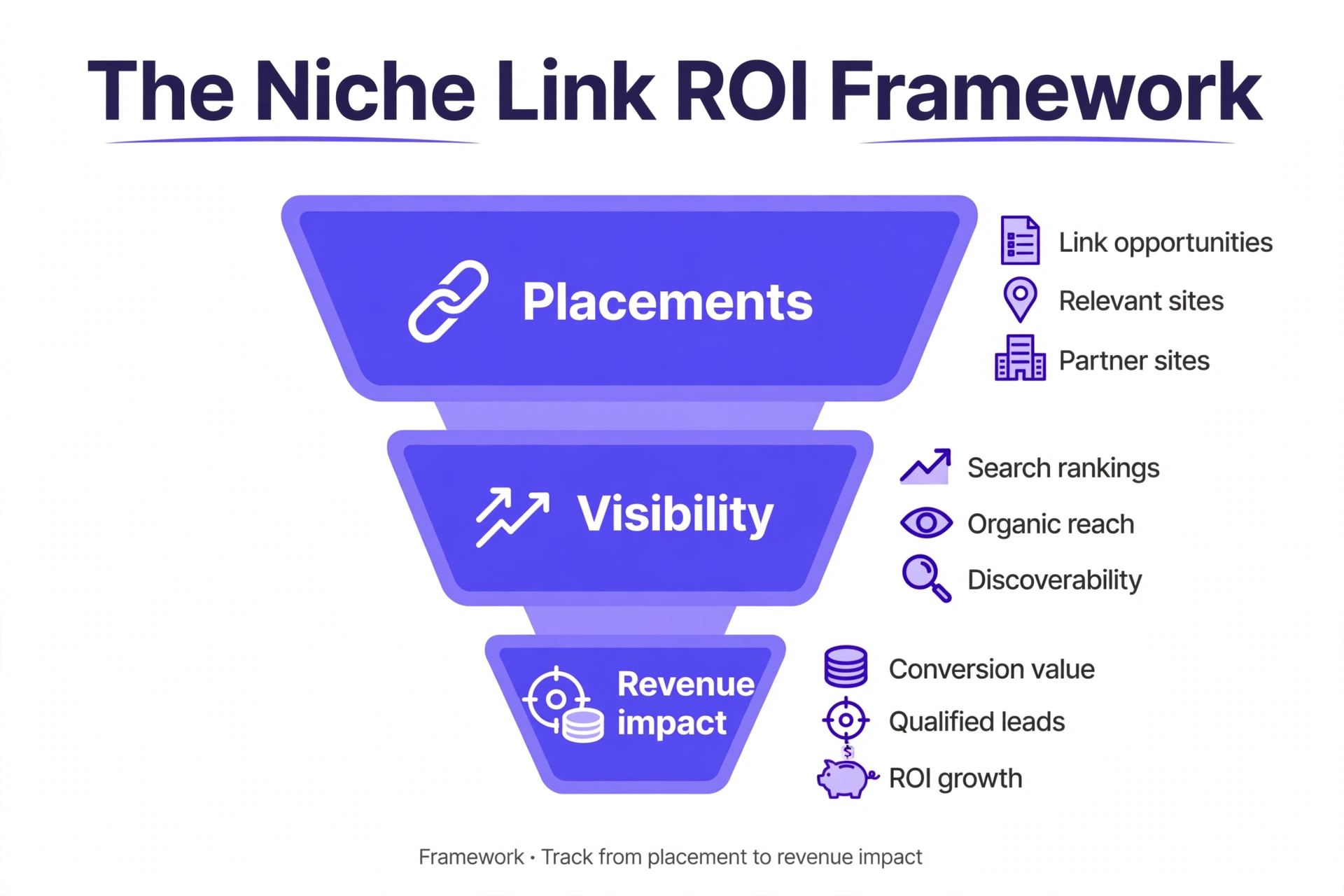
Niche link building is slower and more expensive than generalist tactics. That makes measurement non-negotiable — you need to prove the spend is working before the budget runs out.
Leading indicators: what to watch in months 1–3
Rankings won’t move meaningfully in the first quarter. Watch what you can control instead:
- Placement rate: pitches sent vs. links earned. Benchmarks vary wildly by niche — SaaS outreach converts far better than iGaming.
- Average linking-page quality: traffic, relevance, and authority of pages linking to you — trending up is the goal.
- Referring domain growth: new domains, not just new links. One domain, one vote — mostly.
- Anchor distribution: staying natural as you scale (see Chapter 7, Check 5).
Lagging indicators: what to watch in months 4–12
This is where the investment pays or doesn’t:
- Keyword visibility: rankings and impressions for target terms in your niche.
- Organic traffic to linked pages: the pages earning links should earn traffic.
- Referral traffic: niche links often send direct visitors — especially community and forum links. Track it; it’s real value.
- Revenue attribution: assisted conversions from organic and referral. Imperfect, but directionally essential.
The cost-per-link reality check
Niche links cost more. SaaS links earned through content and PR have real production costs. iGaming links operate in a market where placements command premiums. Budget honestly: estimate your cost per quality placement, multiply by the placements needed to compete, and sanity-check against the revenue the rankings would generate.
Real talk: if the math doesn’t work — if the cost of competing exceeds the value of winning — that’s useful information, not failure. Some niches are won with links; others are won with product, brand, or paid channels. The ROI framework exists to tell you which game you’re actually playing.
Attribution without fairy tales
SEO attribution is inherently messy: links compound, algorithms shift, and multiple channels touch every conversion. Don’t promise precision you can’t deliver. Report directionally and honestly: leading indicators trending right, lagging indicators following with a delay, and revenue correlated — not “this link produced exactly X dollars.”
Anyone selling you exact per-link ROI math is selling you something else. The honest version is slower but it survives contact with reality.
When to pivot
Set review points in advance: at 90 days (leading indicators), at 6 months (early lagging signals), at 12 months (full judgment). If leading indicators are flat at 90 days — placement rate near zero, no quality domains engaging — the strategy is wrong, not the timeline. Pivot the approach, not just the effort level.
Chapter 9: Your 90-Day Niche Link Building Plan
Theory’s over. Here’s the sequence.
Days 1–14: Map the ecosystem
Identify your niche’s gatekeepers, trust signals, and link sources. List the publications, communities, directories, and documentation hubs where your industry’s links live. Note every policy constraint. This map is the strategy — everything else is execution.
Days 15–30: Build the linkable assets
Create the assets your niche actually links to: reference documentation, original data, a free tool, or definitive guides. No outreach happens before the assets exist — pitching without something worth linking to is the #1 wasted effort in link building.
Days 31–60: First outreach wave
Launch outreach using the angles from Chapter 6: data-led pitches, tool announcements, broken-link fixes, expert contributions. Start with warm targets — integration partners, existing relationships, communities you’re already part of. Track placement rate from day one.
Days 61–90: Measure, then double down
Review leading indicators. Which angles converted? Which gatekeepers responded? Kill what’s flat, scale what worked, and add the second wave: digital PR pushes for data assets, niche edit outreach for established ranking pages, and Wikipedia-style reference citations where your content genuinely qualifies.
The one rule for all 90 days
Every link must pass the Chapter 7 checklist. Speed is never an excuse for a placement you’d be embarrassed to defend. In niche link building, one bad link costs more than ten good ones earn — because in a small ecosystem, everyone sees everything.
Chapter 10: Niche Link Building FAQs
What is niche link building?
Niche link building is link acquisition designed around one industry’s specific link ecosystem — its gatekeepers, regulations, trust signals, and link sources. Unlike generic link building, every tactic is adapted to where that industry’s links actually live and what its gatekeepers respond to.
How is niche link building different from regular link building?
The goal is the same (authoritative, relevant backlinks), but the tactics, targets, and constraints differ. Regular link building assumes cooperative channels — guest posts, press, resource pages. Niche link building operates where those channels are closed or insufficient, using industry-specific sources like developer docs, affiliate networks, trade press, and product-led links.
Why is link building harder in iGaming, crypto, adult, and CBD?
Three walls: mainstream publisher policies that prohibit linking to these sites, regulatory fragmentation across jurisdictions, and a trust deficit from each industry’s history of spam. Links concentrate in industry-native channels, outreach converts at lower rates, and compliance isn’t optional — it’s the foundation.
Can SaaS link building tactics work in other niches?
The principles transfer; the tactics need translation. Documentation-as-link-bait works anywhere professionals cite references. Product-led links work wherever products create public artifacts. Data studies work in every niche with an audience that cites data. What doesn’t transfer is the assumption of cooperative gatekeepers — adapt the pitch to each niche’s reality.
How long does niche link building take to show results?
Expect leading indicators (placements, referring-domain growth) in 1–3 months and meaningful ranking movement in 4–12 months, depending on competition and starting authority. Difficult niches trend toward the slower end. Anyone promising faster results in a competitive niche is selling shortcuts — see Chapter 7 for why those end badly.
Should I hire an agency for niche link building or do it in-house?
It depends on the niche’s learning curve. If your team deeply understands the industry’s ecosystem — its gatekeepers, communities, and trust signals — in-house can work. If not, a specialist with genuine niche experience beats a generalist agency every time. Vet any provider on Chapter 7’s checklist: ask how they handle disclosure, relevance, and compliance before discussing price.
Continue the Series: The Complete Link Building Library
This guide is one of seven pillars in Rankestra’s complete link building series. Each one goes deep on a single discipline:
- Pillar 1: White Hat Link Building — The Complete 2026 Guide — the universal foundations every niche builds on.
- Pillar 2: Digital PR for Link Building — The Complete 2026 Guide — earning editorial links through newsworthy campaigns.
- Pillar 3: Guest Posting & Blogger Outreach — The Complete 2026 Guide — the outreach system behind earned placements.
- Pillar 4: Wikipedia Backlinks — The Complete 2026 Guide — earning citations on the world’s most trusted reference.
- Pillar 5: Niche Edits & Link Insertions — The Complete 2026 Guide — placing links into content that’s already winning.
- Pillar 7: Buying Backlinks Safely — coming soon.
Don’t Be the 99%: Your Move
Here’s the uncomfortable truth this whole guide has been building toward: 99% of people in difficult niches build links the lazy way. They buy the same guest posts, from the same vendors, on the same irrelevant sites — then wonder why nothing moves, or why the penalty notice arrives.
You now know what the 1% does instead. Map the ecosystem. Build assets worth citing. Pitch angles that survive policy filters. Pass every compliance check. Measure honestly. It takes longer. It costs more per link. And it actually works — because it’s the only approach designed for the niche you’re actually in.
So here’s the challenge: this week, do one thing the 99% won’t. Map your niche’s real link ecosystem — the gatekeepers, the trust signals, the ten sites that actually matter. Not a vendor’s price list. Not a generic prospecting spreadsheet. The real map.
Everything else — the outreach, the assets, the compounding links — starts there. And if you’d rather have a team that already knows the map, Rankestra’s link insertion service builds vetted, compliant placements in competitive niches every day.
Don’t be the 99%. Draw the map. Then build.