Backlink Exchange: The Honest 2026 Guide (What Google Actually Says)
Backlink Exchange: The Honest 2026 Guide (What Google Actually Says)
Type “backlink exchange” into Google and you’ll get two kinds of articles: the ones quietly selling you the scheme, and the ones wagging a finger at you like a disappointed headmaster. This guide is neither.
So let’s start with the answer, sermon-free.
The short answer: A backlink exchange is any arrangement where websites link to each other as a deal — “you link to me, I’ll link to you.” Google’s spam policies explicitly list “excessive link exchanges” as link spam. But here’s the nuance almost every guide skips: a handful of natural reciprocal links is completely normal — an Ahrefs study of 140,592 traffic-earning domains found 73.6% had them. It’s the exchange — the deal, the scale, the intent to manipulate rankings — that crosses the line, not the mere fact that two sites link to each other.
That’s the whole controversy in one paragraph. Everything below is the evidence: the four types of exchanges, what Google actually says (in their own words), the data on how common reciprocal links really are, the JCPenney case that still gets cited fifteen years later, how detection works in 2026, an honest ranking of the risks, the safe zone where reciprocal links are fine, and what to do instead.
If you’re new to link building, start with our White Hat Link Building 101 guide — it covers the fundamentals this article builds on. And if you want the full map of legitimate link types, see our honest guide to the types of backlinks.
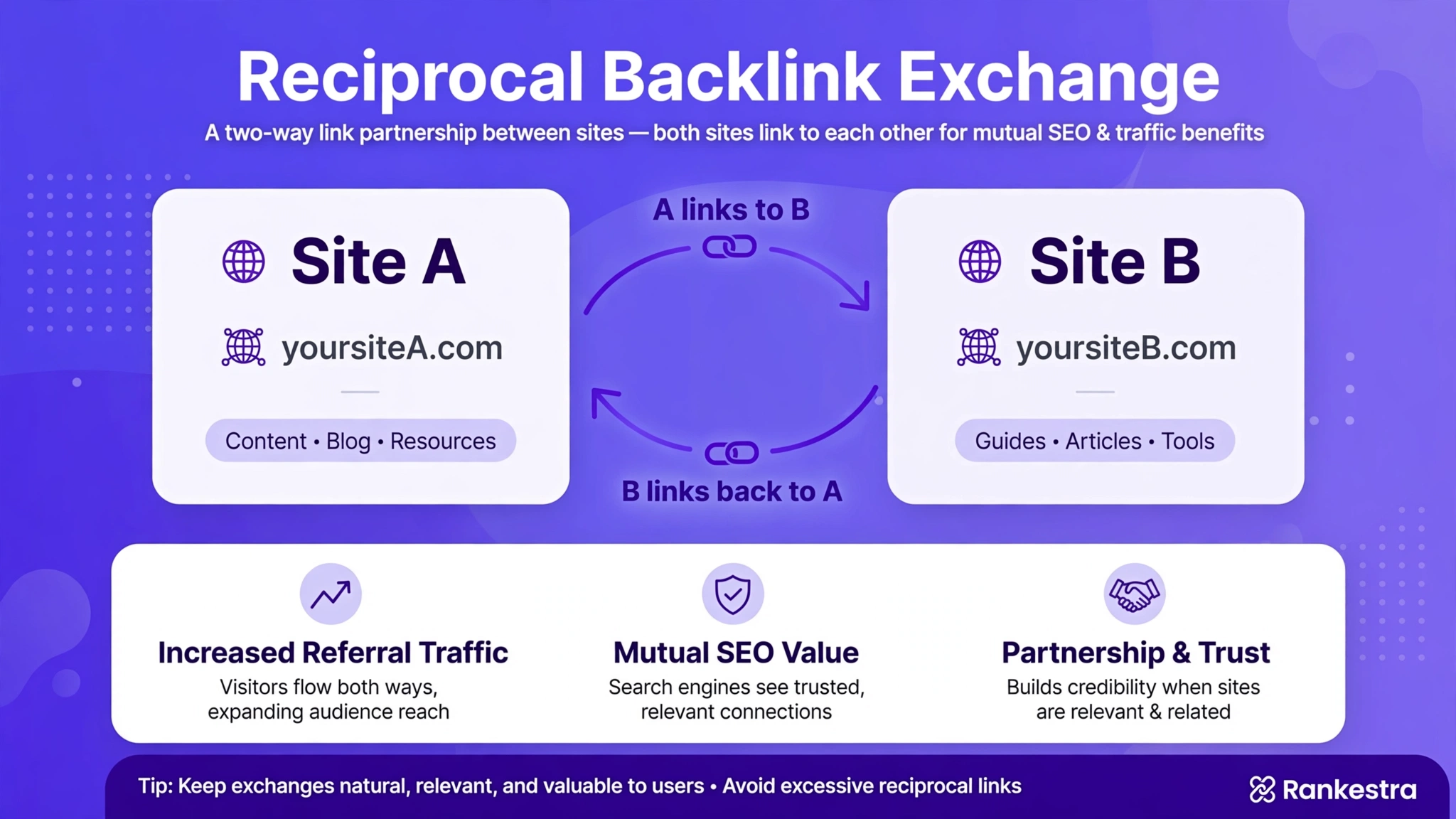
Table of Contents
- 1. What a Backlink Exchange Actually Is
- 2. The 4 Types of Link Exchanges
- 3. What Google Actually Says
- 4. The Data: How Common Reciprocal Links Really Are
- 5. The JCPenney Case: What 2,015 Links Cost
- 6. How Google Detects Exchanges in 2026
- 7. The Risks, Honestly Ranked
- 8. The Safe Zone: Reciprocal Links That Are Fine
- 9. Safe Alternatives That Actually Work
- 10. The Verdict + Your Action Plan
- FAQ: Backlink Exchanges
1. What a Backlink Exchange Actually Is (The A↔B Deal)
Picture two site owners in each other’s DMs. “Nice article on email marketing — I’ll link to it from my resources page if you link to my guide from yours.” Handshake emoji. Done. That, in one message, is a backlink exchange.
No tools required. No budget. No waiting. Which is exactly why it’s tempting — and exactly why it’s a trap worth understanding properly before you touch it.
The definition, stated plainly
A backlink exchange is a reciprocal linking arrangement: two or more websites agree to link to each other, typically to influence search rankings rather than to serve readers. The defining ingredient isn’t the links — it’s the agreement.
Read that twice, because it’s the key to this entire guide. Two sites linking to each other is just the web working as designed. Two sites linking to each other because they made a deal is a scheme. Google judges the intent behind the pattern, not the pattern alone.
Why the “deal” is the whole story
Search engines treat links as votes — editorial endorsements that help determine which pages deserve to rank. A vote only means something if it’s freely given. The moment links become currency traded between webmasters, they stop being votes and start being transactions. And transactions designed to manipulate rankings are, by Google’s definition, spam.
Reciprocity vs. exchange: the distinction that matters
Reciprocity is when two sites link to each other independently, because each found the other’s content genuinely worth referencing. No deal. No DM. Just two good pages acknowledging each other.
Exchange is when the links exist because of an arrangement. The content didn’t earn the link — the negotiation did. That’s the line. Nobody confuses a local bakery linking its flour supplier (who links back) with a 50-site “link to me and I’ll link to you” ring.
A brief history: from links pages to networks
Link exchanges are older than Google. In the late 90s and early 2000s, “links pages” — dedicated directories of reciprocal partners — were standard website furniture. Then came automated exchange scripts, then “three-way” schemes designed to hide the reciprocity, then link wheels, then private networks. Every generation claimed to be undetectable. Every generation was, eventually, detected.
Why people still do it in 2026
Real talk: exchanges persist because the pitch is seductive. It’s free. It’s fast. It feels controllable. For a new site owner staring at zero backlinks, “I’ll get you 20 links this week if you link back” sounds like momentum. It also persists because the punishment is usually invisible — most exchanges don’t end in a dramatic penalty, they end in links that quietly count for nothing. No pain, no lesson learned, just wasted effort.
2. The 4 Types of Link Exchanges (From Obvious to Sneaky)
Not all exchanges are created equal. They range from a handshake between two bloggers to industrial-scale networks — and the “sneakier” versions carry the same risk with extra steps. Let’s meet the family.
Type 1: Direct reciprocal (A↔B)
The classic. Site A links to Site B, Site B links to Site A. Usually arranged by email or DM. It’s the easiest exchange to arrange — and the easiest to detect, because the reciprocity is visible to anyone (or any crawler) that looks at both link profiles. A single direct reciprocal between two relevant, legitimate sites is background noise. Twenty of them, arranged in a week, with keyword-rich anchors, is a pattern.
Type 2: Three-way / ABC exchange (A→B→C→A)
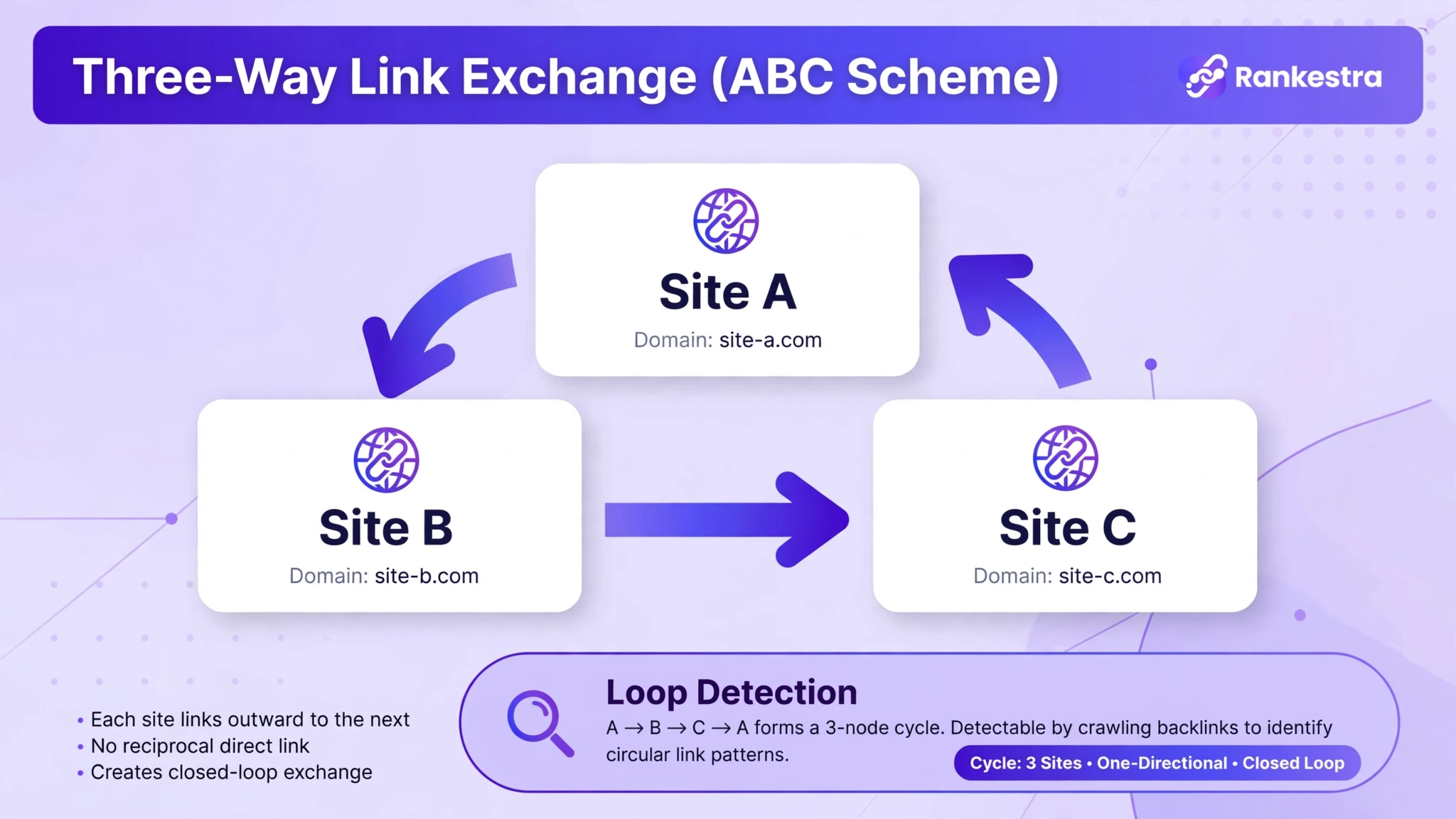
The “clever” one. Site A links to Site B, Site B links to Site C, Site C links back to Site A. Nobody links directly back to whoever linked them, so — the theory goes — no reciprocity is visible. The theory is wrong. On a link graph, A→B→C→A is a closed loop — arguably more suspicious than a simple reciprocal, because natural linking almost never forms tidy little triangles.
Type 3: Link wheels
Take the three-way idea and scale it: a ring of sites where each links to the next, and the last links back to the first — often with all of them also linking to a central “money site.” Link wheels were the hot scheme of the late 2000s. They failed for the same reason all closed-loop schemes fail: real link graphs don’t look like geometry. A perfect wheel is a fingerprint.
Type 4: Private exchange networks
The industrial version. A broker runs a pool of sites — sometimes hundreds — and members trade links across the pool, often with three-way routing to obscure direct reciprocity. This is the highest-risk tier. Networks leave shared footprints: hosting patterns, registration details, content templates, interlinking density that no natural cluster of sites exhibits. When Google identifies a network, it can nuke every participant at once.
Real talk: sneakier doesn’t mean safer
Every step up in “sophistication” from Type 1 to Type 4 is a step up in detectability, not safety. A simple reciprocal between two real sites at least resembles natural linking. A 40-site triangular exchange network resembles nothing in nature. The safest-looking link is the simple one that would exist without any deal at all.
3. What Google Actually Says (No, Really — Their Words)
Forget forum opinions and guru threads. When the question is “what does Google think about link exchanges,” there’s exactly one opinion that matters — Google’s. And they’ve stated it plainly, in writing, more than once. Let’s read the actual words.
The spam policy, quoted
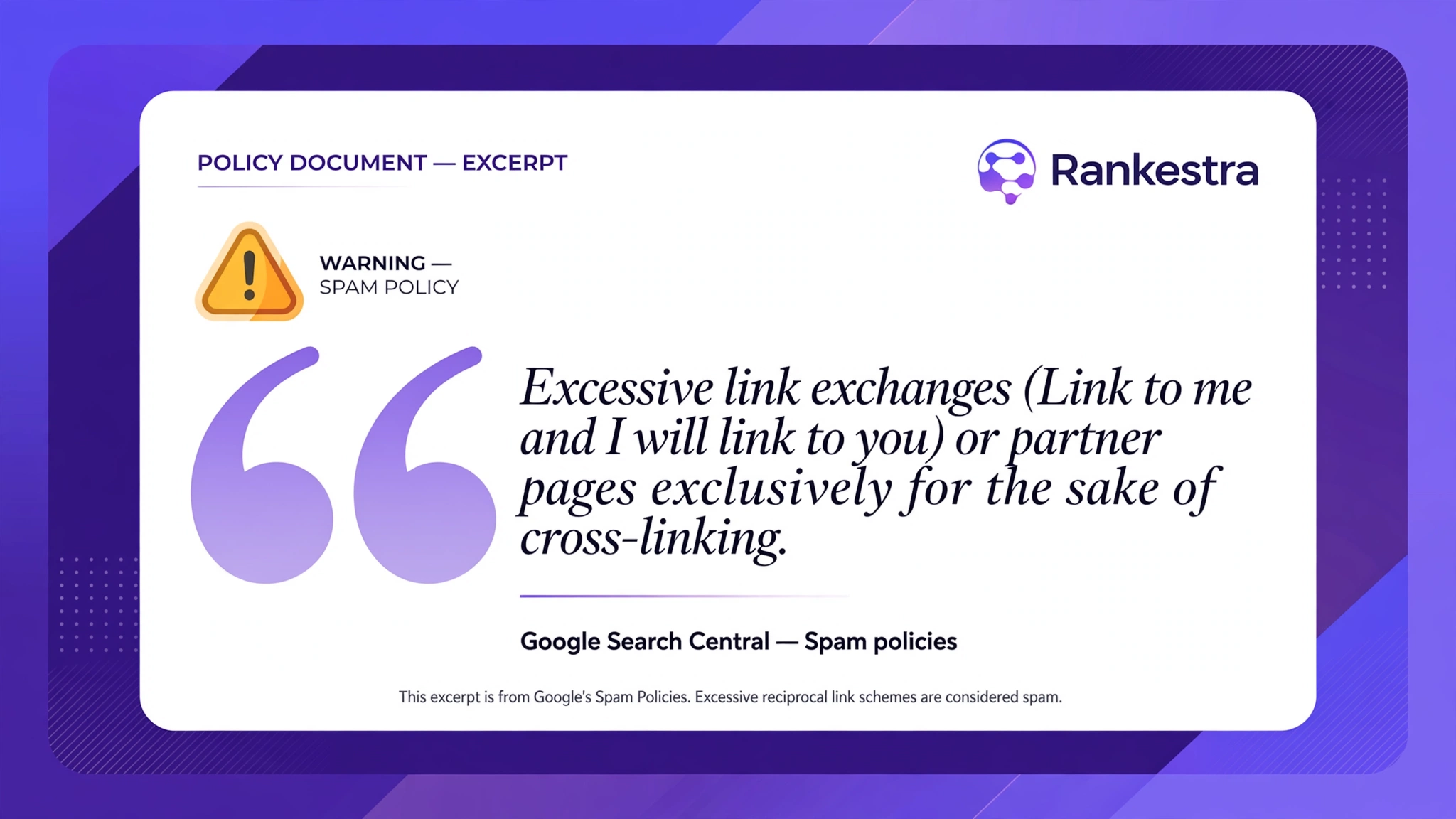
Google’s Search Central spam policies list link spam as including: “Excessive link exchanges (‘Link to me and I’ll link to you’) or partner pages exclusively for the sake of cross-linking.”
That’s not an interpretation. That’s the policy, in quotation marks, on Google’s own site. “Link to me and I’ll link to you” — the literal definition of a backlink exchange — is named as an example of link spam. If you’re running exchanges and wondering whether Google considers it manipulation, they’ve answered: yes, when it’s excessive.
The keyword that matters: “excessive”
Notice the word Google chose: excessive. Not “all.” Not “any.” Excessive. That single word is doing enormous work — it’s Google acknowledging that reciprocal linking happens naturally on the web, and that the violation is a matter of degree and intent, not mere existence.
This is where most fear-mongering guides go wrong. They read “link exchanges = spam” and conclude that any two sites linking to each other is dangerous. Google’s own wording says otherwise. The policy targets exchanges for the sake of cross-linking — arrangements whose purpose is manipulating rankings, not serving readers.
Mueller on natural reciprocity: “perfectly fine”
John Mueller, Google’s Search Advocate, addressed this directly in the January 28, 2022 SEO office hours. His take: natural reciprocity is “perfectly fine… Especially if you’re a local business, you link to your neighbors.”
Think about what that means. The local bakery links its flour supplier; the supplier links the bakery. These are reciprocal links — and Google’s own spokesperson calls them perfectly fine. The difference from a scheme? Nobody’s gaming anything. The links exist because the businesses genuinely relate to each other.
Mueller on systematic exchanges: “a bad idea”
But Mueller drew the other boundary just as clearly. Speaking via Search Engine Journal in July 2021, he said that systematic “you link to me and therefore I will link back to you… is essentially against our webmaster guidelines… If you’re doing this systematically then we think that’s a bad idea.”
Put the two Mueller statements together and Google’s position is perfectly coherent: reciprocity is fine; exchange schemes are not. Occasional, natural, relevant reciprocal links — fine. A systematic program of trading links to manipulate rankings — against the guidelines. The line isn’t the link. It’s the system.
Why Google cares: the vote analogy
To understand why Google draws the line here, remember what links are for. In Google’s model, a link is a vote of confidence — an editorial signal that page A vouches for page B. Now imagine an election where candidates trade votes with each other: “I’ll vote for you if you vote for me.” The votes stop measuring public confidence and start measuring deal-making ability. That’s what systematic exchanges do to the link graph.
What this means for you, practically
Three practical takeaways. One: don’t panic about the three reciprocal links already in your profile — they’re normal. Two: don’t build a program around trading links — that’s the “systematic” behavior Mueller flagged. Three: when evaluating any reciprocal opportunity, ask: would this link exist without the deal? If yes, you’re in the safe zone. If no, you’re building the thing the policy describes.
4. The Data: How Common Reciprocal Links Really Are
Google says excessive exchanges are spam — but how much reciprocity actually exists on the ranking web? Fortunately, someone measured.
The Ahrefs study: 140,592 domains, one striking number
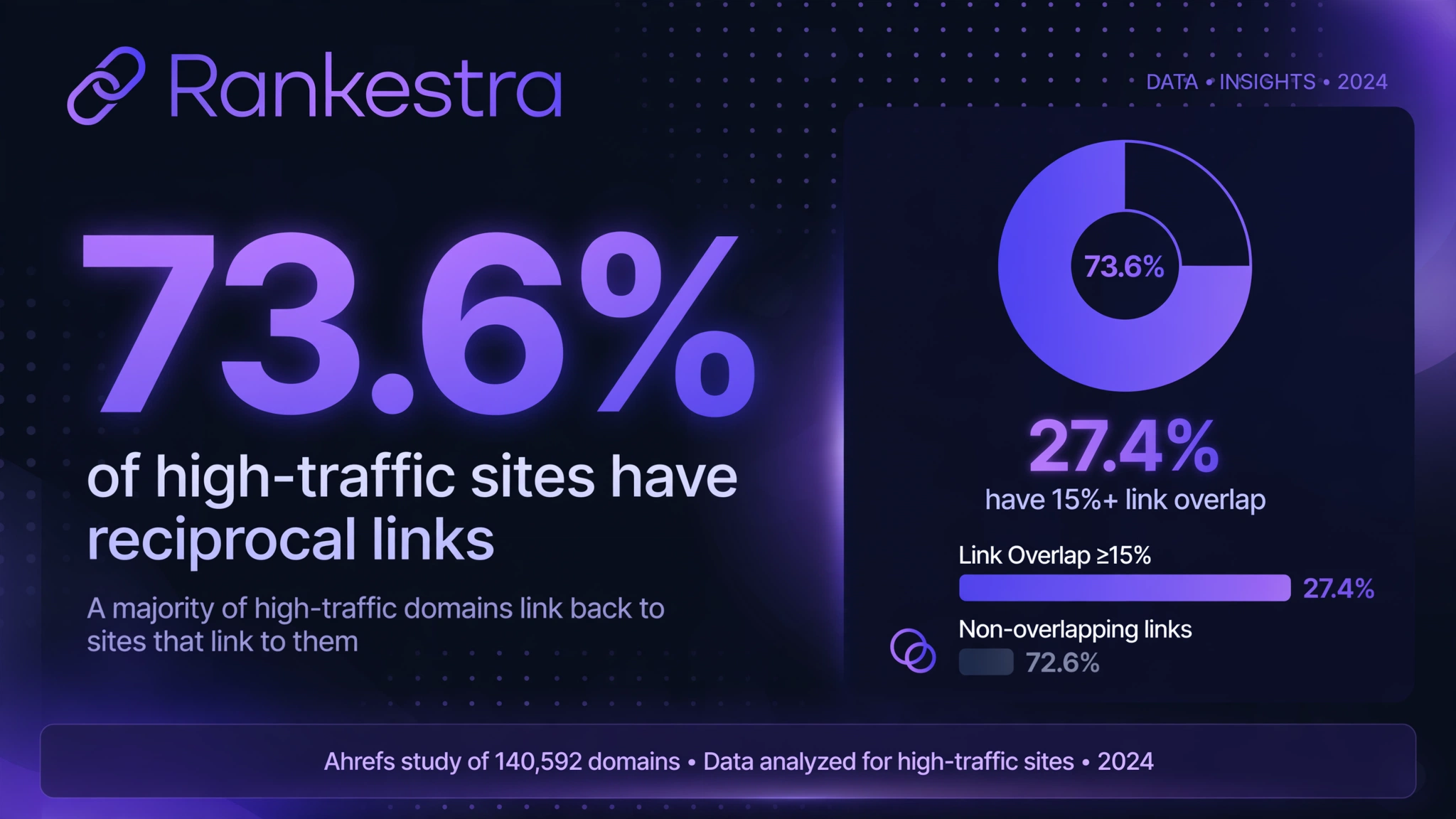
In March 2020, Ahrefs’ Tim Soulo published a study of 140,592 domains, each earning at least 10,000 monthly visits from Google. The headline finding: 73.6% of them had reciprocal links — domains that both linked to them and received links from them.
Read that again. Nearly three-quarters of sites successfully ranking in Google have reciprocal links in their profiles. If reciprocity itself were a penalty trigger, most of the ranking web would be penalized. It isn’t — because reciprocity, at normal levels, is just how the web works.
The study went further: 27.4% of the domains had at least 15% overlap between the domains they link out to and the domains linking back to them. More than a quarter of successful sites have substantial reciprocal overlap — and they rank just fine.
What this actually proves
It proves that reciprocal linking is background noise on the real web. Sites in the same industry cite each other. Partners link each other. None of this is scheming — it’s the natural texture of a connected web, and Google’s systems are calibrated to expect it.
What it doesn’t prove: the survivorship-bias caveat
Real talk: this study has a built-in limitation, and honest guides disclose it. Ahrefs studied only domains already earning 10,000+ monthly visits — sites that survived Google’s filters. That’s survivorship bias by definition. The study can’t tell us about sites that ran aggressive exchange schemes and got filtered out, because those sites aren’t in the dataset.
So the correct reading is narrower: among sites Google already trusts, reciprocal links are extremely common. That’s evidence that normal-level reciprocity is tolerated — not evidence that exchange schemes work.
The honest reading of the data
A few reciprocal links: normal, expected, harmless — the data is unambiguous. A profile built on reciprocal exchanges: that’s not what the study measured, and it’s exactly what the spam policy describes. Think of it like salt in cooking. The study proves that 73.6% of good dishes contain salt. It does not prove that eating salt by the spoonful is fine. Dose and context are everything.
5. The JCPenney Case: What 2,015 Links Cost
Every discussion of manipulative link schemes eventually arrives at the same story — because it’s the most documented, most dramatic, and most instructive case in SEO history. February 2011. The New York Times. And a household retail brand caught with its hand in the link jar.
February 2011: the investigation
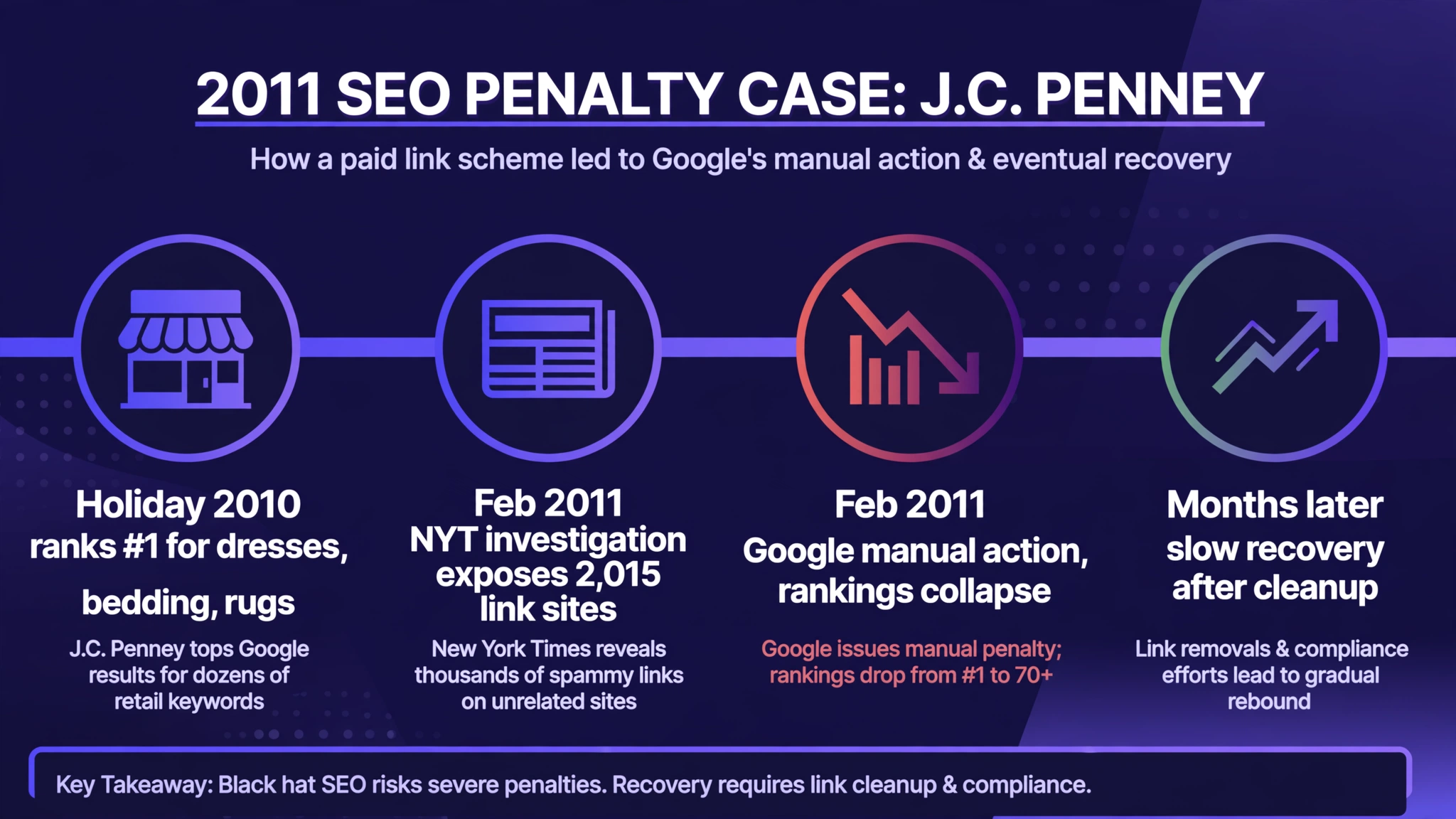
NYT reporter David Segal published an investigation into JCPenney’s search rankings, and the findings were staggering. The retail giant ranked #1 for an absurd range of terms — “dresses,” “bedding,” “area rugs,” and dozens more. The reason wasn’t superior content. It was links: the investigation found JCPenney links placed on 2,015 sites, many of them irrelevant, many with keyword-stuffed anchors — the signature of a paid link operation.
To be precise: JCPenney’s case was paid links rather than pure reciprocal exchange. But the principle is identical — links acquired through deals rather than earned through merit, at industrial scale, to manipulate rankings.
The fall: from #1 to ~70th
The timeline is brutal. Google was notified of the findings — and JCPenney’s rankings collapsed. Terms where it had dominated at #1 dropped to around 70th position. Overnight, one of America’s biggest retailers became nearly invisible in organic search for its most valuable keywords.
The corporate fallout was immediate: JCPenney fired its search firm, SearchDex. And Google’s then-spam-chief Matt Cutts noted it was the third infraction cited against them — this wasn’t a first-time misunderstanding, it was a pattern.
Why this case still matters in 2026
Three reasons. One: it proves scale doesn’t protect you — a Fortune 500 brand got dismantled publicly. Two: it shows how arranged links look under scrutiny — irrelevant sites, keyword-stuffed anchors, patterns no natural profile exhibits. Three: it demonstrates the real cost — not just rankings, but reputation, vendor relationships, and news cycles you can’t undo.
What JCPenney did wrong vs. what a small exchange does
Honest calibration: JCPenney’s operation was industrial — thousands of paid placements, blatant anchor manipulation. Your five reciprocal links with fellow bloggers are not JCPenney. But the mechanism of failure scales down perfectly: arranged links are rented rankings, and the rent always comes due. For a deeper look at how to vet link opportunities safely, see our guide to buying backlinks safely.
6. How Google Detects Link Exchanges in 2026
“But how would Google even know?” It’s the most common objection — and it’s built on a 2010 mental model of detection. Nobody at Google is manually reading your emails. They don’t need to. The link graph tells the story on its own.
SpamBrain: the AI watching the graph
Google’s spam detection is powered by SpamBrain, its AI-based spam prevention system. Google has described SpamBrain as identifying both “known” spam patterns and previously unseen ones — meaning it doesn’t just match against a blacklist of tricks, it learns what manipulative linking looks like structurally.
This matters because it defeats the “new trick” defense. Every generation of exchange schemers believes their variation is novel. SpamBrain doesn’t need to have seen your specific scheme. It needs to recognize the shape of arranged linking, and arranged linking has a shape.
Pattern 1: reciprocal overlap percentage
Remember the Ahrefs metric from chapter 4 — the percentage overlap between domains you link out to and domains linking back? That metric cuts both ways. Normal sites show modest overlap. Exchange participants show extreme overlap: huge fractions of their link profile pointing at the same small set of domains that point back at them.
It’s a statistical signal, not a single-link judgment. One reciprocal link is noise. A profile where 60% of your outbound domains also link to you, with matching placement timing, is a confession written in data.
Pattern 2: footprint signals
Exchanges — especially brokered networks — leak side-channel evidence everywhere. Common footprints include: links appearing in clusters within short time windows; identical or templated anchor text across participants; shared hosting, IP ranges, or analytics IDs among supposedly independent sites; similar site architectures; and “partners” pages that exist solely to host exchange links.
Individually, each footprint is explainable. Together, they’re a fingerprint. And unlike 2010, today’s detection correlates these signals automatically.

Pattern 3: the links-page signature
Dedicated “link partners” pages are a relic that still incriminates. A page whose only purpose is hosting outbound links to exchange partners — thin content, dozens of unrelated outbound links, no traffic — is one of the oldest detectable signatures in SEO. Google’s policy even names “partner pages exclusively for the sake of cross-linking” alongside exchanges. It’s a public ledger of your scheme, crawlable by anyone.
Why three-way exchanges don’t fool graph analysis
The ABC exchange assumes detection looks for A↔B pairs. But graph analysis doesn’t look for pairs; it looks for structures. A→B→C→A is a directed cycle of length 3. Natural link graphs contain some cycles, but tight, contemporaneous cycles among sites with no other relationship are anomalous. Worse, three-way exchanges usually run through brokers — timing clusters, participant overlap, same footprints. The triangle doesn’t hide the scheme; it just makes the geometry slightly more interesting to the algorithm looking for geometry.
Real talk: you are not smarter than the graph
Every evasion idea you’ve had — delaying the return link by a month, varying anchors, routing through a third site — has been tried at scale, by professionals, years ago. The detection systems were trained on the corpses of those schemes. The energy spent engineering undetectable exchanges would, invested in legitimate link building, produce links that don’t need to be undetectable. That’s not moralizing. It’s arithmetic.
7. The Risks of Backlink Exchanges, Honestly Ranked
Most guides pick one of two dishonest positions: “you’ll definitely get penalized” (fear-mongering) or “it’s totally fine, everyone does it” (scheme-selling). The truth is a probability distribution, not a certainty. Let’s rank the actual outcomes.
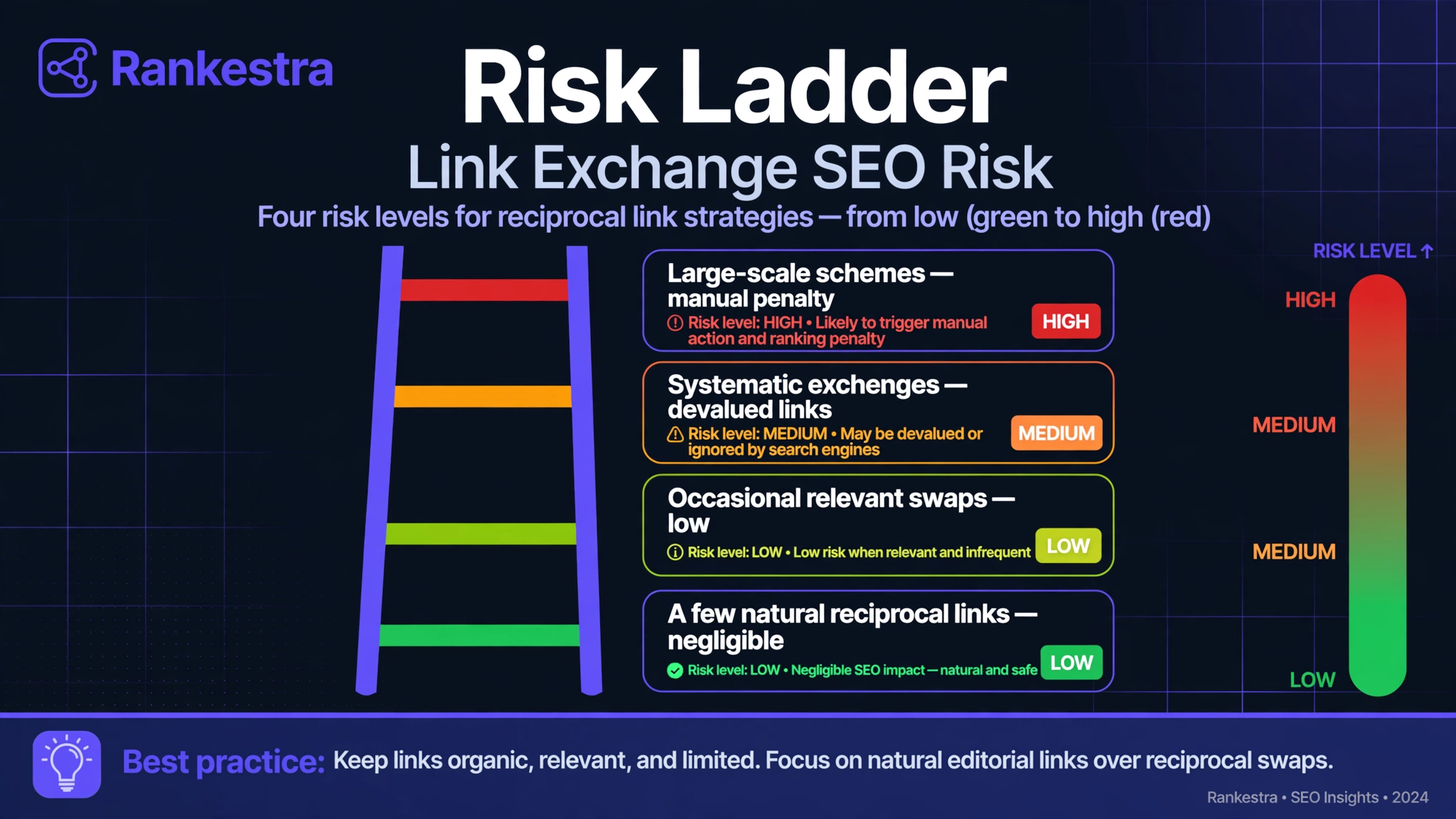
Outcome 1: silent devaluation (the most common)
By far the most likely outcome: they simply stop counting. Google’s systems identify the arranged pattern and neutralize the links’ ranking value — no notification, no drama, no Search Console message. Your rankings don’t crash; they just don’t improve. The effort was wasted, but nothing visibly breaks.
This is why exchanges feel safe. Nothing bad happens — but nothing good happens either. You’ve traded real effort for links with zero ranking value. It’s the worst kind of failure: the kind that doesn’t teach you anything, so you keep doing it.
Outcome 2: algorithmic suppression
A step up: Google’s systems decide the pattern is egregious enough to suppress the site’s overall trust — not a formal penalty, but a dampening of how much your link profile counts. Rankings stagnate or slide across the board. Harder to diagnose than a manual action because there’s no message telling you what happened. You just stop growing.
Outcome 3: manual action (the rarest, but real)
The outcome everyone fears: a human reviewer confirms manipulative linking and applies a manual action — the “unnatural links” message in Search Console, with rankings demoted until you clean up and file a reconsideration request. Manual actions are rare relative to the number of sites running exchanges — but “rare” isn’t “never,” and they’re disproportionately applied to egregious, large-scale, or reported cases.
The honest probability ranking
Stated plainly: silent devaluation >>> algorithmic suppression > manual action. The overwhelmingly likely “punishment” isn’t punishment at all — it’s irrelevance. Your arranged links join the vast population of neutralized spam: counted by your rank tracker, ignored by Google.
This reframes the decision. The question isn’t “will I get penalized?” — it’s “am I willing to invest months building links that probably won’t count?” The scheme doesn’t need to be dangerous to be stupid; it just needs to not work.
Why “it worked for me” stories are survivorship bias
Someone in a forum will always claim exchanges boosted their rankings. Maybe they’re telling the truth — about a site that also had good content, real editorial links, and brand signals doing the actual heavy lifting, with exchange links as harmless decoration. Or maybe they ranked despite the exchanges, not because of them. “It worked for me” is not data. It’s an anecdote from someone who can’t see which of their links actually counted.
The cleanup cost, if it goes wrong
If you land in outcome 2 or 3, understand the price: auditing every arranged link, removing what you can, disavowing the rest, and — for manual actions — filing a reconsideration request and waiting weeks or months. All to return to the position you were in before the scheme. Exchanges offer small, uncertain upside with open-ended downside.
8. The Safe Zone: Reciprocal Links That Are Fine
After three chapters of warnings, here’s the part the fear-mongers skip: reciprocal links are not radioactive. The web runs on them. Google’s own spokesperson calls natural reciprocity “perfectly fine.” This chapter maps exactly where the safe zone is.
The Mueller test: would this link exist without the deal?
One question resolves 90% of cases: if there had never been any arrangement, would this link still exist? If a site links to you because your content genuinely helped their readers — and you happen to link back for equally genuine reasons — that’s reciprocity, not exchange. No deal, no scheme, no problem.
Apply it in reverse, too: if the only reason the link exists is the trade, it’s an exchange link regardless of how nicely it’s dressed up.
Natural reciprocity: real-world examples
What does the safe zone look like? Local business networks: the bakery and its flour supplier linking each other (Mueller’s own example). Partnerships: an agency and its white-label provider, a SaaS tool and its integration partners. Supplier relationships: manufacturers linking distributors and vice versa. Genuine citations: two research-heavy sites referencing each other’s studies. Industry associations: member directories that link both ways.
The common thread: the business relationship came first and the links document it. The links describe reality; they don’t manufacture it.
The proportion rule
Recall the Ahrefs data: among trusted ranking sites, reciprocal overlap of 15%+ is common. Your reciprocal links should look like that — a minority of your profile, the natural background texture of a real business. When reciprocal links dominate your profile, you’ve left the safe zone no matter how innocent each individual link looks. There’s no official “safe percentage” (anyone quoting one is inventing it), but the principle is clear: reciprocity should be the garnish, never the meal.
Checklist: 5 questions before you say yes
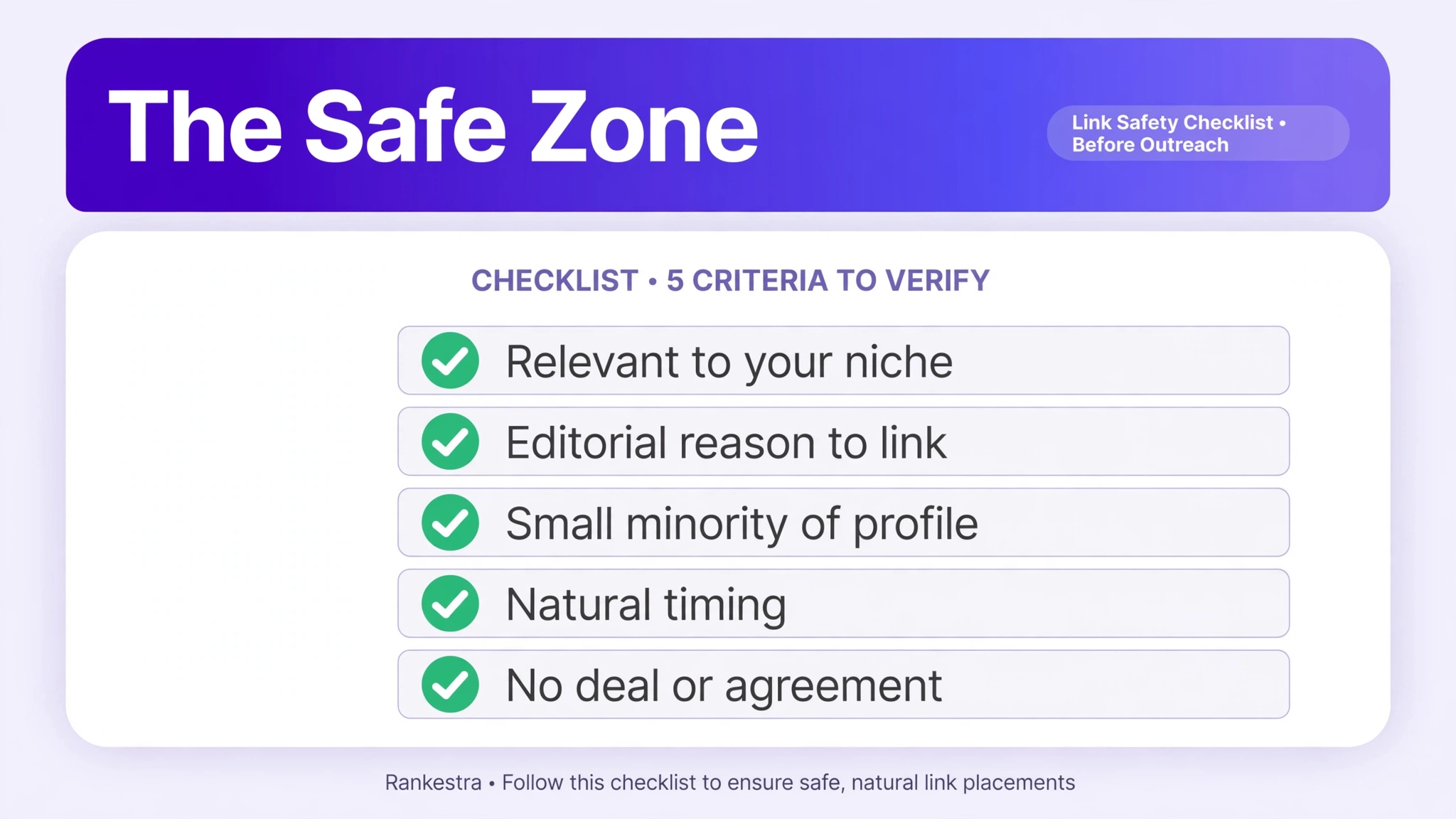
Someone proposes a link swap. Run this checklist: 1. Is there a real relationship? Customer, partner, supplier — or a stranger from a Facebook SEO group? 2. Is it topically relevant? Would your readers actually benefit? 3. Would the link make sense standalone? If nobody linked back, would you still link out? 4. Is it a small fraction of your profile? One of dozens — or one of five total? 5. Is there anything to hide? If you’d be embarrassed explaining this link to a Google reviewer, that’s your answer.
Five yeses: proceed with confidence. Any no: decline politely. Thirty seconds, zero regret.
Already done exchanges? Don’t panic — diversify
Real talk: if you’ve done some reciprocal exchanges in the past, don’t spiral. A handful of arranged links in an otherwise healthy profile is not a death sentence. The fix isn’t panic, it’s dilution: stop arranging new exchanges and start earning links that would exist without any deal. Over time, your arranged links become an ever-shrinking fraction of a growing, legitimate profile. And if you’re ever unsure whether a specific opportunity is safe, our buying backlinks safely guide covers how to vet any link before you commit.
9. Safe Alternatives That Actually Work
Here’s the good news nobody selling exchange schemes wants you to focus on: every hour you’d spend negotiating reciprocal deals can buy links that are stronger, safer, and permanent — with no devaluation risk and nothing to hide. These are the tactics that actually move rankings in 2026.
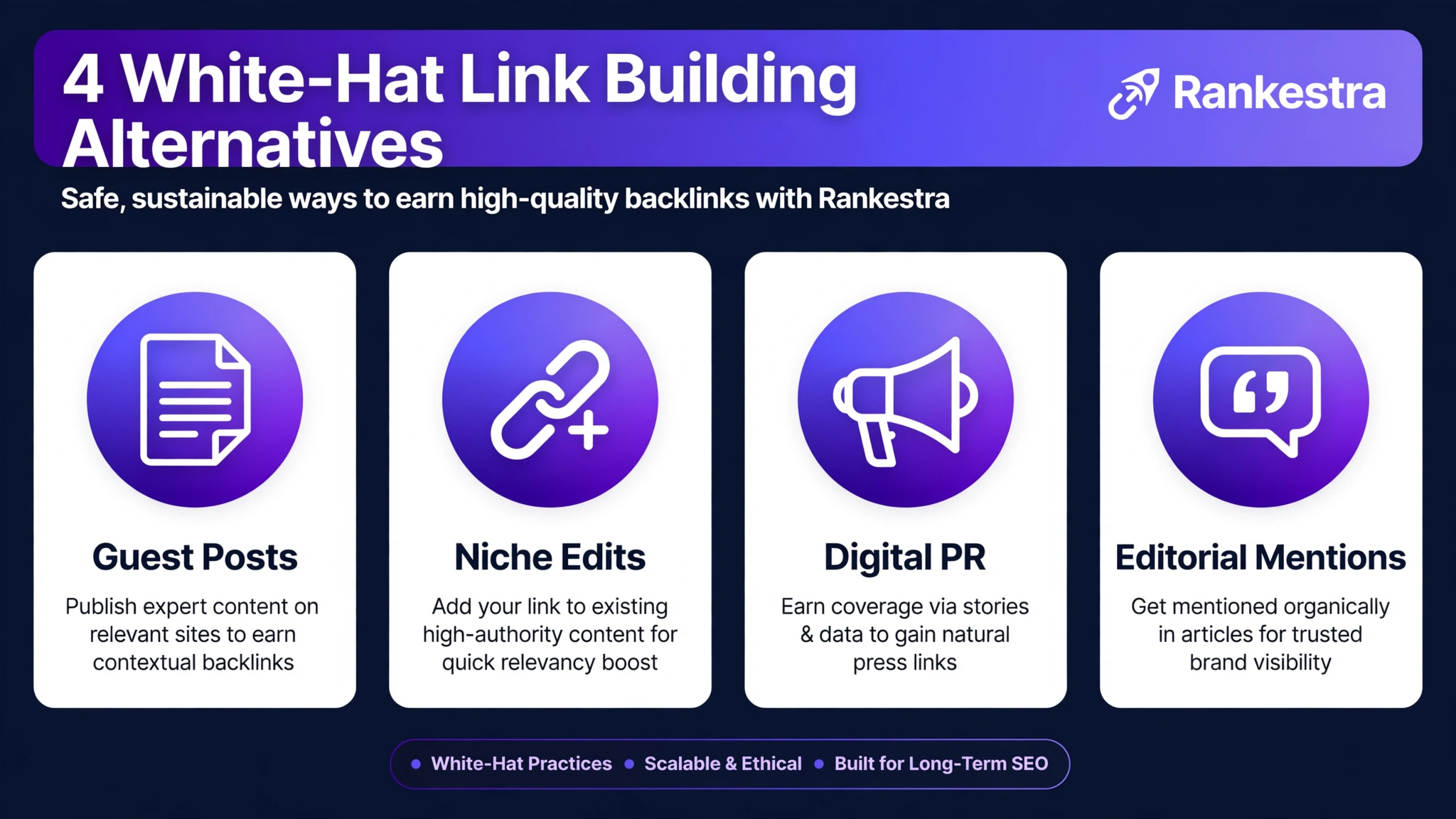
Guest posts on real publications
The workhorse. You write a genuinely useful article for a real publication with real traffic; they publish it; your contextual link sits inside it. Unlike an exchange, there’s no deal between linkers — there’s an editorial transaction where content is the currency. The dividing line is the publisher: real site with editorial standards and actual readers, not a “write for us” farm. For the full playbook read our guest posting and blogger outreach guide. Prefer done-for-you? Our guest post service places only on traffic-verified publications.
Niche edits on already-ranking pages
Instead of trading links, get your link inserted into an article that’s already indexed, already trusted, and already ranking. The advantage over exchanges is structural: you’re borrowing existing authority instead of manufacturing reciprocal signals. One clean insertion on a ranking page outperforms twenty arranged swaps. Our niche edits guide covers vetting and outreach; our link insertion service handles it done-for-you.
Digital PR: earn links by being newsworthy
The highest-ceiling tactic on this list. Original data, surveys, and expert commentary earn coverage — and links — from publications that would never touch a link scheme. A single digital PR link from a major outlet can outperform an entire exchange network, with zero risk attached. Our digital PR link building guide walks through story angles and outreach that journalists actually answer.
Broken link building
Find dead links on relevant sites, then pitch your working content as the replacement. The site owner gets a fixed page; you get an editorial link. Nobody’s trading anything — you’re providing a service, and the link is the thank-you.
Linkable assets: give people a reason
The most durable alternative: publish things worth citing. Original research, free tools, definitive guides, striking visuals. Our types of backlinks guide showed how image and file links accumulate passively when the asset deserves it. Every link it earns is editorial, permanent, and immune to every detection system ever built, because there’s nothing to detect.
The unsexy truth: real relationships
The alternative the scheme-sellers can’t package: genuine professional relationships. Participate in your industry. Help people without keeping score. Over time, people who know and respect your work link to it — freely, contextually, permanently. It’s the safe zone from chapter 8, built deliberately. For niche-specific plays, see our niche link building guide; for citation-style authority, our Wikipedia backlinks guide.
10. The Verdict + Your Action Plan
Ten chapters in, here’s everything distilled. The definition, the data, Google’s own words, the cautionary tale, the detection reality, the honest risks, the safe zone, and the alternatives. One verdict, one table, one plan.
The one-paragraph verdict
A backlink exchange is a deal to trade links for rankings — and Google’s spam policy names “excessive link exchanges” as link spam for exactly that reason. A few natural reciprocal links are normal (73.6% of ranking sites have them) and perfectly fine. But systematic exchanging — direct, three-way, wheels, or networks — is a scheme whose most likely outcome isn’t a penalty but irrelevance: links that silently stop counting. The effort you’d spend arranging trades buys far more ranking power invested in guest posts, niche edits, and digital PR. Don’t trade votes. Earn them.
Every exchange type, ranked by risk
| Exchange Type | How It Works | Risk Level | Verdict |
|---|---|---|---|
| Direct reciprocal (A↔B) | You link to me, I link to you | Low–Medium | Harmless in small natural doses; a scheme at scale |
| Three-way / ABC | A→B→C→A routing to hide reciprocity | Medium | Closed loops are detectable; sneakier-looking, not safer |
| Link wheel | Ring of sites linking in a cycle | High | Geometric fingerprints; obsolete since the 2000s |
| Private exchange network | Brokered pool trading links at scale | Very high | Shared footprints; one bust takes down every member |
| Natural reciprocity (control) | Mutual links with no arrangement | None | The safe zone — “perfectly fine” per Google |
Notice the pattern: risk scales with orchestration. The more arranged the linking, the more detectable — and the less it resembles the natural reciprocity Google explicitly allows.
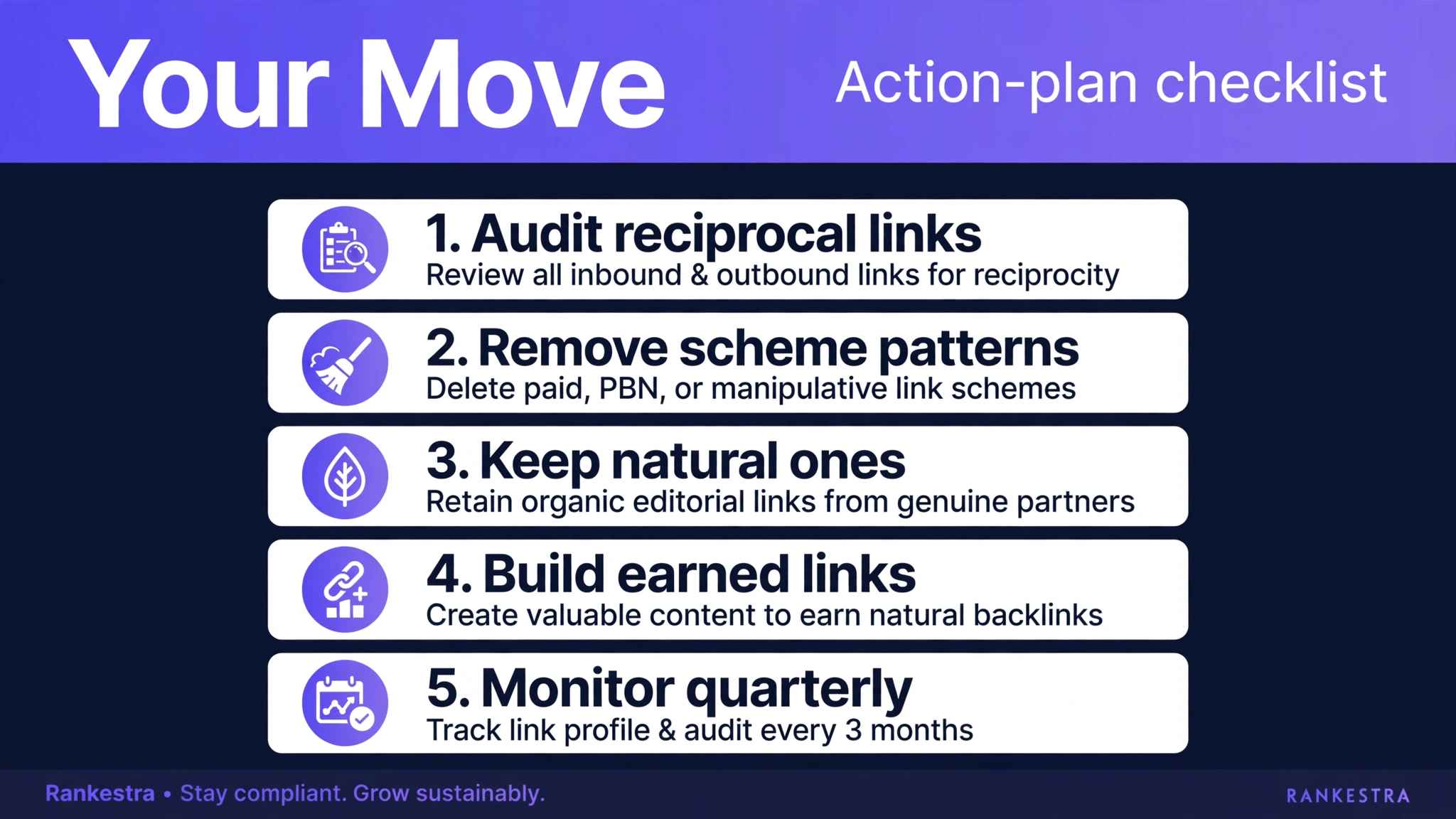
Your action plan: what to do this week
1. Stop arranging new exchanges. No more swap DMs, no more “partners” pages, no network memberships. The pipeline of arranged links ends today.
2. Audit what exists. Pull your backlink profile and identify reciprocal clusters — especially links from pages that exist only to host them. You don’t need to panic or mass-disavow; just know what you have.
3. Keep the natural ones. Genuine partner, supplier, and local-business reciprocal links stay. They were never the problem. Apply the Mueller test from chapter 8: would the link exist without the deal?
4. Redirect the effort. Every hour you spent negotiating swaps now goes to one alternative from chapter 9. Start with guest posts or niche edits — they’re the fastest legitimate wins. Our White Hat Link Building 101 guide is the full foundation.
5. Build link-worthy assets. One definitive guide, one data study, one free tool. Assets earn the editorial links that no exchange can replicate — and they compound instead of decaying.
Don’t trade votes. Earn them.
Here’s the uncomfortable closing truth: link exchanges survive because they feel like progress. Deals signed, links placed, numbers going up in a tracker. But rankings are the only number that matters — and arranged links, at best, don’t move them.
You now know what Google actually says, what the data actually shows, and what to do instead. Pick one tactic from chapter 9 and execute it this week. One earned link beats a hundred traded ones.
Explore the Rankestra Link Building Library
Master every link building discipline with our in-depth pillar guides:
- White Hat Link Building 101 — the fundamentals
- Digital PR for Link Building — earn media links
- Guest Posting & Blogger Outreach — the workhorse tactic
- Wikipedia Backlinks — citations done right
- Niche Edits & Link Insertions — borrow existing authority
- Niche Link Building — SaaS, iGaming & more
- Buying Backlinks Safely — vet sellers, avoid penalties
FAQ: Backlink Exchanges
What is a backlink exchange?
A backlink exchange is a reciprocal linking arrangement where two or more websites agree to link to each other — “you link to me, I’ll link to you” — typically to influence search rankings. Variants include direct (A↔B) swaps, three-way (ABC) routing, link wheels, and private exchange networks. The defining ingredient is the arrangement, not the links themselves.
Are backlink exchanges against Google’s guidelines?
Yes — when systematic. Google’s spam policies explicitly list “excessive link exchanges (‘Link to me and I’ll link to you’) or partner pages exclusively for the sake of cross-linking” as link spam. Google’s John Mueller has said natural reciprocity is “perfectly fine” (especially for local businesses), but doing it “systematically” is “essentially against our webmaster guidelines.”
Do reciprocal links hurt SEO?
A few natural reciprocal links don’t hurt — 73.6% of traffic-earning domains have them, per Ahrefs’ study of 140,592 sites. What hurts is systematic exchanging: arranged reciprocal patterns tend to get silently devalued, meaning the links stop passing ranking value. In egregious cases, algorithmic suppression or manual actions can follow.
What is a three-way (ABC) link exchange?
A three-way exchange routes links in a triangle — Site A links to Site B, Site B links to Site C, Site C links back to Site A — so no two sites link directly back to each other. It’s designed to hide reciprocity, but on a link graph it forms a closed loop, which is its own detectable pattern. It’s not safer than a direct swap, just more elaborate.
How many reciprocal links are safe?
There’s no official number — anyone quoting one is inventing it. The practical rule: reciprocal links should be a small, natural minority of your link profile, arising from genuine relationships (partners, suppliers, local businesses). Apply the test: would this link exist if there had never been any deal? If yes, you’re fine.
What should I do instead of link exchanges?
Invest the same effort in tactics that earn real links: guest posts on traffic-verified publications, niche edits on already-ranking pages, digital PR, broken link building, and linkable assets like original data and free tools. These build editorial links with zero devaluation risk — see our White Hat Link Building 101 guide for the full foundation.