Authority Backlinks: The Honest 2026 Guide (What Actually Makes a Link Authoritative)
Authority Backlinks: The Honest 2026 Guide (What Actually Makes a Link Authoritative)
Type “authority backlinks” into Google and you’ll meet the internet’s favorite sales pitch: “500 DA 50+ backlinks for $49!” Scroll past the spam and you’ll find the opposite extreme — people telling you links don’t matter anymore, that Google moved on, that you’re chasing a ghost.
Both camps are wrong. And both are expensive to believe.
So let’s start with the answer, hype-free.
The short answer: An authority backlink is a followed, editorial, in-content link from a trusted, topically relevant page that real people actually visit. “Authority” is not a Google metric — Domain Authority, Domain Rating, and Authority Score are third-party estimates made by SEO tools, not signals Google uses. The authority that actually moves rankings lives at the page level (relevance, real traffic, editorial placement), not in a domain-wide score. One genuinely authoritative link can outweigh a hundred high-“DA” placements.
That’s the whole debate in one paragraph. Everything below is the evidence: what Google actually says about links in 2026 (in their own words), what 131 SEO professionals voted in a recent survey, what Ahrefs found across 44,589 SERPs and roughly 14 billion pages, where authority really lives (page vs domain), the anatomy of a truly authoritative link, the myths that waste people’s money, and how to earn the real thing.
If you’re new to link building, start with our White Hat Link Building 101 guide — it covers the fundamentals this article builds on. And for the full map of link types, see our honest guide to the types of backlinks.
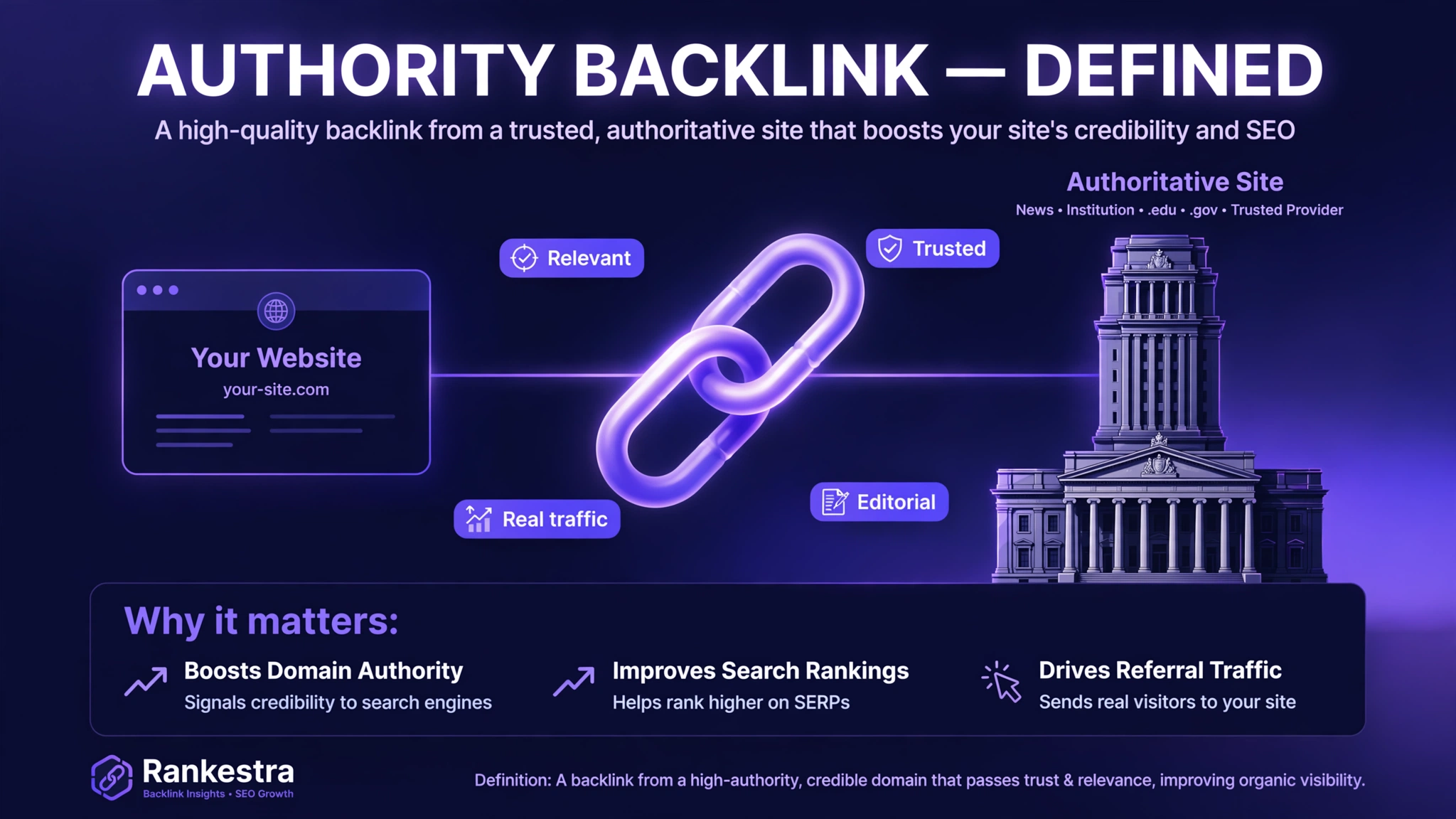
Table of Contents
- 1. What an Authority Backlink Actually Is
- 2. “Authority” Is Not a Google Metric
- 3. What Google Actually Says About Links in 2026
- 4. What 131 SEOs Actually Say
- 5. The Data: Referring Domains vs Traffic
- 6. Page vs Domain: Where Authority Really Lives
- 7. Anatomy of a Truly Authoritative Backlink
- 8. Myths That Waste Your Money
- 9. How to Actually Earn Authority Backlinks
- 10. The Verdict + Your Action Plan
- FAQ: Authority Backlinks
1. What an Authority Backlink Actually Is
Before we argue about how to get authority backlinks, we need to agree on what the words mean. Because right now, “authority backlink” means three different things to three different people — and only one of them is right.
The definition, stated plainly
An authority backlink is a followed, editorial, in-content link from a trusted, topically relevant page on a website that search engines and users already respect. Every word in that sentence is load-bearing: followed (actually vouching), editorial (placed by a human with standards), in-content (inside the article body, not a footer), trusted and topically relevant (real content, real traffic, real reputation).
Miss any one of those and you don’t have an authority backlink. You have a backlink with an impressive number next to it — which is a very different thing, as chapter 2 will show.
The four ingredients, in plain English
Strip away the jargon and an authoritative link has four ingredients: trust (the source is legitimate), relevance (the page is about your topic), placement (it’s editorial and in-content), and realness (actual humans visit the linking page). A link with all four is worth pursuing at almost any reasonable cost. A link missing two or more is decoration.
Notice what’s not on the list: any mention of DA, DR, or Authority Score. Those numbers can correlate with the four ingredients — but the number is the shadow, not the object. Chasing the shadow is how people end up paying for “DA 70” links from hacked pages and link farms.
What it is NOT
An authority backlink is not a link from a high-scoring domain regardless of context. It’s not a footer credit on a “DA 80” site. It’s not one of 400 outbound links on a “resources” page nobody visits. And it’s definitely not whatever a seller means when they promise “100 authority backlinks” for the price of a pizza.
Real talk: if someone can sell you “authority” by the hundred, it isn’t authority. Authority is scarce by definition — that’s what makes it valuable.
Why the definition matters more than the metric
Every bad purchase in link building starts with a vague term. “High quality.” “Premium.” “Authority.” Sellers love vague terms because they can’t be falsified. A definition with four checkable ingredients can be. Before you pay for a single link, run it against the four ingredients. If it fails two, walk away.
2. “Authority” Is Not a Google Metric
Deep breath. This is the chapter that breaks some hearts — because a multi-million-dollar industry runs on pretending otherwise.
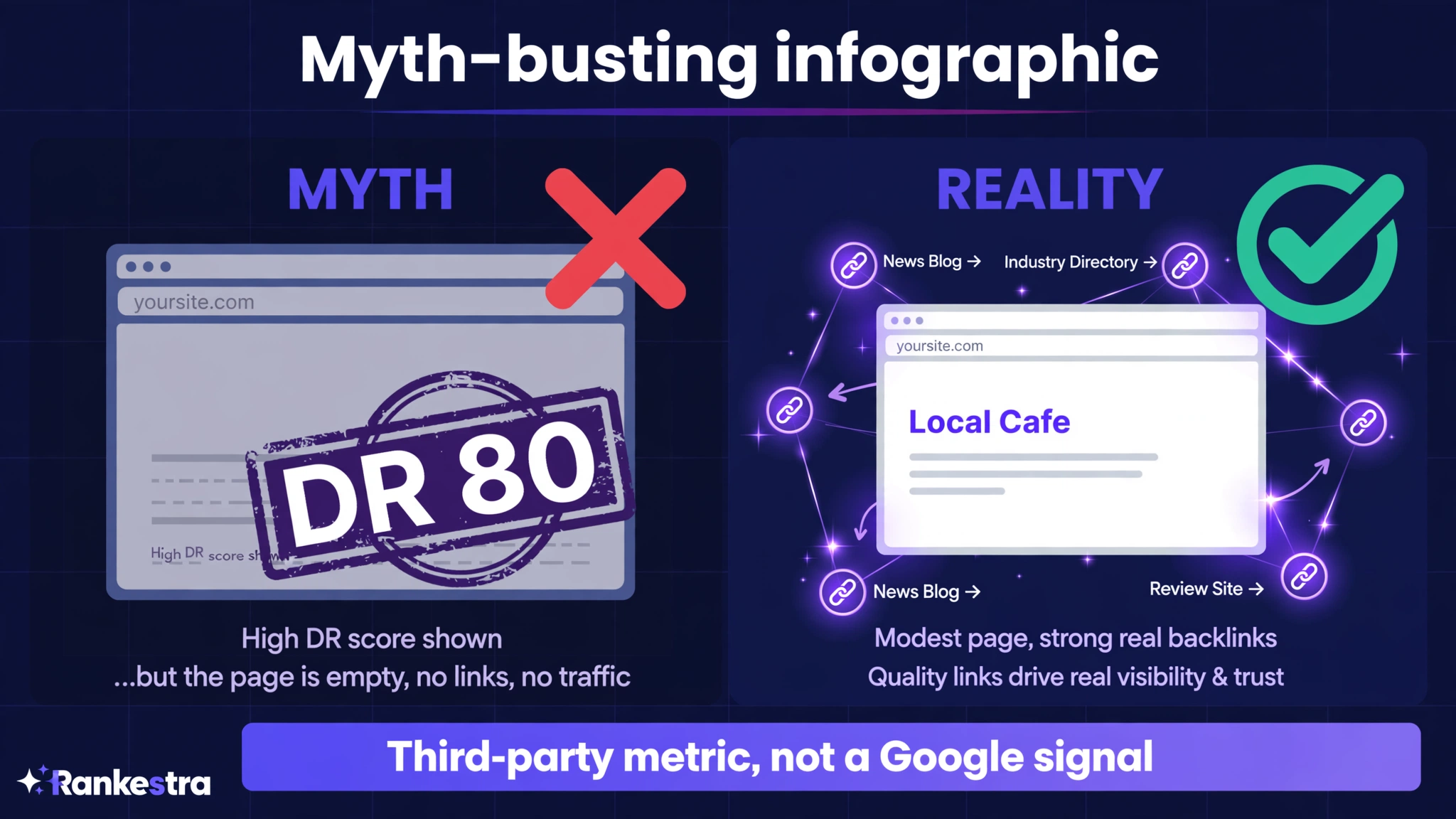
Google does not have a “Domain Authority” score. It does not have “Domain Rating.” It does not have “Authority Score.” None of these exist inside Google’s ranking systems. They are third-party estimates, invented by SEO tool companies, computed from each company’s own link index, using each company’s own formula.
The three scores, honestly explained
Domain Rating (DR) — Ahrefs’ metric, 0–100. It estimates a domain’s link-profile strength based on referring domains in Ahrefs’ index. Ahrefs themselves state plainly that DR is not a direct Google ranking factor.
Domain Authority (DA) — Moz’s metric, 0–100. It predicts how likely a domain is to rank, based on Moz’s link index. A prediction, not a measurement of anything Google computes.
Authority Score (AS) — Semrush’s metric, 0–100, blending link data with traffic estimates and spam signals. Same story: a composite third-party estimate, not a Google signal.
All three are useful as rough proxies — a DR 85 site is usually more established than a DR 12 site. The problem starts when the proxy becomes the target.
Ahrefs says it themselves
This isn’t conspiracy thinking — it’s the tool vendors’ own documentation. Ahrefs states that Domain Rating is not a Google ranking factor. When even the company selling you the number tells you Google doesn’t use it, believe them.
Why the numbers still get used (and abused)
If the scores aren’t Google signals, why does everyone quote them? Because they’re convenient. “DA 60” fits in a sales pitch; “followed, editorial, in-content link from a topically relevant page with real organic traffic” doesn’t. And sellers know it — the entire “high DA backlinks” marketplace exists because a number is easier to fake than the four ingredients from chapter 1. You can inflate a domain’s DR with link spam or buy expired domains with residual scores. The number goes up; the actual authority never existed.
The honest way to read third-party scores
Use them as a first-pass filter, never as a verdict. A high score plus real organic traffic plus topical relevance plus editorial standards? Worth a closer look. A high score alone, with no traffic and no relevance? That’s a number without a story — and numbers without stories are how money gets wasted.
3. What Google Actually Says About Links in 2026
Forget what link sellers tell you. Forget what the “links are dead” crowd tells you. When the question is what Google thinks about backlinks, there’s exactly one opinion that matters — Google’s. And in the last few years, they’ve said it unusually clearly.
Gary Illyes at PubCon 2023: “people overestimate the importance of links”
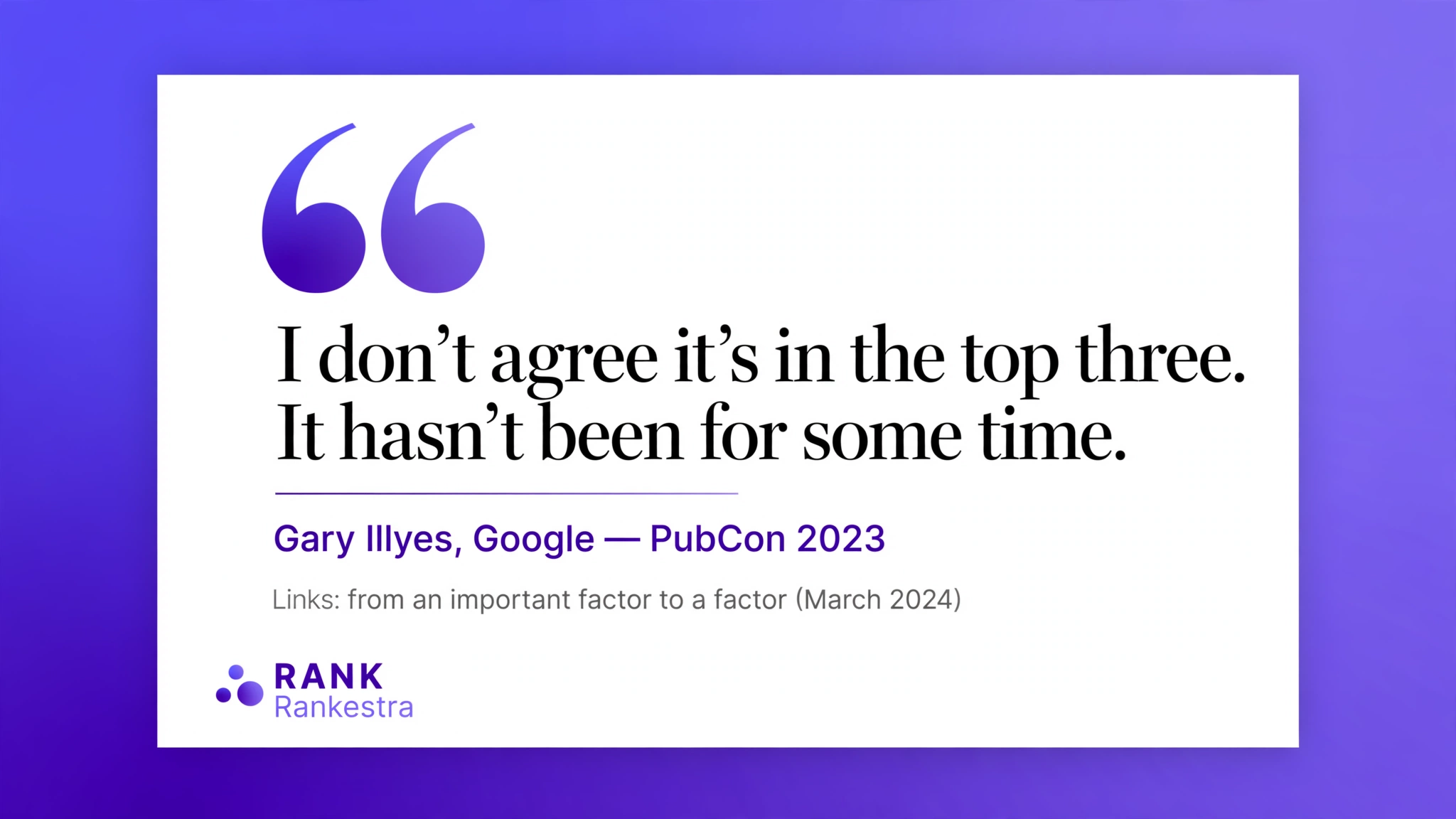
Google Search Analyst Gary Illyes, speaking at PubCon 2023, put it bluntly: “I think they are important, but I think people overestimate the importance of links. I don’t agree it’s in the top three. It hasn’t been for some time.” He added that “there really isn’t a universal top 3.”
Read that carefully. A Google search analyst saying links are not in the top three ranking factors, and haven’t been “for some time.” That’s not “links are dead.” It’s something more precise: links matter, but the industry’s obsession with them is out of proportion to their actual weight.
March 2024: Google quietly deletes the word “important”
Then came the documentation edit heard around the SEO world. In March 2024, alongside a core update, Google changed its spam-policy documentation from “Google uses links as an important factor in determining the relevancy of web pages” to “Google uses links as a factor in determining the relevancy of web pages.”
One word removed: “important.” Nobody at Google does that by accident. The deliberate choice was to demote links from “an important factor” to “a factor.” Not dead. Not irrelevant. Just one factor among many, no longer important enough to earn the adjective.
John Mueller, April 2024: stop over-focusing
John Mueller, Google’s Search Advocate, drove the point home in April 2024: “There are more important things for websites nowadays, and over-focusing on links will often result in you wasting your time doing things that don’t make your website better overall.”
That’s the practical translation of Illyes’ statement. The danger isn’t that links do nothing — it’s that link obsession consumes the budget and attention that should go into the site itself: content, relevance, user experience.
The honest read: demoted, not dead
Put the three statements together and Google’s position is coherent: backlinks remain a ranking factor, but their relative importance has declined as Google got better at understanding content, relevance, and user satisfaction directly.
Real talk: this is actually good news for honest link builders. When links were everything, spammy volume could win. As their weight normalizes, the quality bar matters more — and quality is exactly what white-hat tactics produce. Our White Hat Link Building 101 guide is built on this exact premise.
4. What 131 SEOs Actually Say
So Google downplays links. Case closed? Not quite — because the people who rank websites for a living see something more nuanced. And in September 2026, 131 of them were asked to put numbers on it.
The Zyppy survey: backlinks voted #2
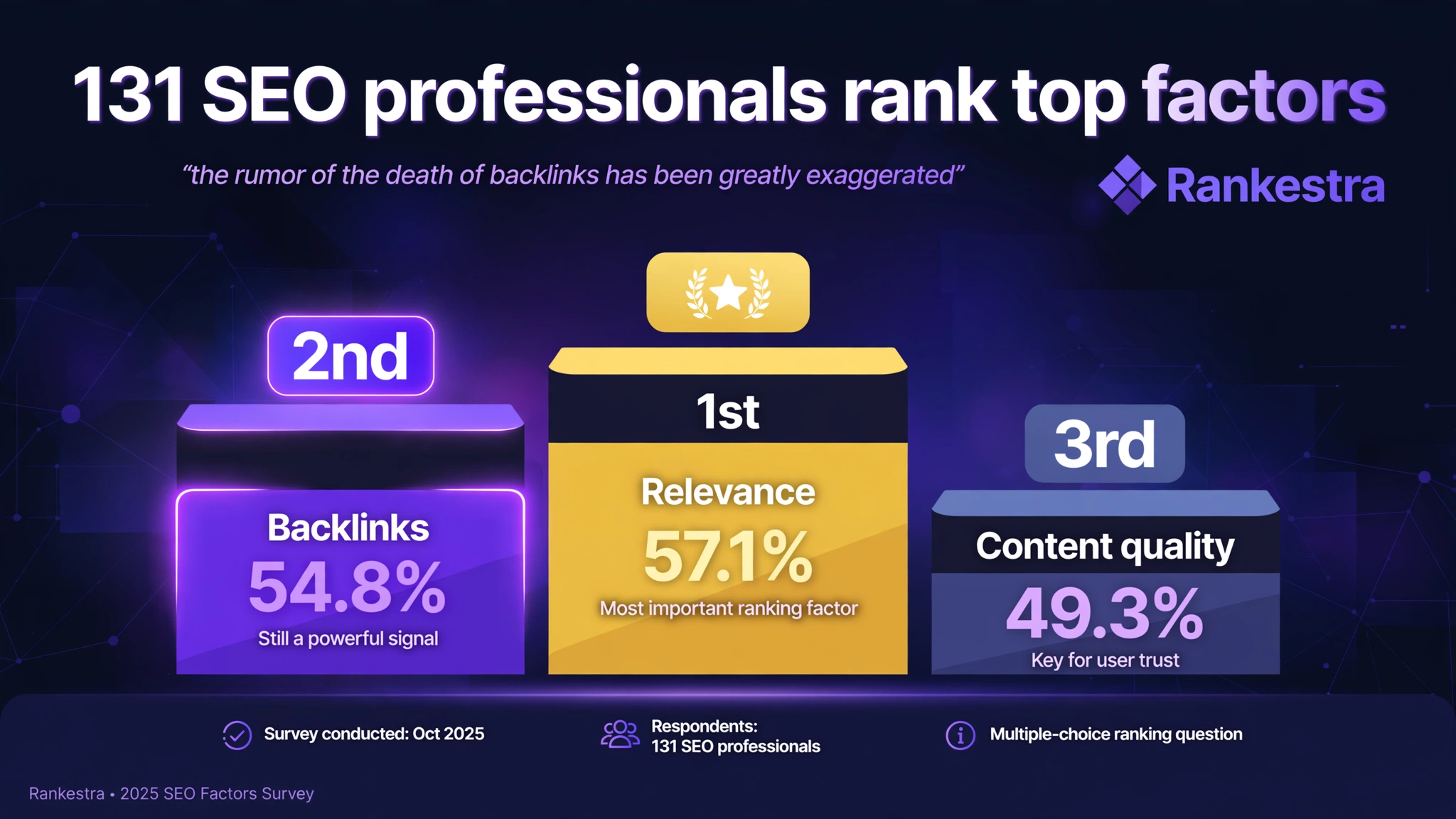
A Zyppy survey of 131 SEO professionals, reported by Search Engine Land in September 2026, asked practitioners to rank the most important ranking factors. The result: backlinks ranked #2, selected by 54.8% of respondents — behind relevance (#1, 57.1%) and ahead of content quality (#3).
Let that sink in. After years of Google telling the industry that links are overestimated, a majority of working SEOs still put backlinks second only to relevance itself. That’s not nostalgia — these are people whose livelihoods depend on being right about what moves rankings.
What the voters actually value
The survey’s detail matters more than the headline. Among backlink-related factors, “links from trusted, topically relevant domains and pages with real visitors received some of the highest ratings.”
Read that as a definition and it’s nearly word-for-word the four ingredients from chapter 1: trusted source, topical relevance, real visitors. The practitioners aren’t voting for “DA 90 links” — they’re voting for exactly the kind of link this guide defines as authoritative.
“The rumor of the death of backlinks has been greatly exaggerated”
Cyrus Shepard, quoted in the report, summarized it: “the rumor of the death of backlinks has been greatly exaggerated.” The “links are dead” crowd overstates Google’s demotion; the “links are everything” crowd ignores it. The survey lands where the evidence lands: links are the second-most-important factor, and the links that count are the authoritative kind.
Reconciling Google and the practitioners
Here’s the honest synthesis. Google says: links are overestimated, not top-three, one factor among many. Practitioners say: still #2, still decisive. Both can be true — Google describes the average weight of links across all queries, where relevance and content dominate. Practitioners describe the marginal weight in competitive SERPs, where everyone already has relevant content and links are the tiebreaker.
Real talk: if your content isn’t relevant, no link saves you (relevance is #1 for a reason). But when relevance is table stakes, authoritative backlinks are very often what separates position 4 from position 1.
5. The Data: Referring Domains vs Traffic
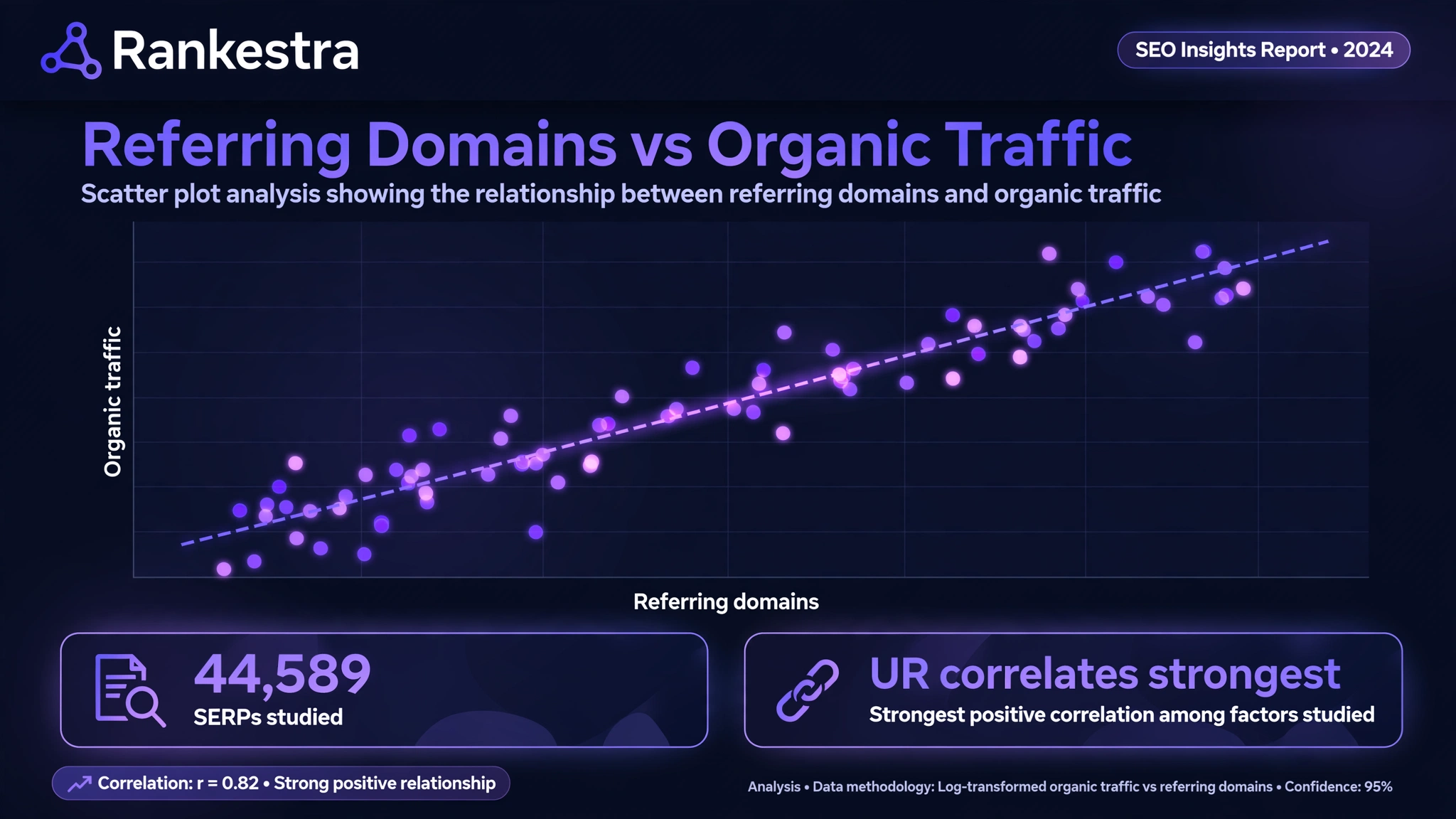
Opinions are nice. Let’s look at measurements. Ahrefs ran one of the largest correlation studies in SEO history across 44,589 SERPs — and the findings redraw the map of what “authority” actually means in practice.
44,589 SERPs: URL Rating correlates strongest
The headline finding: URL Rating (UR) — Ahrefs’ page-level link metric — was the strongest correlating factor with rankings across the 44,589 SERPs studied. Not domain-level scores. Page-level link strength.
The second finding breaks brains: the number of referring domains with traffic did not correlate with rankings any higher than the total number of referring domains. Links from pages that themselves get search traffic were not measurably more predictive of rankings than links in general.
“Links with traffic” are vanishingly rare
Context: links from pages with traffic are rare. In the study, only 20 of the 44,589 SERPs had all top-ranking pages with at least one link from a page with traffic — roughly 1 in 2,229. And for roughly one in five SERPs, none of the top-ranking pages had any links with traffic at all.
Pages are ranking at the top of Google — in one SERP out of five — with zero links from traffic-bearing pages. If traffic-bearing links were a requirement for authority, those rankings couldn’t exist. They’re a nice-to-have, not a prerequisite.
The mandatory caveat: correlation is not causation
Real talk: every finding in this chapter is a correlation, and correlations don’t prove cause. Pages with strong UR might rank because of their links — or strong pages might simply attract both links and rankings independently. Treat this data as a map of what ranking pages look like, not as proof that copying the pattern guarantees the outcome.
What this means for your link building
Three practical takeaways. One: stop filtering link prospects exclusively by “does the page get traffic” — the data says it’s not the decisive correlate you think it is. Two: prioritize the page’s link strength and relevance over the domain’s headline score. Three: total referring-domain growth still matters — the oldest correlation in SEO hasn’t been repealed, just refined. For a deeper look at how different link types contribute, see our types of backlinks guide.
6. Page vs Domain: Where Authority Really Lives
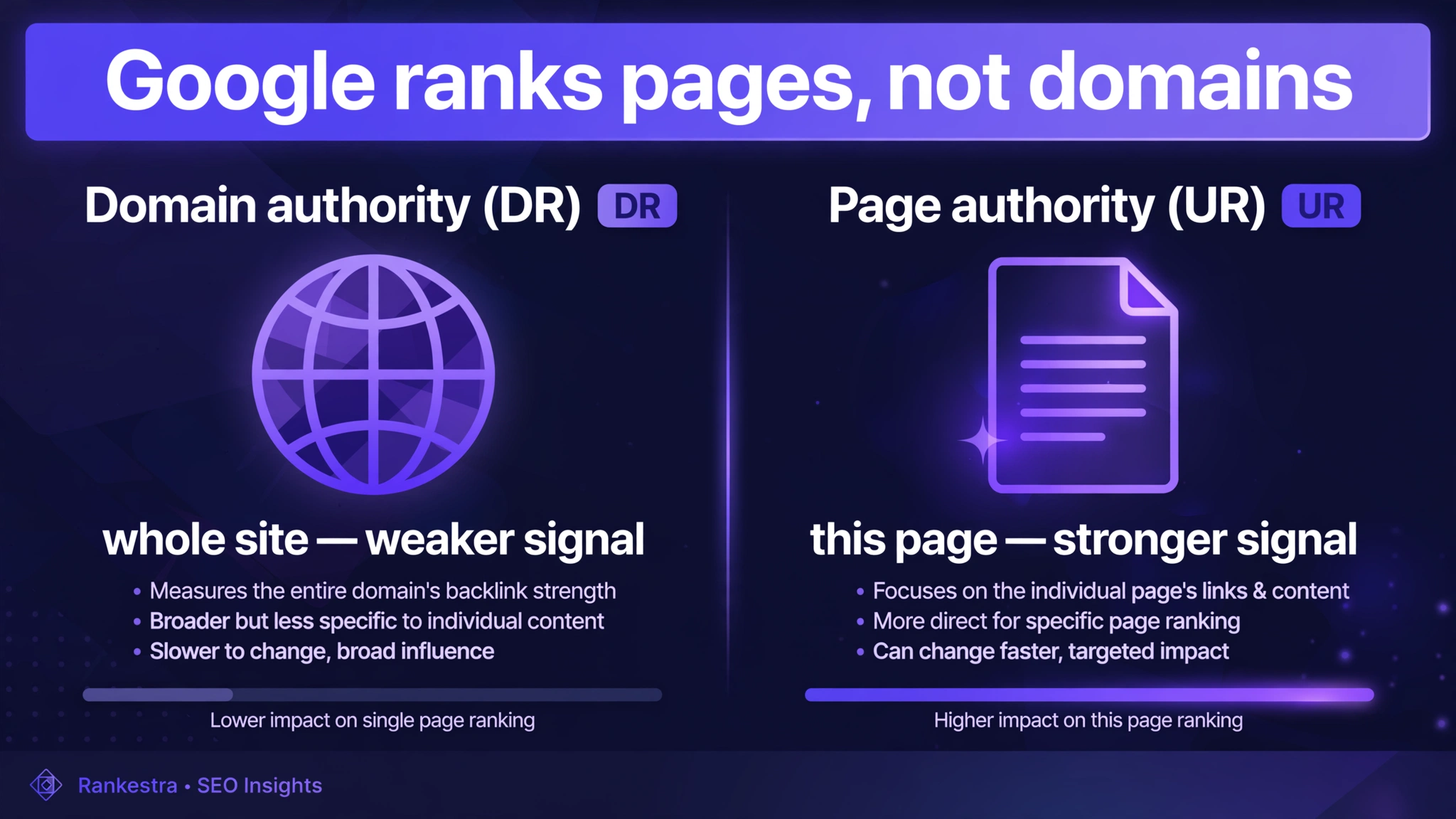
Here’s the single most misunderstood sentence in link building: “Google ranks pages, not domains.” Everyone nods at it. Almost nobody builds links like they believe it.
UR beats DR: the page-level finding
Remember chapter 5’s headline result? Across 44,589 SERPs, URL Rating — the page-level metric — correlated with rankings more strongly than Domain Rating, the domain-level one. When Google ranks your page, what matters most is the link strength of that page (and the pages linking directly to it), not the average strength of the entire domain it sits on.
Practically, this flips how most people vet links. A link from a DR 85 domain’s forgotten, unlinked, zero-traffic subpage is a domain-strong, page-weak link. A link from a DR 35 site’s flagship article — the one with its own backlinks, its own traffic, its own internal links — is domain-modest, page-strong. The data says the second one is the better bet. The marketplace, which prices by domain score, systematically underprices it.
The billion-page finding: no referring domains, no traffic
Zoom out. Ahrefs analyzed roughly a billion pages and found that the vast majority of pages without any referring domains get no traffic from Google — alongside a clear positive correlation between unique referring domains and search traffic.
That’s the baseline reality: links remain the connective tissue of discoverability. A page with zero referring domains is, for ranking purposes, nearly invisible. This doesn’t contradict Google’s “links are overestimated” — it scopes it. Links may not be top-three in relative weight, but zero links still means near-zero traffic in absolute terms for most pages.
14 billion pages: 96.55% get zero traffic
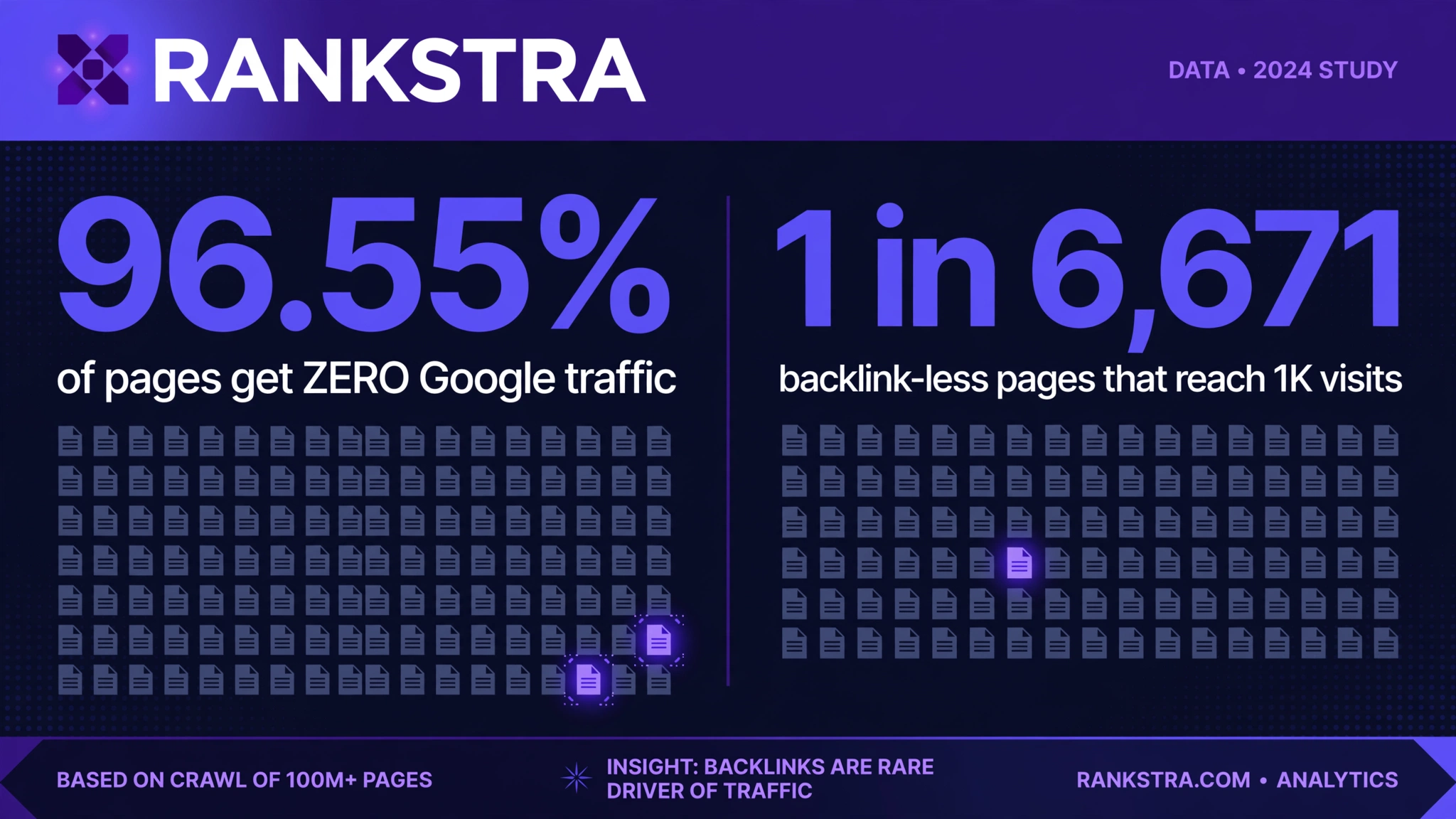
Go bigger still. An Ahrefs Content Explorer study of roughly 14 billion pages found that 96.55% of all pages get zero traffic from Google. Among the pages with no referring domains — about 20 million — only 2,997 exceeded 1,000 monthly visits. That’s roughly 1 in 6,671.
Ahrefs’ Tim Soulo attributes the zero-traffic epidemic to three causes: no search demand, lack of backlinks (“a clear correlation between the number of websites linking to a page and its traffic”), and search-intent mismatch. Backlinks are one of only three causes — and the only one you can directly build after publication.
What “Google ranks pages” means for your strategy
Three shifts. One: vet the linking page, not just the domain — check its own backlinks, its traffic, whether it’s indexed and internally linked. Two: prefer links to the pages you actually want to rank, because page-level strength accrues page-level. Three: stop paying domain-score premiums for page-weak placements — a DR 80 link on a dead page is a designer label on an empty box.
7. Anatomy of a Truly Authoritative Backlink
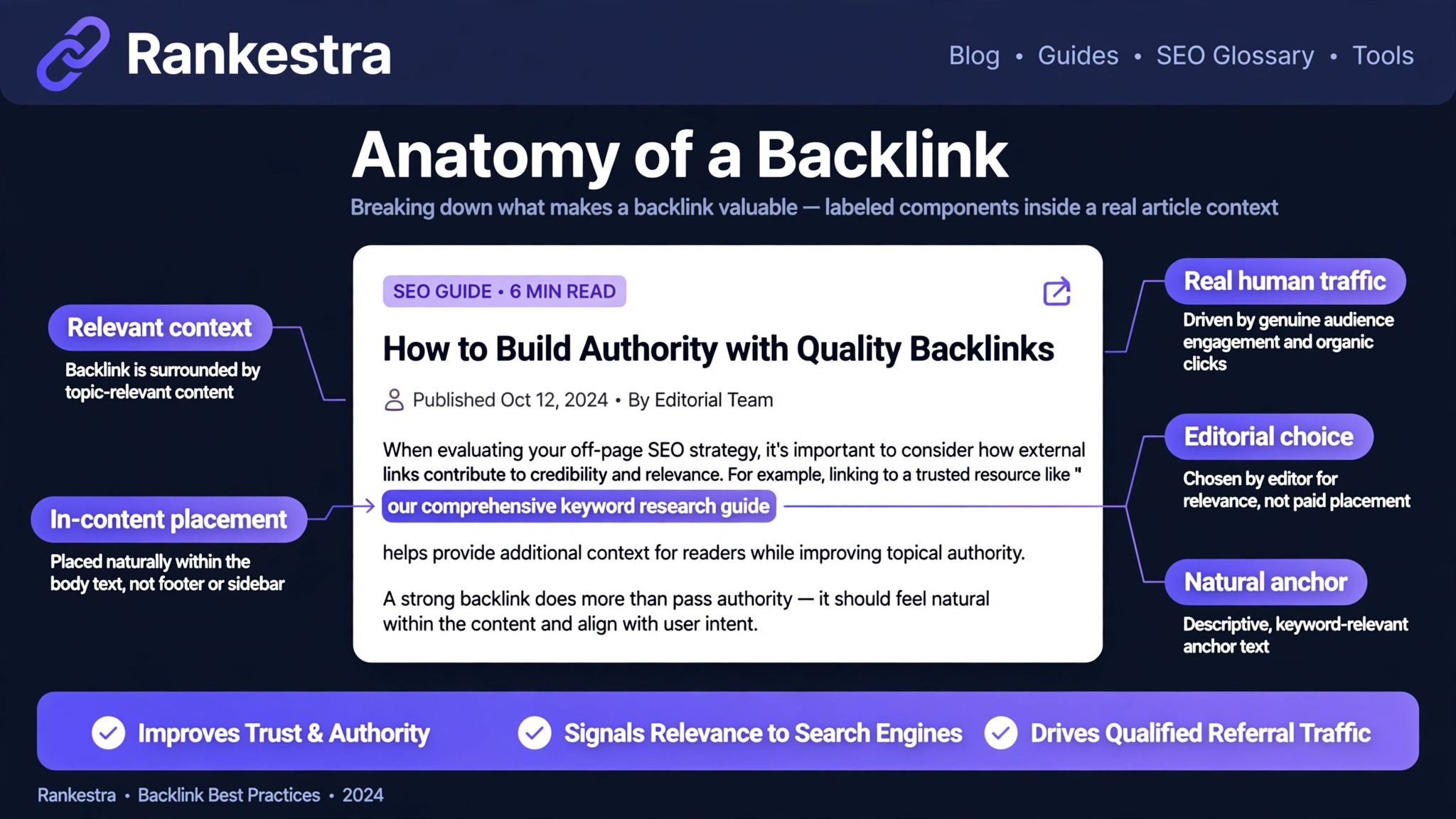
Theory’s over. Let’s get surgical. When you’re staring at a link opportunity, here are the five components to check, in order of importance.
1. Topical relevance
The linking page should be about your topic. A link to your link-building guide from an SEO article beats the same link from a cooking blog, even if the cooking blog’s domain scores higher. Relevance is how search engines interpret why the link exists. The Zyppy survey’s practitioners rated “topically relevant domains” among the highest-value link factors. They’re right.
2. Page-level strength
Check the linking page: does it have its own backlinks? Its own traffic? Is it indexed, internally linked, and alive — or an orphaned page published three years ago? Chapter 6’s data says page-level strength out-correlates domain scores. A strong page on a modest domain beats a dead page on a famous one.
3. Editorial, in-content placement
The link should sit inside the article body, placed by someone with editorial standards, surrounded by relevant text. A followed link in paragraph three of a real article; not a footer credit, not a sidebar badge, not one of 200 links on a “resources” page. For the full taxonomy, see our types of backlinks guide.
4. Natural anchor text
The clickable text should read like a human wrote it — branded, descriptive, or natural-phrase anchors. Exact-match keyword anchors repeated across placements are a footprint, not a feature. Relevance in the surrounding text matters more than keyword-stuffing the anchor itself.
5. A clean neighborhood
Look at who else the page links to. A page linking to ten legitimate resources is a good neighborhood. A page linking to casinos, payday loans, and “essay writing services” is a bad one — your link inherits the company it keeps. Sites that sell links indiscriminately dilute every link they carry, including yours.
The 60-second vetting routine
Put it together: open the linking page — is it indexed and topically relevant? Check its traffic and backlinks — is the page alive? Read the paragraph your link would sit in — editorial and contextual? Scan the page’s other outbound links — clean neighborhood? Pass all five in sixty seconds: worth pursuing. Fail two: not an authority link no matter what the domain score says. Evaluating paid opportunities? Run the same routine through our buying backlinks safely guide first.
8. Myths That Waste Your Money
Now the expensive part: the myths. Each has a thriving marketplace behind it, which is exactly why they survive contact with the evidence. Let’s kill them with data.
Myth 1: “DA 50+ backlinks” packages
The pitch: hundreds of links from “high DA” domains, cheap, fast. The reality: sellers optimize for the number, because the number is what’s being sold. The domains are typically expired-domain rebuilds, hacked pages, or link farms — high score, zero relevance, zero traffic, zero editorial standards. You’ve paid for the shadow while the object never existed.
Real talk: if “authority” could be bought by the hundred for pocket change, it wouldn’t be worth having. Scarcity is the entire mechanism.
Myth 2: higher DR always beats lower DR
A DR 70 link is not automatically better than a DR 40 link. Chapter 6’s data says page-level strength out-correlates domain scores — a strong, relevant, trafficked page on a DR 40 domain routinely beats a dead page on a DR 70 domain. Domain-score comparison without page-level and relevance context is numerology.
Myth 3: more links always wins
The billion-page finding does show correlation between referring-domain counts and traffic — but correlation across a billion pages doesn’t mean your next 100 links help. What the data supports: going from zero to some real links matters enormously; going from 200 decent links to 400 mediocre ones matters far less. Diminishing returns are real. Ten authoritative links beat a hundred decorative ones — not as a slogan, as arithmetic.
Myth 4: you can shortcut with “authority” marketplaces
Every shortcut marketplace exploits the same gap: buyers checking the domain score instead of the five components. The defense is always the 60-second routine from chapter 7. Sellers hate it because it works. For a full field guide to vetting sellers, our buying backlinks safely guide names every trick in the book.
The pattern behind all four myths
Every myth substitutes a number for a judgment: DA for trust, DR for relevance, count for quality, marketplace ratings for vetting. Numbers feel objective, which is why they’re such effective sales tools — and why they fail. Authority is a judgment about trust, relevance, placement, and realness. No single number captures it.
9. How to Actually Earn Authority Backlinks
Enough diagnosis. Here’s the treatment: the tactics that produce links passing all five components of chapter 7 — the ones with trust, relevance, placement, and realness baked in. None of them are shortcuts. All of them work.
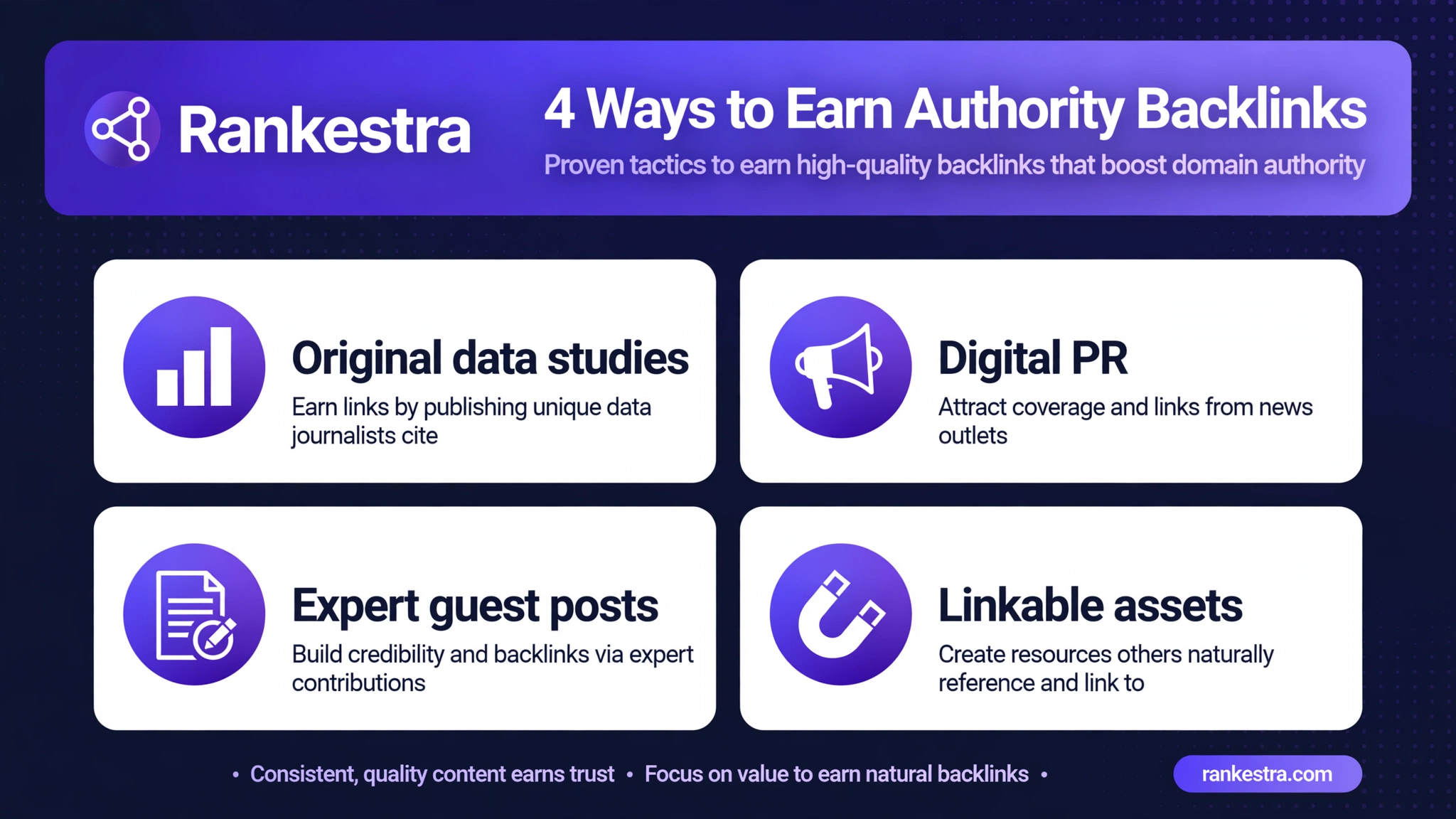
Digital PR: the authority fast lane
The highest-ceiling tactic for authoritative links. Original data, surveys, and expert commentary earn coverage — and links — from publications with genuine standing: news outlets, industry press, research-citing blogs. A single digital PR link from a major publication routinely carries more weight than a year of low-tier placements. Our digital PR link building guide walks through story angles, asset types, and outreach that journalists actually answer.
Guest posts on real publications
The workhorse. You write a genuinely useful article for a real publication with real traffic and editorial standards; your contextual link sits inside it. The key word is real — vet the publication with the 60-second routine from chapter 7, not the domain score. A guest post on a DR 45 site with actual readers beats a “DA 70 guest post” on a content farm every single time. For the full playbook read our guest posting and blogger outreach guide. Prefer done-for-you? Our guest post service places only on traffic-verified publications.
Niche edits on already-ranking pages
Get your link inserted into an article that’s already indexed, already trusted, and already ranking — borrowing existing page-level authority instead of building from zero. This is the tactic that most directly exploits chapter 6’s finding: you’re attaching your link to a page whose UR-type strength is already proven. Our niche edits and link insertions guide covers vetting checklists; our link insertion service handles outreach and placement done-for-you.
Linkable assets: give people a reason
The most durable tactic of all: publish things worth citing. Original research, free tools, definitive guides, striking visuals. Assets earn editorial links on autopilot — the linking pages chose you, which means all five components arrive by default. Slow to start, unstoppable once compounding. Our types of backlinks guide shows how image and file links accumulate passively when the asset deserves it.
Broken link building
Find dead links on relevant, established sites; pitch your working content as the replacement. The webmaster gets a fixed page; you get an editorial link on a page with history. Nobody’s trading anything — you’re providing a service, and the link is the thank-you.
Wikipedia citations (if you’re genuinely notable)
A niche but potent source: citations on Wikipedia pass enormous trust signals. The bar is real notability with published, verifiable sources — and the links are nofollow. Worth pursuing for trust and referral value. Our Wikipedia backlinks guide covers the notability requirements and the right way to earn them.
What NOT to do (the exchange trap)
One warning: don’t try to shortcut authority with reciprocal schemes. Trading links manufactures the appearance of endorsement without any of the five components. Google’s spam policies explicitly name excessive link exchanges, and the most likely outcome is silent devaluation. Our honest guide to backlink exchanges covers the full picture.
10. The Verdict + Your Action Plan
Ten chapters in. The definition, the metric myth, Google’s own words, 131 practitioners, 44,589 SERPs, a billion pages, the five-component anatomy, the four myths, and the earning playbook. One verdict, one table, one plan.
The one-paragraph verdict
An authority backlink is a followed, editorial, in-content link from a trusted, topically relevant page that real people visit — judged by five components (relevance, page-level strength, editorial placement, natural anchor, clean neighborhood), not by a domain score. “Authority” scores like DR, DA, and AS are third-party estimates Google doesn’t use; useful as rough filters, dangerous as targets. Google has demoted links from “an important factor” to “a factor” — yet 131 SEOs still vote them the #2 ranking factor, and billion-page data shows pages without referring domains get near-zero traffic. The synthesis: earn fewer, better links at the page level, on relevant pages, through tactics that can’t be faked. Authority isn’t a number you buy. It’s a judgment you earn.
Every authority signal, honestly ranked
You’ve read 6,000 words. Here’s the cheat sheet — every signal people use to judge links, scored on what it actually measures and how much to trust it:
| Signal | What It Actually Measures | Reliability | Weight in Your Decision |
|---|---|---|---|
| Topical relevance | Whether the linking page is about your subject | 5/5 | Highest — check first |
| Page-level strength (UR-type) | The linking page’s own link profile | 5/5 | Highest — out-correlates domain scores |
| Editorial in-content placement | Human endorsement vs boilerplate inventory | 5/5 | Highest — non-negotiable |
| Real traffic to linking page | Whether humans actually visit | 4/5 | High — nice to have, not required |
| Clean outbound neighborhood | Who else the page links to | 4/5 | High — guilt by association is real |
| Third-party domain score (DR/DA/AS) | One tool’s estimate of domain link strength | 3/5 | Medium — filter, never verdict |
| Raw referring-domain count | Link popularity at domain scale | 3/5 | Medium — correlates, with steep diminishing returns |
| Exact-match anchor text | Keyword in the clickable text | 2/5 | Low — footprint risk outweighs the gain |
Notice the pattern: the top of the table is all judgment; the bottom is all numbers. The signals that matter most require you to actually look at the page. The signals that matter least are the ones a spreadsheet can sort. That’s the whole lesson of this guide.
Your action plan: what to do this week
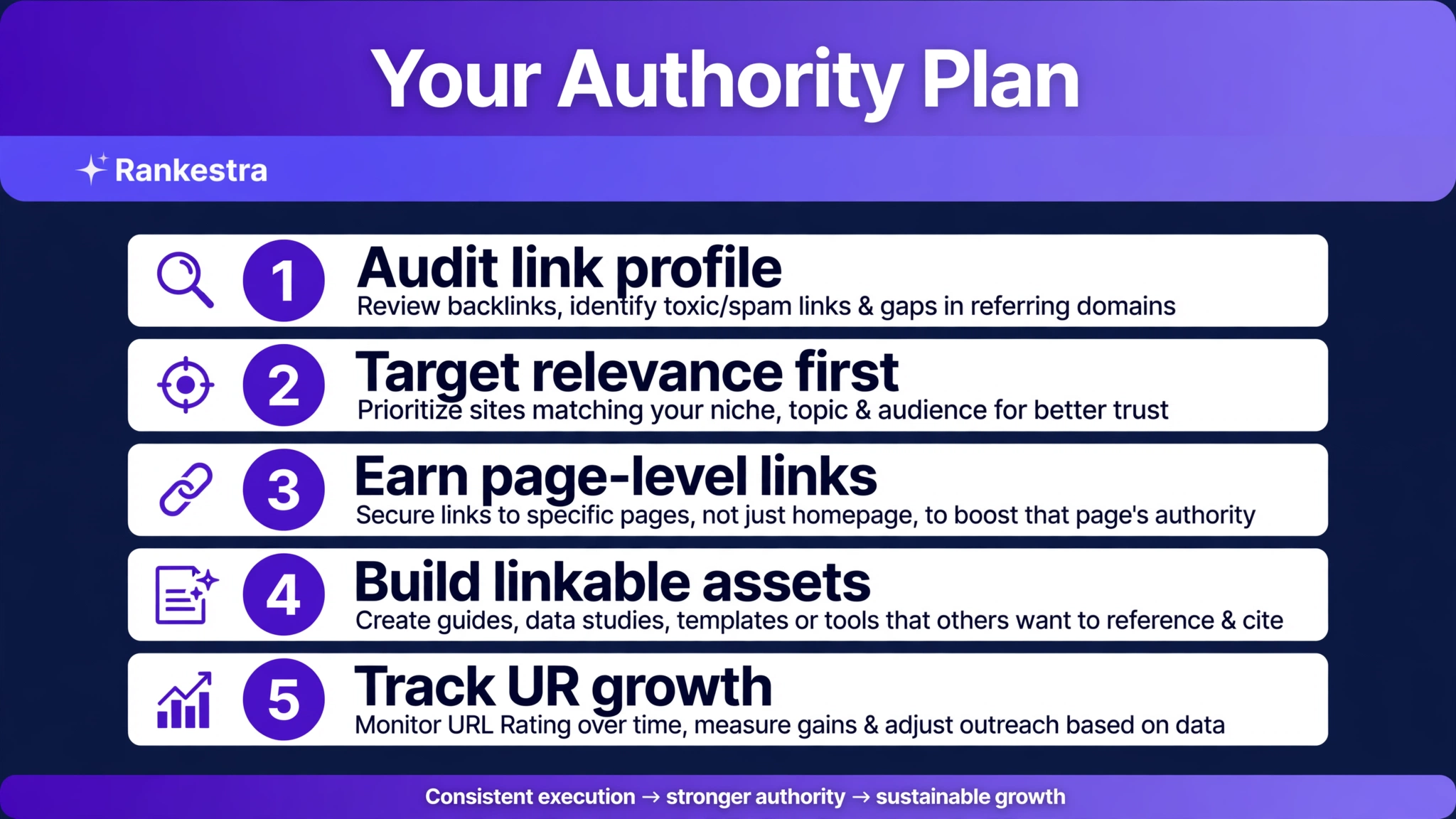
1. Adopt the definition. Write the four ingredients (trust, relevance, placement, realness) on a sticky note. Every link decision runs through them from now on.
2. Re-vet your current prospects. Pull your outreach list and re-score it by the five components from chapter 7 — page-level strength and relevance first, domain score last.
3. Pick one earning tactic. Guest posts on real publications or niche edits on ranking pages are the fastest legitimate wins. Our White Hat Link Building 101 guide is the full foundation.
4. Build one linkable asset. One definitive guide, one data study, one free tool. Assets earn the editorial links no outreach can replicate — and they compound instead of decaying.
5. Stop buying numbers. Cancel the “DA 50+ package” subscription. Every dollar spent on a domain score is a dollar stolen from a real placement. The 60-second routine is free, and it outperforms every package.
Don’t buy the shadow
Here’s the uncomfortable closing truth: the “authority backlink” marketplace exists because a number is easier to sell than a judgment. Sellers will keep selling DA, DR, and bulk packages as long as buyers keep sorting spreadsheets by them.
You now know what the numbers actually are (third-party estimates), what Google actually says (a factor, not the factor), what practitioners actually vote (#2, for the right kind of links), and what the data actually shows (page-level strength wins; zero links means near-zero traffic). Pick one tactic from chapter 9 and execute it this week. One real authority link beats a hundred bought shadows.
Explore the Rankestra Link Building Library
Master every link building discipline with our in-depth pillar guides:
- White Hat Link Building 101 — the fundamentals
- Digital PR for Link Building — earn media links
- Guest Posting & Blogger Outreach — the workhorse tactic
- Wikipedia Backlinks — citations done right
- Niche Edits & Link Insertions — borrow existing authority
- Niche Link Building — SaaS, iGaming & more
- Buying Backlinks Safely — vet sellers, avoid penalties
FAQ: Authority Backlinks
What is an authority backlink?
An authority backlink is a followed, editorial, in-content link from a trusted, topically relevant page that real people visit. It’s defined by four ingredients — trust, relevance, editorial placement, and real visitors — not by a domain score. One genuinely authoritative link can outweigh a hundred high-“DA” placements.
Is Domain Authority (DA) a Google ranking factor?
No. Domain Authority (Moz), Domain Rating (Ahrefs), and Authority Score (Semrush) are third-party estimates computed from each tool’s own link index — Google uses none of them as ranking signals. Ahrefs states this plainly about DR themselves. The scores work as rough first-pass filters, but they’re dangerous as purchasing targets.
Do backlinks still matter for SEO in 2026?
Yes, with nuance. Google has demoted links — Gary Illyes said people overestimate them and they’re not top-three, and Google’s documentation now calls links “a factor” rather than “an important factor.” Yet a Zyppy survey of 131 SEO professionals still ranked backlinks the #2 ranking factor (54.8%), and billion-page data shows pages without referring domains get near-zero traffic. Links matter, especially as tiebreakers in competitive SERPs — but content relevance (#1) comes first.
How many authority backlinks do I need to rank?
There’s no universal number — it depends on your SERP’s competitiveness. Going from zero to some real links matters enormously (most pages without referring domains get no traffic), while adding more links shows steep diminishing returns. In practice: enough authoritative, relevant links to match or exceed the page-level link strength of the pages currently outranking you.
Are “high DA backlink” packages worth buying?
Almost never. These packages optimize for the domain score — the easiest thing to inflate and the least predictive of actual value. The links typically come from expired-domain rebuilds, hacked pages, or link farms: high score, zero relevance, zero traffic, zero editorial standards. Vet every opportunity with the five-component check instead — and read our buying backlinks safely guide before spending anything.
What’s the difference between page authority and domain authority?
Domain-level scores (like DR) estimate a whole domain’s link strength; page-level metrics (like Ahrefs’ URL Rating) measure the specific page’s link strength. Across 44,589 SERPs, URL Rating correlated with rankings more strongly than Domain Rating — because Google ranks pages, not domains. Always vet the linking page itself, not just the domain’s headline score.