Link Acquisition: The Honest 2026 Guide (How to Earn Backlinks That Work)
Link Acquisition: The Honest 2026 Guide (How to Earn Backlinks That Work)
Link acquisition is the deliberate process of earning backlinks from other websites — through outreach, content worth citing, digital PR, and relationship building. It differs from casual “link building” mainly in intent: acquisition treats every link as an asset to be earned from a real publication with a real audience, not a placement to be manufactured. Done honestly, it is the slowest but most durable way to grow a site’s authority. Done badly — bought in bulk, exchanged in rings, automated into spam — it is the fastest way to earn a penalty.
This guide covers the full picture: what link acquisition actually means, how it differs from generic link building, the strategies that genuinely work in 2026, what they cost, how long they take, what makes a link worth acquiring, the risks of cutting corners, and how to measure whether any of it is working. No inflated promises, no invented case studies — just the mechanics, the trade-offs, and real data.
1. What Is Link Acquisition?

The definition, without the jargon
Strip the SEO vocabulary away and link acquisition is simple: it is the work of getting other websites to link to yours. Outreach emails, guest articles, press coverage, resource mentions, citations — every tactic is just a different route to the same destination, which is another site’s voluntary endorsement.
The word “acquisition” matters because it frames links as assets you acquire through effort and merit, not tricks you deploy. A link you acquired from a respected industry publication is an asset: it keeps sending referral visitors, supporting rankings, and lending credibility for as long as the page exists. A link you manufactured on a throwaway blog is a liability wearing an asset’s clothes.
Acquisition is a process, not an event
Here is what most guides skip: real link acquisition is a pipeline, not a purchase. It runs in stages — prospecting (finding sites worth approaching), qualification (checking they are real, relevant, and reputable), outreach (giving them a reason to care), placement (the link goes live), and verification (confirming the link exists, is crawlable, and points at the right page).
Each stage has a failure mode. Prospect at scale without qualification and you pitch spam blogs. Outreach without a real reason and you get ignored — or worse, marked as spam. Skip verification and you pay for links that are nofollowed, buried, or removed within weeks. The unglamorous truth is that most of link acquisition is process discipline, not clever tactics. The teams that win are the ones that run the pipeline cleanly, month after month.
Who does link acquisition, really?
In practice, three groups do this work. In-house SEO teams at larger companies run acquisition as part of content marketing — their advantage is brand credibility, which makes outreach dramatically easier. Agencies and freelancers run it as a service, selling their prospecting systems and publisher relationships. And founders and solo marketers do it themselves, usually slower but with an authenticity advantage that big operations cannot fake.
Real talk: the label on the work matters less than the standard it is held to. An in-house team buying links in bulk is doing the same damage as a shady vendor — the org chart does not launder the tactic. Judge link acquisition by what is actually being earned and where it is being placed, never by who is doing it or what they call it.
What link acquisition is not
It is not buying 500 links for $50 and hoping Google does not notice. It is not swapping links with fifty strangers in a Telegram group. It is not blasting ten thousand identical outreach emails. Those are not acquisition strategies — they are lottery tickets with a penalty attached, and Google’s spam policies describe exactly why: sites caught in link schemes “may rank lower in results or not appear in results at all.”
This distinction is the entire foundation of the guide. Everything that follows assumes you want links that survive contact with reality — links from real sites, earned for real reasons, that still exist and still work a year from now. If that sounds slower than the alternatives, it is. It is also the only version with a future.
Real-World Proof: What 627,000 Referring Domains Looks Like in Semrush
You have the definition. Now — before the strategies, the costs, the timelines — let us look at the evidence. Here is what aggressive, sustained link acquisition looks like inside Semrush on one of the most link-earned domains on the web.
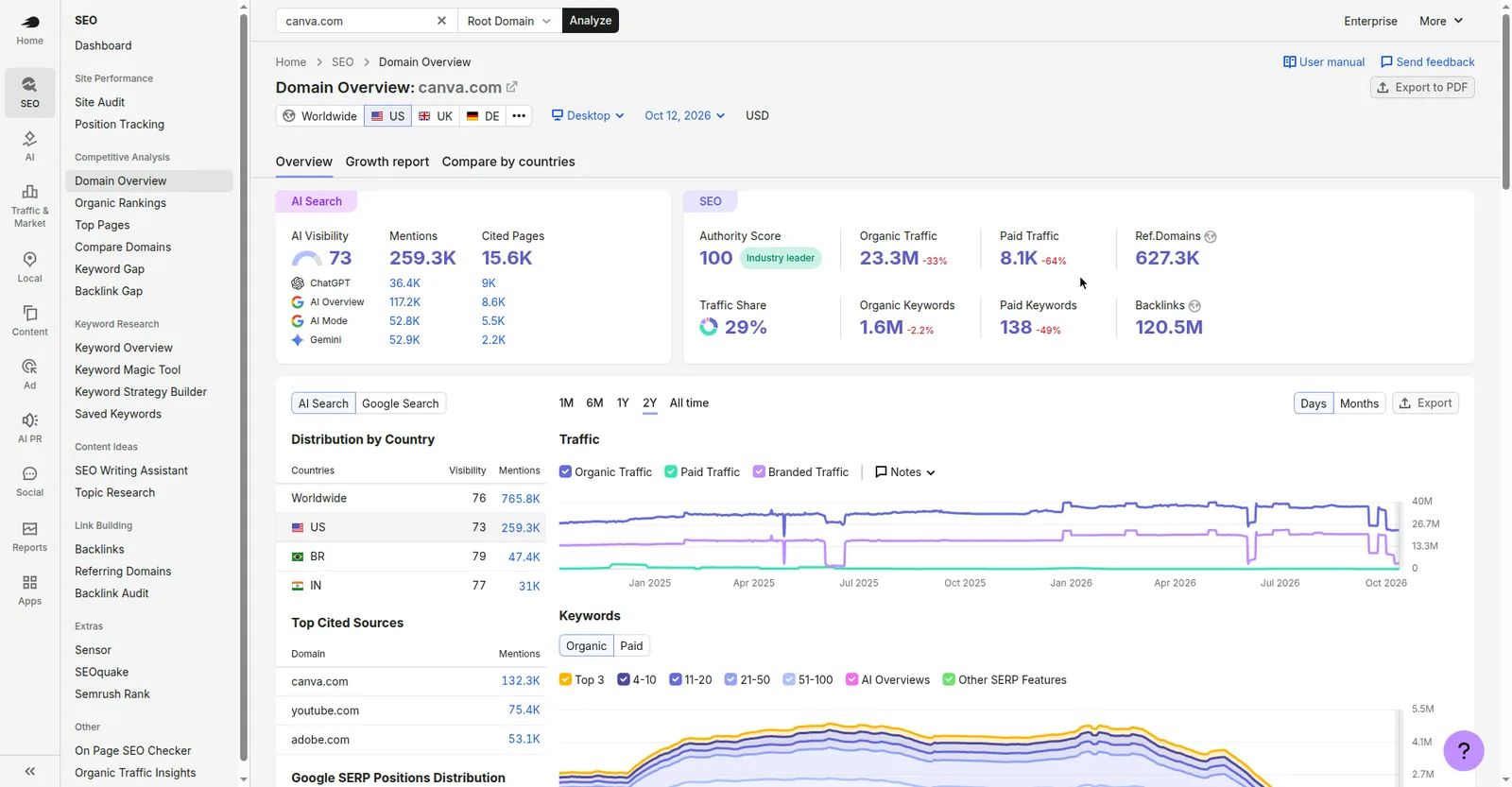
The numbers, exactly as Semrush reports them
Canva — the design platform, used here purely as a public data example — has one of the most formidable link profiles ever measured. Semrush’s Domain Overview (US database, October 12, 2026) reports: Authority Score 100 (“Industry leader” — the maximum), 23.3 million monthly organic visits, 627,300 referring domains, and 120.5 million total backlinks. These are Semrush’s measurements, not ours, and not Google’s.
Fourteen years of compounding
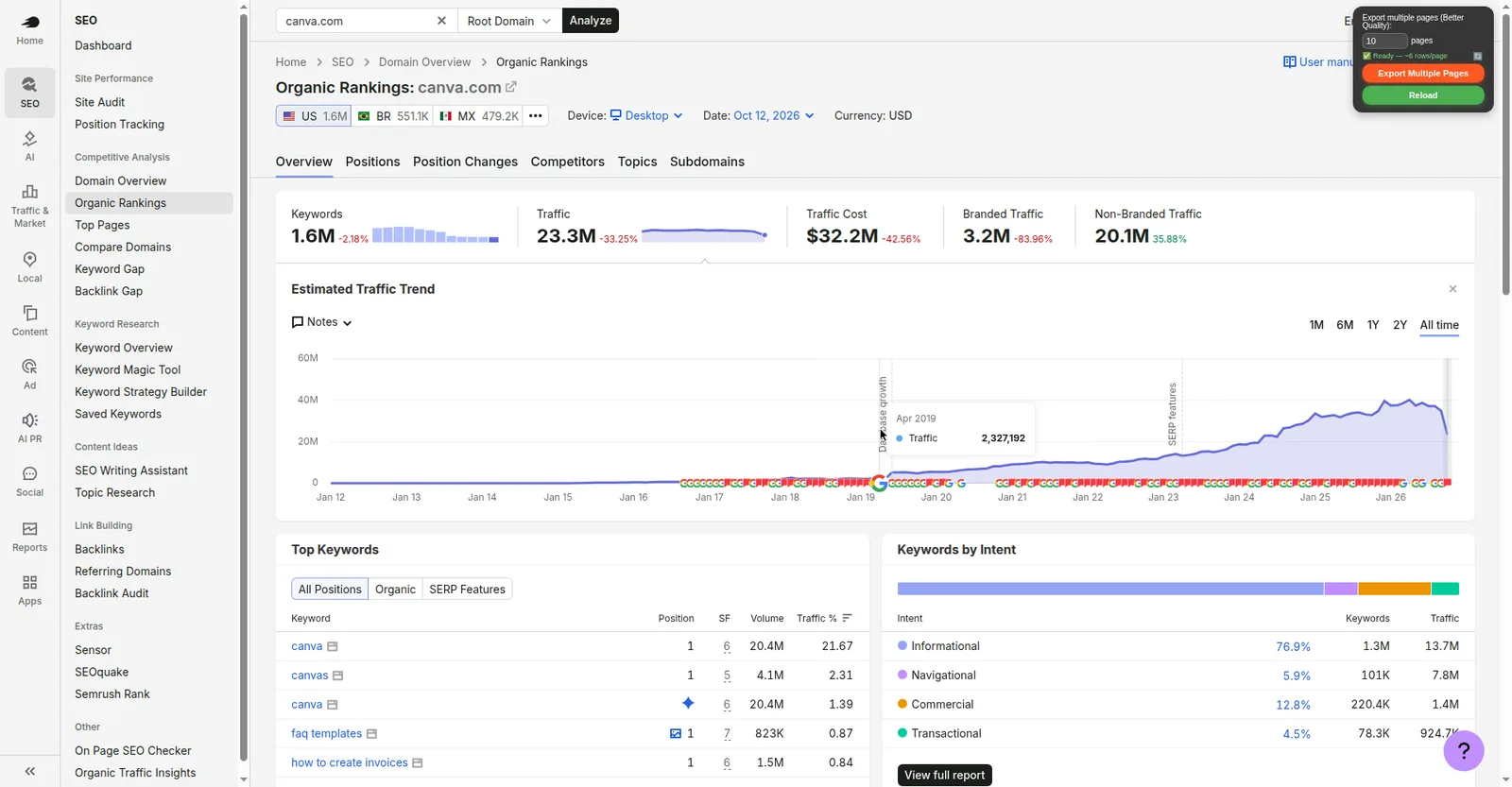
Canva’s estimated organic traffic sat near zero in 2012, passed 2.3 million monthly visits by April 2019, and climbed to a peak above 40 million around 2025–2026.
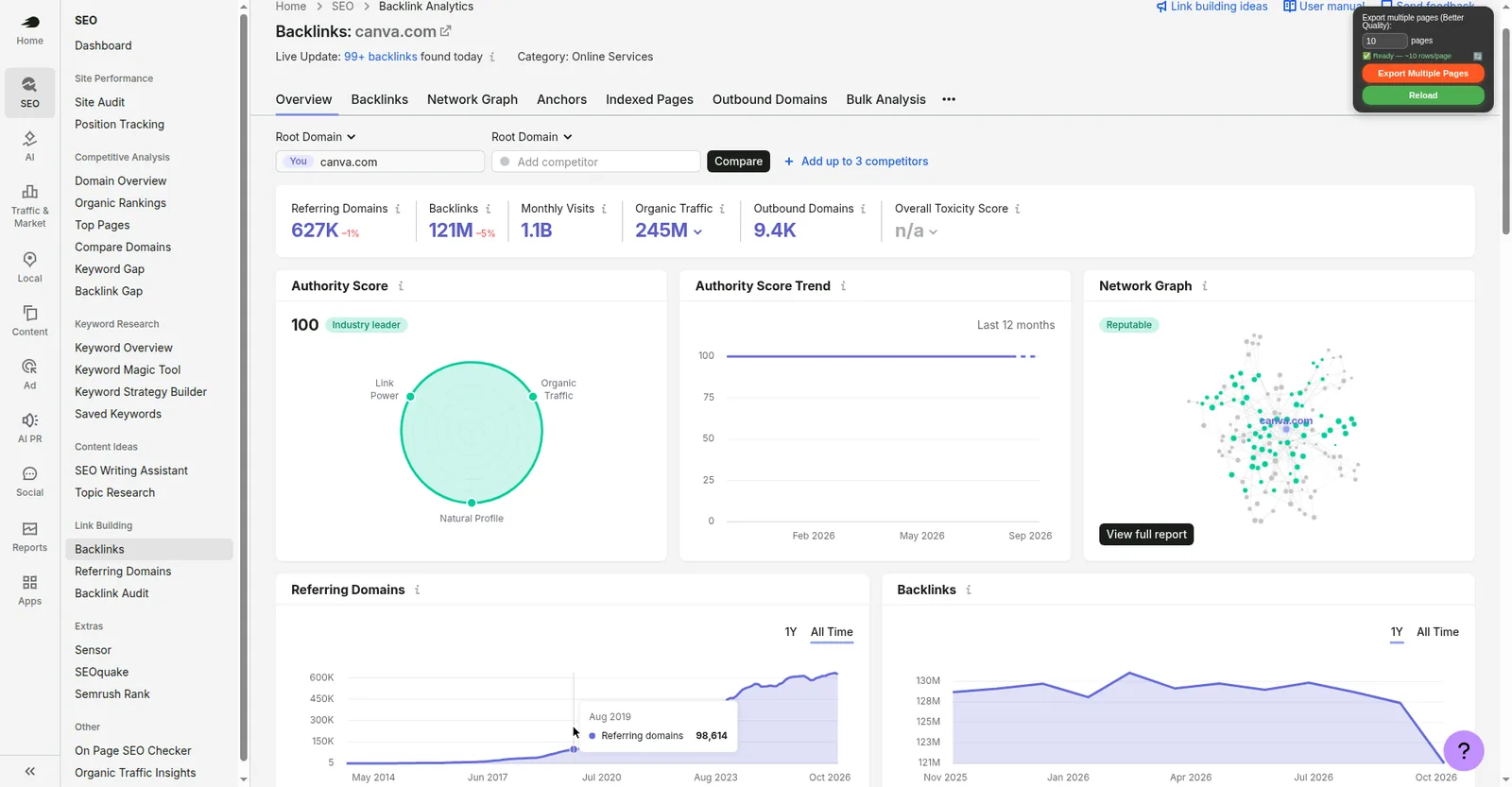
Now the referring-domains chart: essentially zero in 2014, climbing every single year to 627,000 by October 2026. Two curves, one decade-plus, same direction — link acquisition compounding into traffic compounding. This is what the strategies in chapter 4 produce when executed relentlessly for years: not a spike, but a slope.
The honest twist
And once again, look at the right edge. Canva’s estimated traffic has fallen from its 40M+ peak to 23.3M — while referring domains kept climbing past 627,000. Same lesson as ever: links are a factor, not the factor. Content shifts, SERP layout changes, AI Overviews, and competition all move traffic too. Link acquisition gives you the strongest possible foundation; it does not exempt you from everything else. Anyone selling links as a complete strategy has not looked at these charts.
2. Link Acquisition vs Link Building: What’s the Real Difference?

The honest answer: mostly framing, partly standard
Let us not pretend these are different sciences. “Link building” and “link acquisition” describe the same fundamental activity — getting backlinks — and most of the industry uses them interchangeably. Anyone who tells you they are radically different disciplines is usually selling a course.
But the framing difference is real and useful. “Building” suggests construction: you assemble links like bricks, and the metaphor quietly encourages volume thinking — more bricks, bigger wall. “Acquisition” suggests curation: you select assets, and the metaphor encourages quality thinking — better assets, stronger portfolio. The words nudge behavior, and behavior is what determines whether you end up with an asset or a penalty.
Where the standard actually differs
In practice, teams that talk about “acquisition” tend to operate with a stricter filter. A link builder might celebrate fifty new links this month. A link acquirer asks fifty new links from where — and rejects forty of them for being irrelevant, invisible, or untrustworthy. The output looks similar on a spreadsheet. It looks very different in a backlink audit two years later.
This shows up in how success gets measured too. Volume-first link building counts links. Acquisition-first work tracks outcomes: ranking movement on target pages, referral sessions from new referring domains, the caliber of publications now citing the brand. If you remember one sentence from this chapter, make it this one — count outcomes, not links — because it is the practical difference between the two mindsets.
Does Google care what you call it?
No. Google’s systems evaluate the links themselves — their relevance, placement, and patterns — not the philosophy of the person who earned them. A brilliant “acquisition” campaign and a careful “building” campaign produce identical results if the links are identical. The terminology is for humans: it keeps teams, clients, and vendors aligned on what good looks like.
That said, the language you use shapes the vendors you attract. Brief an agency on “building 100 links” and you will get quotes optimized for volume. Brief them on “acquiring editorial coverage in our industry’s top publications” and the conversation changes completely — different tactics, different prices, different results. For a full map of the tactics both labels cover, see our guide to the types of backlinks, which breaks down what each kind of link actually delivers.
Which term should you use?
Use whichever your audience understands — and then define your standard explicitly. If you are briefing a team or hiring help, the term matters less than the sentence that follows it: “we only want links from real publications with real audiences, earned editorially.” That one sentence does more work than any label. The white-hat link building guide is built entirely around that standard, whatever you choose to call the work.
3. Why Does Link Acquisition Matter in 2026?

Because the close contests are decided by links
Here is the thing nobody disputes: when two pages both satisfy search intent, both load fast, and both cover a topic thoroughly, the one with stronger backlinks usually ranks higher. Links are the tiebreaker. And in 2026, with AI-assisted content flooding every niche, more contests are close than ever — which makes the tiebreaker more valuable, not less.
The practitioner data backs this up. In Zyppy’s September 2026 survey of 131 SEO professionals, 54.8% ranked backlinks among the three most important ranking factors — second only to relevance at 57.1%. As the report’s author Cyrus Shepard put it, “the rumor of the death of backlinks has been greatly exaggerated.” Google’s spokespeople keep downplaying links; the people ranking pages keep investing in them. Both can be true: links matter less than they did in 2012 and still decide outcomes in 2026.
Because AI search runs on cited sources
There is a newer reason that barely existed three years ago. AI-generated answers — Google’s AI Overviews, ChatGPT, Perplexity — synthesize responses from sources they trust, and independent analysis keeps finding that widely-cited brands show up more. An Ahrefs analysis of 75,000 brands found branded web mentions correlated with AI Overview visibility at 0.664. The same editorial placements that earn you backlinks earn you the mentions and citations these systems draw on.
Think about what that means strategically. Every quality placement now pays twice: once in traditional search, once in AI answers. Link acquisition aimed at genuine editorial coverage — original data, expert commentary, genuinely useful resources — is simultaneously AI-visibility acquisition. The tactics converge; only the measurement needs to catch up.
Because everything else got easier to copy
Consider the competitive landscape. AI tooling has made decent content cheap, templates have made good design cheap, and page-speed optimization is largely solved knowledge. Almost every on-page advantage a site could hold in 2020 can now be replicated in weeks. What cannot be replicated quickly is a backlink profile built over years — hundreds of independent publishers who chose to reference you.
This is the moat argument, and it is the most durable reason link acquisition matters. Competitors can copy your keywords, your layout, and your content briefs. They cannot copy the relationships and reputation behind your referring domains. Our backlink benefits guide walks through all seven advantages this creates, from the ranking tiebreaker to compounding long-term returns — but the moat is the one competitors feel most directly.
Because referral traffic compounds quietly
One underrated reason: links on well-read pages send visitors who arrive pre-sold. A reader who clicks your link inside an article they trust shows up with context and intent that cold search traffic rarely matches. No honest marketer can give you a universal conversion rate for this — it varies wildly by niche — but the mechanism is structural: editorial context plus reader trust equals warmer visitors.
And unlike rankings, referral traffic does not fluctuate with algorithm updates. A placement on a publication your buyers actually read keeps delivering humans whether Google shuffles the SERPs or not. Teams that measure link acquisition purely through ranking movement are missing half the return. Measure both, always.
4. What Are the Most Effective Link Acquisition Strategies?

Digital PR: earn coverage, get links as a byproduct
Digital PR means creating something journalists want to cover — original survey data, a striking industry study, a genuinely useful free tool — and pitching it to publications. When it lands, you get the full package: the backlink, the brand mention, the referral traffic, and the credibility of third-party coverage. It is the highest-ceiling strategy in link acquisition and the hardest to execute well.
Why it works: journalists need stories, and data-driven stories with a clear headline are catnip. A well-designed study can earn dozens of placements from a single asset. The honest caveat is the failure rate — most pitches die unread, and a study that finds nothing interesting earns nothing. Real talk: digital PR is a hits business. Budget for several campaigns knowing most will underperform and one will pay for all of them. Our digital PR link building guide covers the full playbook, from ideation to outreach.
Guest posting: borrow someone else’s audience
Guest posting means writing genuinely good articles for relevant publications in your niche, with a link back to your site in the author bio or contextually in the content. Done on real sites with real readers, it delivers links, referral traffic, and relationships with editors — the relationship part compounds into future placements.
The standard that separates good from garbage: the publication should be one you would proudly show a potential customer. If the site exists only to host guest posts, its links carry little weight and its audience is imaginary. Pitch topics the publication’s readers actually need, write the best article on that topic they have published, and the link takes care of itself. Our guest posting and blogger outreach guide details how to find and pitch the right targets.
Niche edits: get placed inside content that already ranks
Niche edits — also called link insertions — mean earning a link inside an existing article that already ranks and already gets traffic, rather than in something newly published. The appeal is obvious: you skip the waiting period. The link sits in proven content, on a page Google already trusts, in front of an audience that already exists.
The honest trade-off: you are asking an editor to modify published work, which requires a genuinely good reason — your resource improves the article, updates an outdated claim, or fills a gap. Site owners can smell a purely transactional insertion request instantly. Lead with what the addition does for their readers. Our niche edits guide covers outreach angles that actually get yeses.
Broken link building: fix the web, earn the link
Broken link building is exactly what it sounds like: find dead links on relevant resource pages, then tell the site owner — helpfully, specifically — and suggest your working resource as a replacement. It works because you are leading with genuine value: nobody wants dead links on their site, and webmasters are often grateful for the heads-up.
The catch is scale. Good broken-link prospects require manual research, and the hit rate per outreach email is modest. It is a excellent strategy for sites with genuinely linkable assets (guides, tools, original data) and a poor one for thin commercial pages nobody would replace a dead link with. Be honest about which category your pages fall into before investing weeks here.
Expert commentary (HARO and its successors)
Platforms that connect journalists with expert sources — HARO’s successors and equivalents — let you earn links by answering reporter queries with genuinely useful quotes. A single sharp insight can land you in a major publication. The cost is time: monitoring queries, responding fast, and accepting that most pitches go nowhere.
Real talk: this strategy rewards actual expertise. Generic, could-have-been-written-by-AI quotes get ignored; specific, opinionated, experience-grounded answers get picked up. If you or your team genuinely know your field, this is one of the highest-ROI channels available. If not, fix that first — no outreach tactic compensates for having nothing to say.
Resource page outreach: the quiet workhorse
Many niches have curated resource pages — “best tools for X,” “essential reading on Y” — maintained by bloggers, educators, and associations. Getting listed is straightforward outreach: your resource genuinely belongs, you ask politely, you follow up once. These links are rarely glamorous and consistently valuable: relevant, editorial, and often on pages that rank for years.
What to skip (or handle with extreme care)
Directories, forum profiles, blog comments, and social bookmarks still get pitched as “easy wins.” They are easy, and that is the problem — anything that easy has been abused into near-worthlessness, and patterns of such links look manipulative in aggregate. Press releases with optimized anchor text, article spinning, and private blog networks belong in the same bucket: tactics optimized for fooling algorithms rather than earning endorsements. Our guide to buying backlinks safely draws the line between legitimate paid placements and the schemes that get sites penalized.
5. How Much Does Link Acquisition Cost?

The range is enormous — and that is the point
Anyone quoting you a single price for “a backlink” is either selling something specific or does not understand the market. A resource-page listing you earn with one polite email costs an hour of your time. A digital PR campaign with original survey data can cost thousands in research, design, and outreach before a single link lands. A sponsored placement on a major industry publication sits somewhere in between, with the price reflecting the publication’s audience, not some universal link tariff.
This variance is why cost-per-link is a treacherous metric. A $500 link from a publication your buyers read — one that sends referral traffic for years and gets cited by others — is cheap. A $20 link on a site nobody visits is expensive at any price, because it delivers nothing and adds risk. Always divide cost by outcomes (ranking movement, referral sessions, brand exposure), never by link count.
What drives the price
Four factors dominate. Audience quality: real readership costs more than empty metrics — a site with 100,000 monthly readers charges accordingly. Relevance: topically aligned placements are scarcer and harder to earn than generic ones. Editorial standards: publications with real editors reject most pitches, which is precisely why their links are worth more. Labor: prospecting, personalization, and follow-up are skilled work; cheap outreach is cheap because it is automated, and automated outreach is what gets ignored or flagged.
Geography matters too. English-language placements in competitive B2B niches (finance, SaaS, health) command premiums because every competitor is bidding for the same editors’ attention. Less saturated niches and non-English markets are often dramatically cheaper — not because the links are worse, but because fewer buyers are competing for them.
DIY vs agency: the real trade-off
Doing it yourself costs time instead of money — and the time is substantial. Expect 5-15 hours per earned placement when you are starting out: prospecting, qualifying, personalizing pitches, following up, and handling the back-and-forth. Your advantage is authenticity and niche knowledge, which no outsourced team can fully replicate.
Agencies charge for systems and relationships: established prospecting pipelines, trained outreach staff, and existing publisher contacts. Good ones are worth it if your time is better spent elsewhere; bad ones are just expensive ways to buy the same spam you could generate yourself. Vet any provider the same way you would vet a link: look for real placements on real sites, transparent reporting, and a refusal to guarantee specific outcomes. Guarantees in link acquisition are a red flag — nobody can promise a journalist will say yes.
How to budget honestly
Start from outcomes, not link counts. Decide what a first-page ranking for your target keywords is worth, or what qualified referral traffic costs you through paid channels, and budget link acquisition against those numbers. Then pick one or two strategies that fit your strengths — a data-rich company should lean into digital PR; a founder with deep expertise should lean into commentary and guest posting — and fund them consistently for at least six months.
Real talk: the most common budgeting mistake is going too thin across too many tactics. Three months of half-hearted outreach across five strategies produces nothing measurable and teaches you nothing. Six months of focused execution on one strategy produces either results or a clear lesson about why it did not work. Concentration beats diversification in link acquisition until you have a working playbook.
6. How Long Does Link Acquisition Take to Work?

The pipeline has its own clock
Link acquisition is slow for structural reasons, not because practitioners are lazy. Prospecting and outreach take weeks. Editors reply on their own schedules — or never. A placed link then needs to be discovered by crawlers, and search engines need time to fold new signals into their evaluations. Each stage adds latency, and the stages do not parallelize neatly.
A realistic first-timer timeline: month one is prospecting and initial outreach with little to show. Months two and three bring the first placements trickling in. Months four to six are when you can start measuring — enough links live long enough to correlate with movement. Anyone compressing this into “results in 30 days” is describing either paid placements (faster, different risk profile) or fiction.
What “working” looks like at each stage
Measure the right thing at the right time or you will misjudge everything. In months one to three, the metrics are pipeline health: reply rates, placement rate per outreach batch, and the quality tier of sites saying yes. These tell you whether the machine works. In months four to six, shift to outcomes: ranking movement on target pages, new referring domains in your analytics, referral sessions from placements.
The mistake is judging month-two pipeline metrics by month-six outcome standards — or vice versa. A campaign with great reply rates but no ranking movement at month five has a targeting problem (wrong pages, wrong anchors, or links too weak for the competition). A campaign with poor reply rates at month two has an outreach problem (bad targeting, weak pitch, or an offer nobody wants). Diagnose by stage.
Why some links work faster than others
Not all placements move at the same speed. Links on frequently-crawled, high-traffic pages get discovered and counted quickly; links on rarely-crawled sites can take weeks to even register. Niche edits inside already-ranking content tend to show effects sooner than guest posts on new URLs, because the linking page’s authority is established rather than pending.
Competition sets the threshold too. In a low-competition niche, a handful of decent links can move a page within weeks. Against entrenched competitors with years of link history, your new links are drops in their ocean — progress is real but gradual, measured in quarters. Set expectations from the competitive reality, not from the tactic’s theoretical speed.
The compounding part nobody advertises
Here is the genuinely good news about the slowness: acquired links keep working after the effort stops. A placement earned in January still passes value in December, still sends referral visitors, still gets discovered by other writers who link to you in turn. Paid ads stop the day you stop paying; earned links have no meter. This is why the slow start is worth enduring — you are building an asset with a multi-year half-life, not renting a position. Our backlink benefits guide details exactly how these returns stack over time.
7. What Makes a Link Worth Acquiring?

Relevance first, always
The single most important quality factor is topical relevance. A link from a site in your niche — or from a page specifically about your topic — carries more weight than a higher-authority link from somewhere unrelated. Search engines are trying to determine what your page is about, and endorsements from topically aligned sources answer that question directly.
Practical test: would this linking page’s regular readers plausibly care about your page? A project-management tool linked from a productivity blog passes. The same tool linked from a recipe site fails — even if the recipe site has impressive metrics. Relevance is the filter that eliminates most bad opportunities before you waste outreach on them.
Real audience, real editorial standards
The second filter: does anyone actually read this site, and does a human decide what gets published? Real traffic (check Similarweb or Semrush estimates, not the site’s own claims), recent posts with genuine engagement, an about page with real names, and visible editorial standards are all green flags. The opposite — no traffic, no author names, every post a guest post, “write for us” pages advertising paid placements — marks a site that exists to sell links, not to inform readers.
Real talk: metrics like Domain Authority and Domain Rating are third-party estimates, not Google data. They are useful for triage — sorting a thousand prospects into “worth a look” and “ignore” — and dangerous as targets. A vendor optimizing for DR 50+ placements will happily sell you links from high-DR sites with zero traffic and zero relevance. Judge sites like a reader, not like a spreadsheet.
Placement and context matter enormously
Where the link sits on the page changes what it is worth. A contextual link inside the article body — surrounded by relevant text, where readers actually encounter it — is the gold standard. Author-bio links are weaker but legitimate. Footer, sidebar, and blogroll links are nearly decorative. And a link on a page with two hundred other outbound links shares its value two hundred ways.
Anchor text deserves honest mention too. Descriptive, natural anchors help search engines understand the linked page; exact-match commercial anchors repeated at scale look manipulated and have triggered penalties historically. The natural pattern is variety — branded anchors, URL anchors, descriptive phrases — because that is what editorial linking actually looks like. If your anchor profile reads like a keyword list, it was built like one.
The five-second quality audit
Before pursuing any placement, run this audit. One: is the site topically relevant to my page? Two: does it have real traffic and real readers? Three: would I proudly show this placement to a customer? Four: is the link editorial — would it exist if SEO had never been invented? Five: does the page linking to me have its own standing (traffic, rankings, or at least genuine content)? Three or more “no” answers means walk away, no matter how attractive the metrics look. Our authority backlinks guide goes deeper on separating genuine authority from metric theater.
8. What Are the Risks of Link Acquisition Done Wrong?

Manual penalties: rare, severe, and memorable
Google’s human reviewers can and do penalize sites for manipulative link schemes. A manual action can suppress a site’s rankings dramatically or remove it from results entirely, and recovery requires cleaning up the offending links and filing a reconsideration request — a process measured in months, not days. These penalties are relatively rare precisely because most manipulative link building is now handled algorithmically. But “rare” is cold comfort when it happens to you.
The patterns that attract manual review are well known: large-scale paid link networks, private blog networks with footprint patterns, and aggressive exact-match anchor schemes. If your acquisition strategy would be embarrassing to explain to a Google reviewer, that is the reviewer’s answer too.
Algorithmic devaluation: the quiet killer
Far more common than manual penalties is simple devaluation: Google’s systems identify manipulative links and quietly ignore them. No penalty notice, no drama — the links just do not count. This is the fate of most bulk-bought links, directory blasts, and automated placements. The money is spent, the spreadsheet shows hundreds of new links, and nothing moves.
This is actually the more expensive failure mode, because it is invisible. A penalized site at least knows it has a problem. A site with a devalued link profile just looks like link building “doesn’t work” — and the usual response is to buy more of what is not working. Real talk: if your link acquisition shows zero outcome movement after six months of consistent effort, the likeliest explanation is not that you need more links — it is that the links you have are being ignored.
The schemes to avoid, specifically
Google’s spam policies name the patterns explicitly: buying or selling links for ranking purposes, excessive link exchanges, large-scale article marketing with keyword-rich anchors, and automated link creation. Link exchange schemes deserve special mention because they feel collaborative and harmless — but reciprocal linking at scale, especially between unrelated sites, is a documented spam pattern, not a growth hack.
Private blog networks (PBNs) are the other classic trap: networks of sites built solely to link to money pages, often on expired domains with inherited authority. They can work briefly and fail expensively — footprint detection keeps improving, and a network penalty can take down every site it touches at once. The short-term gains are never worth the correlated risk.
How to stay on the safe side
The safety rule is simple and absolute: every link you acquire should be defensible as editorial. Ask of each placement — would this link exist if search engines did not exist? Would the site owner link to me without payment or reciprocation, purely because my page deserves it? If yes, you are safe regardless of how the link was initiated. Outreach is not manipulation; payment for placement without disclosure is where the line sits.
Keep records too. Document your outreach, keep copies of editorial correspondence, and maintain a clean list of acquired placements. If you ever need to disavow bad links — from a previous vendor, a negative SEO attack, or your own early mistakes — a documented history makes the cleanup surgical instead of panicked. Prevention beats cure, but documentation beats both.
9. How Do You Measure Link Acquisition Success?

Start with the pages, not the domain
The most meaningful measurement happens at page level. Pick the specific pages you built links to, record their ranking positions before the campaign, and track movement over the following months. Domain-level metrics (total referring domains, domain authority) are background context — useful for trend-spotting, useless for judging whether a specific campaign worked.
Isolate as best you can. If you built links to three product pages while also publishing new content and redesigning the site, attributing ranking changes to links alone is guesswork. The cleanest reads come from pages where link acquisition was the main variable that changed. Perfect isolation is impossible; honest approximation is the goal.
The four outcome metrics that matter
One — ranking movement on target pages. Track the specific keywords each linked page targets, weekly, in a rank tracker. Look for sustained movement over 8-12 weeks, not daily noise. Two — referral traffic from new referring domains. In your analytics, segment sessions by referral source and watch the domains you earned placements on. Real editorial links send real humans; this metric separates them from decorative ones.
Three — indexation and crawl behavior. New pages on a strengthening domain get discovered and indexed faster. If your time-to-index is shrinking as referring domains grow, the profile is doing its discovery job. Four — brand and citation signals. Track branded search volume, brand mentions, and the caliber of publications citing you. These are the leading indicators that compound into future links — the flywheel made visible.
What not to measure (or not to worship)
Do not judge campaigns by raw link counts — ten earned editorial links beat a hundred manufactured ones, and counting them equally is how bad vendors survive. Do not worship third-party authority scores as goals; they are estimates that lag reality and can be gamed. And do not expect linear returns: link acquisition produces step-changes (a great placement moves a page suddenly) more often than smooth curves.
Real talk: the metric that matters most is cost per outcome. Total spend divided by ranking improvements, referral sessions, or revenue influenced. A campaign that cost $3,000 and moved two money pages to page one is a triumph even if it only earned eight links. A campaign that earned two hundred links and moved nothing is a failure at any price. Hold every effort to this standard — including ours, if you ever hire help.
Build the reporting habit
Set a quarterly review rhythm. Pull ranking movement for target pages, referral sessions and assisted conversions from new referring domains, indexation speed for new content, and any uptick in branded search or press mentions. Compare against spend. Then make one decision per quarter: double down on what worked, fix what is close, kill what is not. Link acquisition rewards the patient but punishes the passive — measurement is what turns patience into strategy.
Link acquisition strategies compared, honestly
| Strategy | What it actually is | Effort | Cost profile | Risk | Best for |
|---|---|---|---|---|---|
| Digital PR | Newsworthy data or stories pitched to journalists | Very high | High (research, design, outreach) | Low | Brands with original data; highest ceiling |
| Guest posting | Expert articles written for relevant publications | High | Time-heavy; placements often free | Low | Founders and experts with something to say |
| Niche edits | Links earned inside already-ranking content | Medium | Moderate (outreach + negotiation) | Low-Medium | Pages that improve existing articles |
| Broken link building | Replacing dead links with your working resource | High | Time-heavy; low cash cost | Low | Sites with genuinely linkable assets |
| Expert commentary | Quotes for journalists via source platforms | Medium | Time-heavy; placements free | Low | People with real, specific expertise |
| Resource page outreach | Getting listed on curated resource pages | Low-Medium | Low | Low | Tools, guides, and reference content |
| Buying placements | Paying for links or sponsored posts | Low | Cash-heavy; scales with publication tier | High | Almost never the right first move |
| Link exchanges | Reciprocal “you link me, I link you” deals | Low | Free | High | Avoid — documented spam pattern at scale |
10. How Do You Start a Link Acquisition Campaign?

Start from one strategy, not five
Pick the single strategy that best fits your strengths and run it with total focus for 90 days. Data-rich company? Digital PR. Founder with deep expertise? Guest posting and expert commentary. Genuinely useful free tool or definitive guide? Broken link building and resource page outreach. The strategy you can execute consistently beats the theoretically optimal one you will abandon by week three.
Set a concrete, modest target: twenty qualified prospects per week, ten personalized pitches per week, one follow-up per pitch. That pace is sustainable for one person and produces a real pipeline within a month. Track reply rates and placement rates from day one — the numbers tell you whether to fix the targeting, the pitch, or the offer.
Build the asset first, pitch second
The most common beginner mistake is pitching before having anything worth linking to. Before a single outreach email goes out, make sure the destination page is genuinely the best resource on its topic for its target query — comprehensive, current, well-designed, and fast. Outreach amplifies; it does not compensate. A brilliant pitch pointing at a mediocre page converts nobody and burns the contact.
Real talk: spend the first two weeks improving the pages you will promote, not writing pitches. The conversion rate on every email you ever send depends on what the recipient finds when they click through. Most “outreach doesn’t work” complaints are actually “my page wasn’t worth linking to” confessions.
Run the pipeline like a pipeline
Treat link acquisition as operations, not inspiration. A simple spreadsheet works: prospect, contact, angle, date pitched, follow-up date, status, outcome. Review it weekly. Prospects go stale, follow-ups get forgotten, and placements you never verified quietly disappear — the pipeline only works if someone tends it.
Qualify ruthlessly at the top of the funnel so you do not waste effort at the bottom. Run every prospect through the five-second quality audit from chapter 7 before they enter the pipeline. Fifty qualified prospects beat five hundred unqualified ones, because your reply rate, placement rate, and link quality all rise together. Volume is what you scale after the machine works, never before.
Know when to get help
There is a point where doing it yourself stops making sense — usually when the opportunity cost of your time exceeds the cost of competent help, or when you need publisher relationships and systems you cannot build quickly. If you reach that point, vet providers the way this guide vets links: demand real placements on real sites, transparent reporting, no guaranteed outcomes, and a clear explanation of their methods. Anything less is a gamble with your domain’s reputation.
Whether you build in-house or hire out, the standard never changes: real publications, real audiences, editorially earned. Hold every link to it — including the ones you earn in your first 90 days. Start now, stay consistent, measure outcomes, and let the compounding do the rest.
Explore the Rankestra Link Building Library
Ready to go deeper on any tactic mentioned in this guide? These in-depth guides cover the full spectrum:
- White-Hat Link Building Guide — the complete playbook for earning links the right way
- Digital PR Link Building Guide — earn coverage on publications that move markets
- Guest Posting & Blogger Outreach Guide — place expert content on relevant blogs
- Wikipedia Backlinks Guide — earn citations from the web’s most trusted reference
- Niche Edits & Link Insertions Guide — get placed inside content that already ranks
- Niche Link Building Guide — adapt every tactic to your specific industry
- Buying Backlinks Safely Guide — navigate paid links without risking penalties
- Types of Backlinks — what each kind of link actually delivers
- Backlink Benefits — the honest guide to what links do for you
Frequently Asked Questions
What is link acquisition in SEO?
Link acquisition is the deliberate process of earning backlinks from other websites through outreach, content worth citing, digital PR, and relationship building. It treats each link as an asset acquired through merit from real publications — as opposed to manufactured placements. The core pipeline runs through prospecting, qualification, outreach, placement, and verification.
What is the difference between link acquisition and link building?
Fundamentally, they describe the same activity — getting backlinks — and the industry uses them interchangeably. The practical difference is framing: “acquisition” implies curating quality assets while “building” can nudge toward volume thinking. Google evaluates the links themselves, not the label. What matters is the standard: real publications, real audiences, editorially earned.
How much does link acquisition cost?
It ranges from your time (a polite resource-page pitch costs an hour) to thousands per campaign (original research plus digital PR outreach). There is no honest single price per link — cost depends on audience quality, relevance, editorial standards, and labor. Judge spend by cost per outcome (ranking movement, referral traffic), never by cost per link.
How long does link acquisition take to show results?
Expect months, not days. Month one is prospecting and outreach; months two to three bring the first placements; months four to six are when outcomes become measurable. Search engines need time to discover new links and fold the signals in. Anyone promising ranking movement in days is selling automation or fiction.
Is buying links the same as link acquisition?
No — and confusing the two is expensive. Genuine link acquisition earns editorial placements that would be defensible to a Google reviewer. Buying links for ranking purposes violates Google’s spam policies and risks manual penalties or algorithmic devaluation. Paid placements exist on a spectrum, but anything designed to manipulate rankings rather than earn endorsements sits on the wrong side of it.
How many links do I need to acquire?
There is no honest number — it depends entirely on your competition. In a low-competition niche, a handful of relevant editorial links can move a page within weeks. Against entrenched competitors with years of link history, you need sustained acquisition over quarters. Analyze the referring-domain profiles of the pages currently ranking for your target keywords; your goal is to become competitive with them, not to hit a quota.